|
Slide Rule |
Slide Rule Auction

by the Oughtred Society in conjuction with the
online, September 13, 2026
Draft G of 2026-09-10 03:46 CEST
List of Auction Items
Please note: Work in progress — The list of 40 auction item is complete, all photos are present now. However, there will be a final check and potential correction of all item descriptions. | |
| 01 |
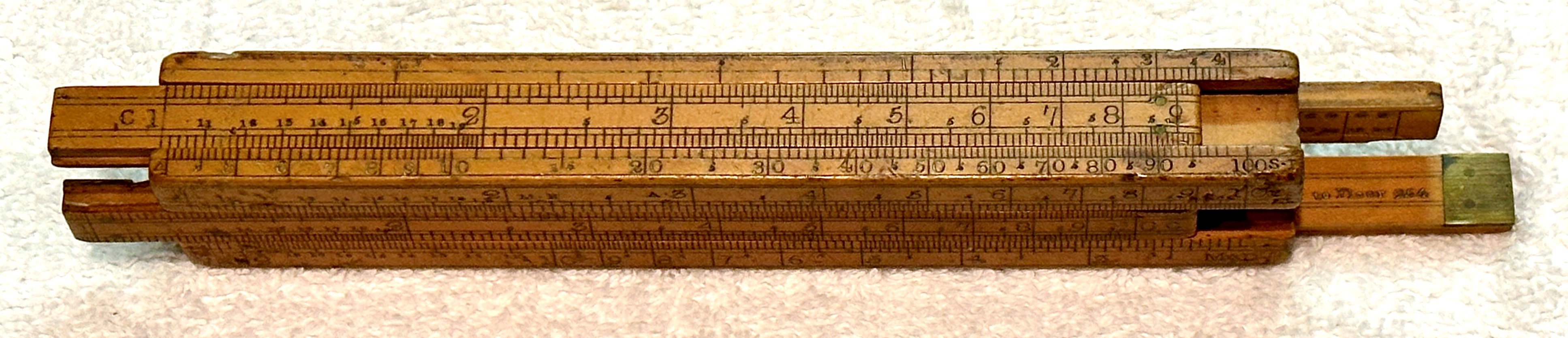
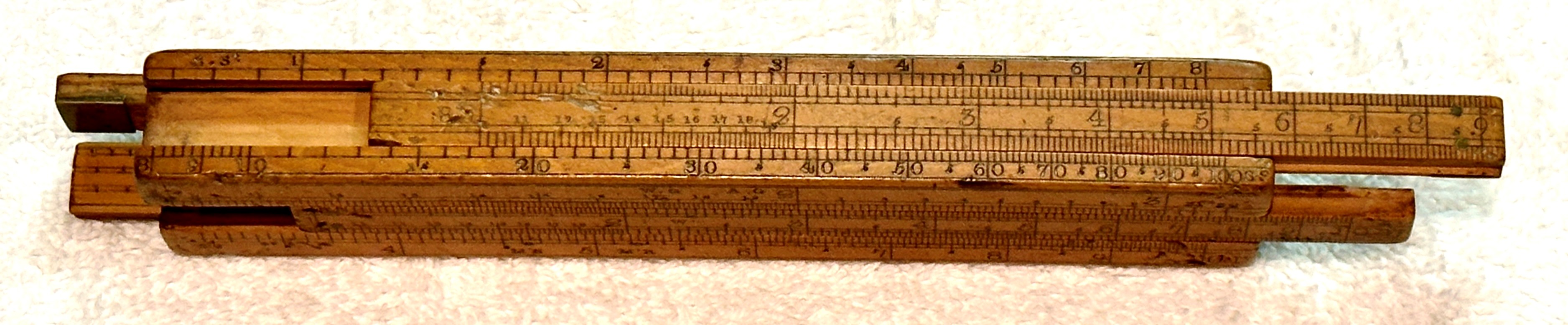
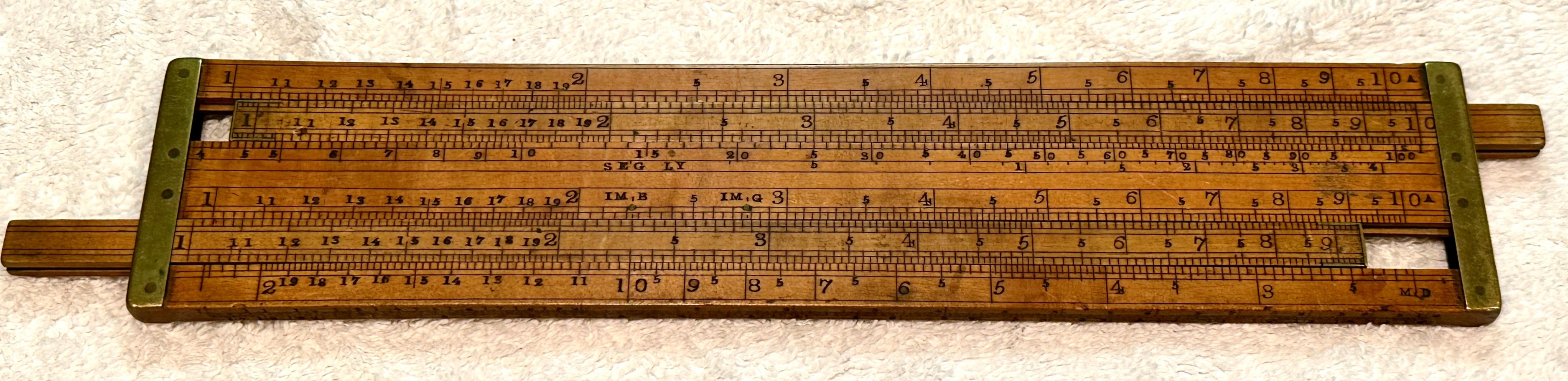
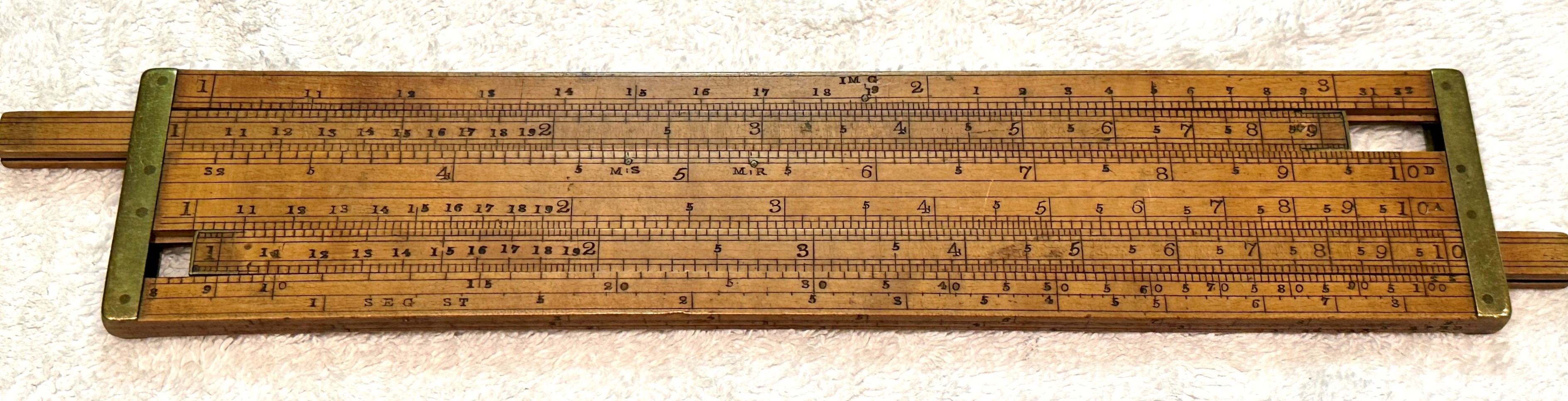
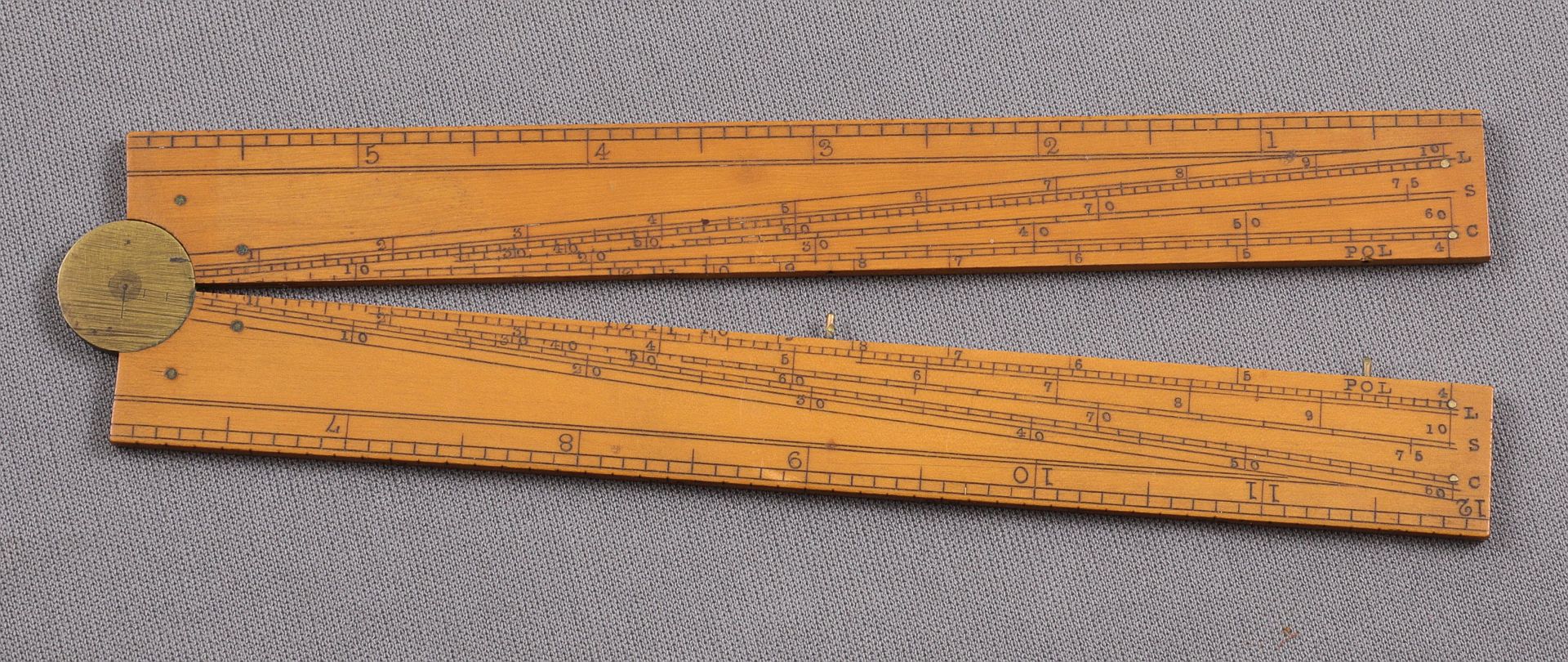
Two-side, two-slide 12-inch boxwood excise rule,
with scales for Proof, Seg St, Seg Ly, IMG gauge point, post-1824 This is an excellent example of an excise rule that was used from the late 18th to the late 19th century for calculating the taxes on alcohol and also on the manufacture of alcoholic beverages such as ale and wine. This rule was a standard in the trade with scales for measuring barrels that were standing on end (Segment Standing) or lying on their side (Segment Lying). Additional scales include those that are used to gauge the tax of beverages with different concentrations (proof) of alcohol. Given the gauge point IMG found on the rule, this clearly dates it to post-1824 which is when the Imperial Gallon was introduced to replace both the old ale gallon and wine gallon. Incidentally, our current US gallon is still based on the old English wine gallon which was defined in 1707 under the rule of Queen Anne.
|
|
| 02 |
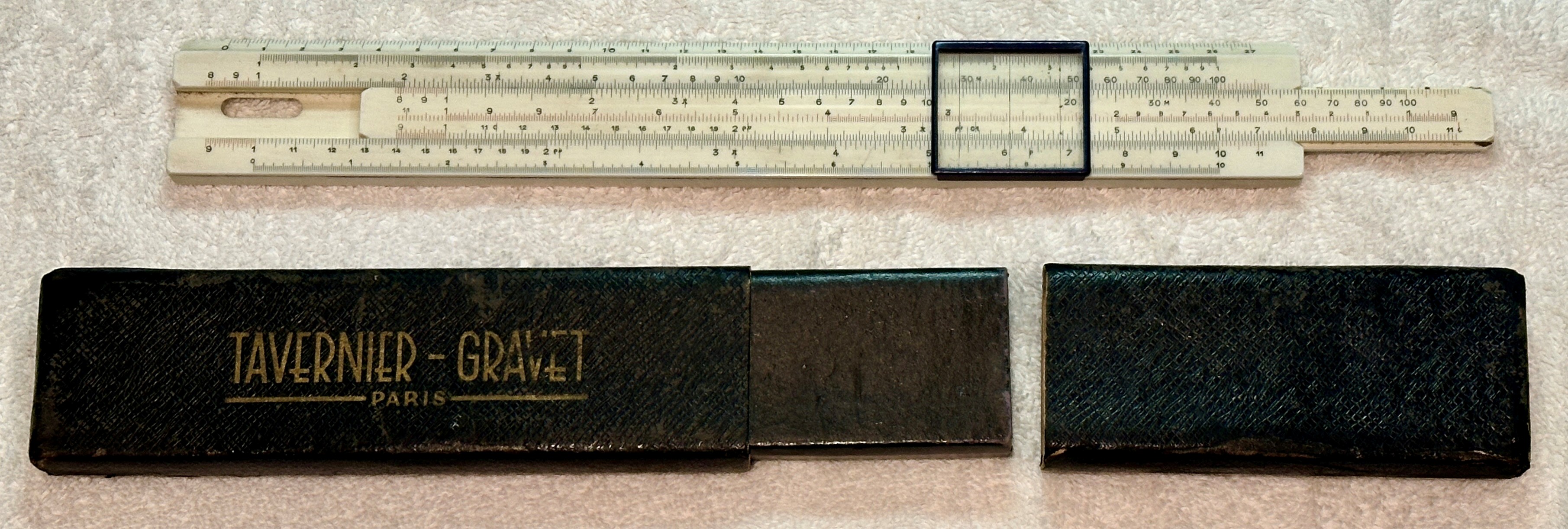
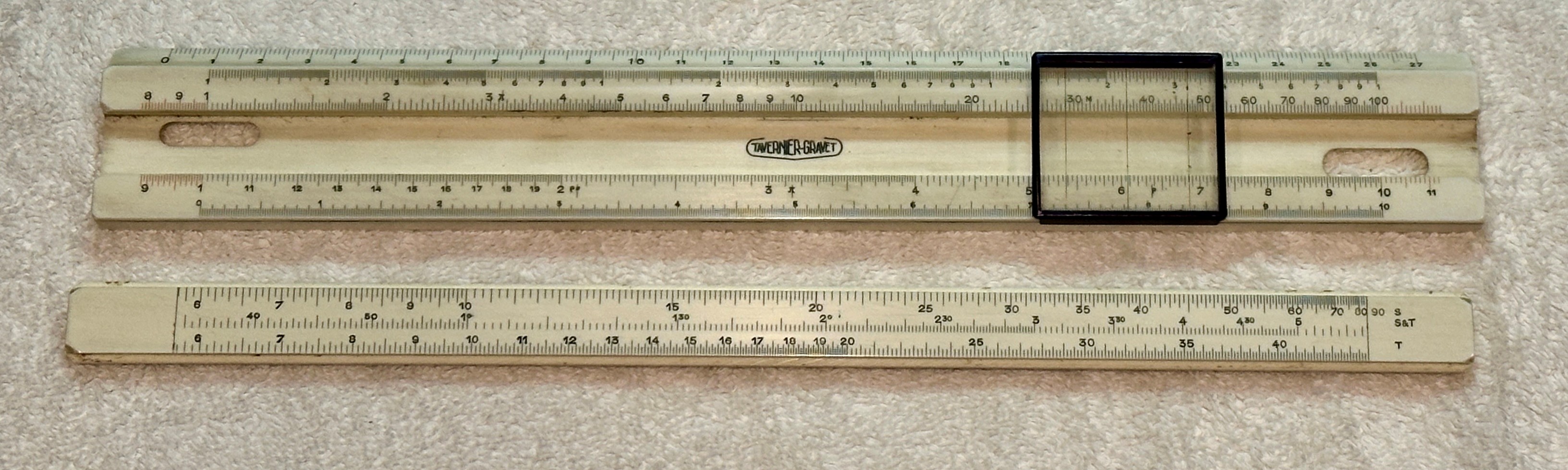
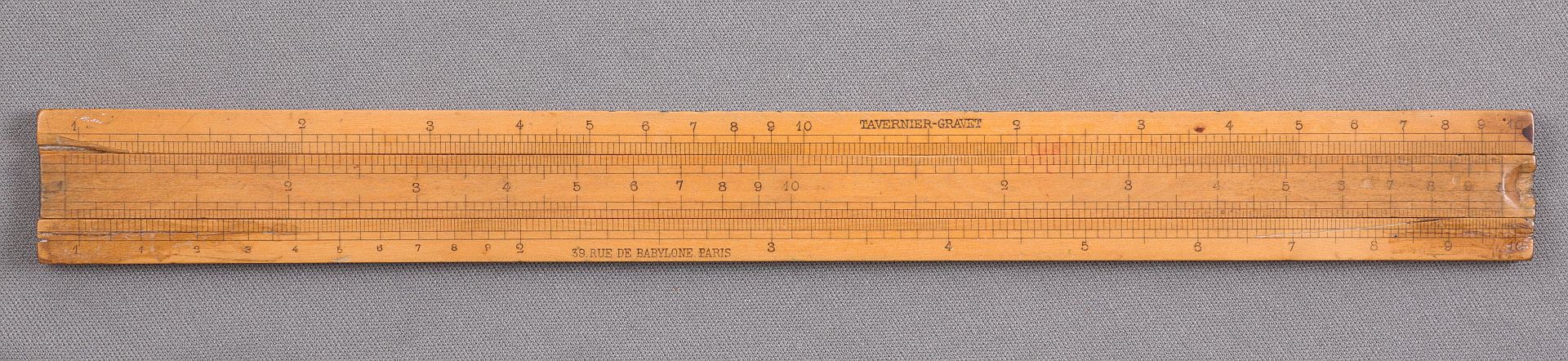
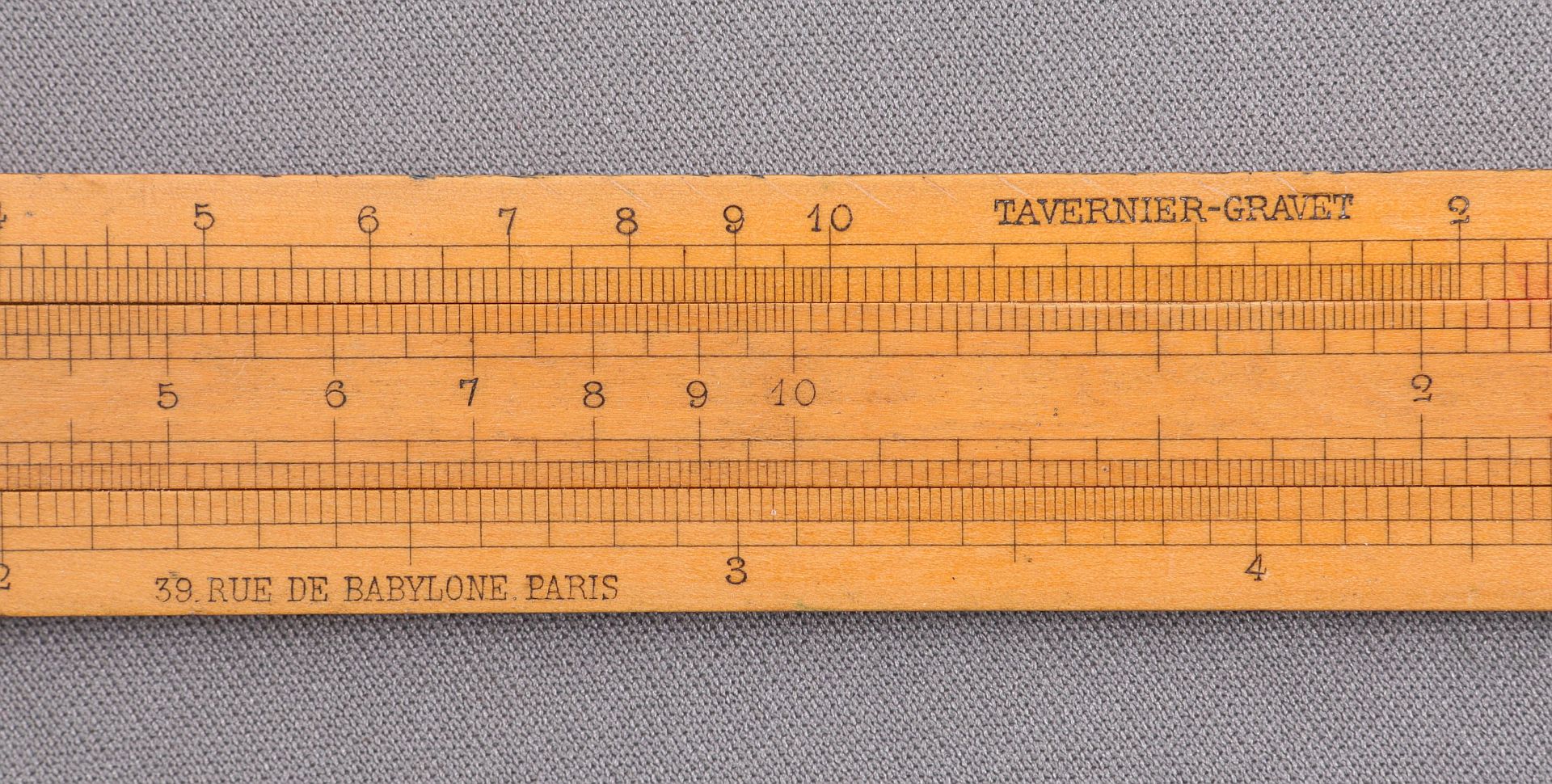
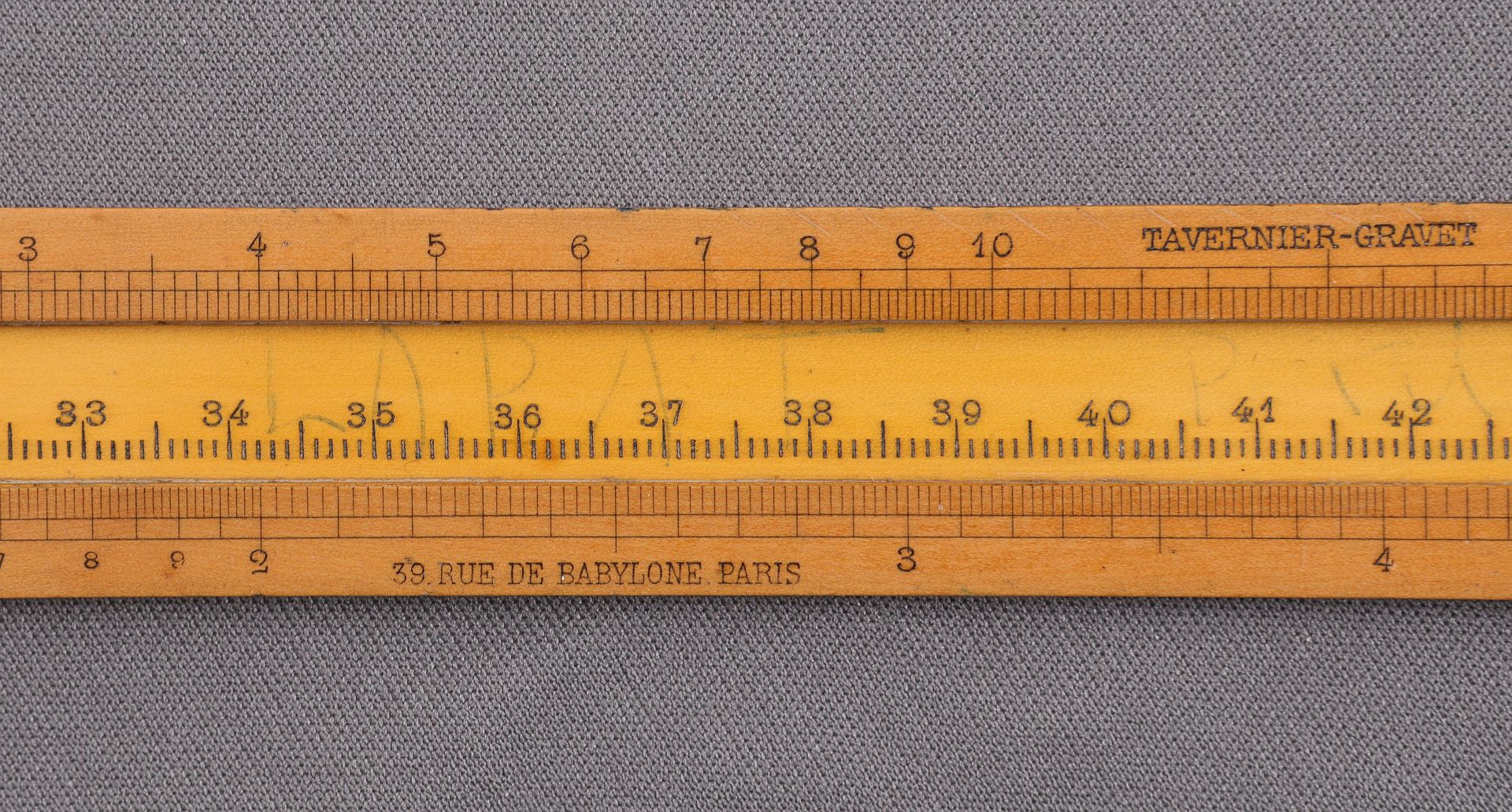
Celluloid/plastic 10-inch rule by Tavernier-Gravet,
wide metal-framed cursor with three hairlines Tavernier-Gravet was a major 19th and 20th century French scientific instrument maker, famous for producing high quality slide rules. The firm was founded by Etienne Lenoir (1744-1832). The name was changed to Gravet-Lenoir around 1827 and then finally Tavernier-Gravet in 1867. The firm was instrumental in popularizing both Soho and Mannheim rules. This particular example is a sturdy celluloid/plastic Mannheim rule from the first half of the 20th century, with a wide metal-framed cursor containing three hairlines. It also comes with its original two-piece card box labeled Tavernier-Gravet Paris.
|
|
| 03 |
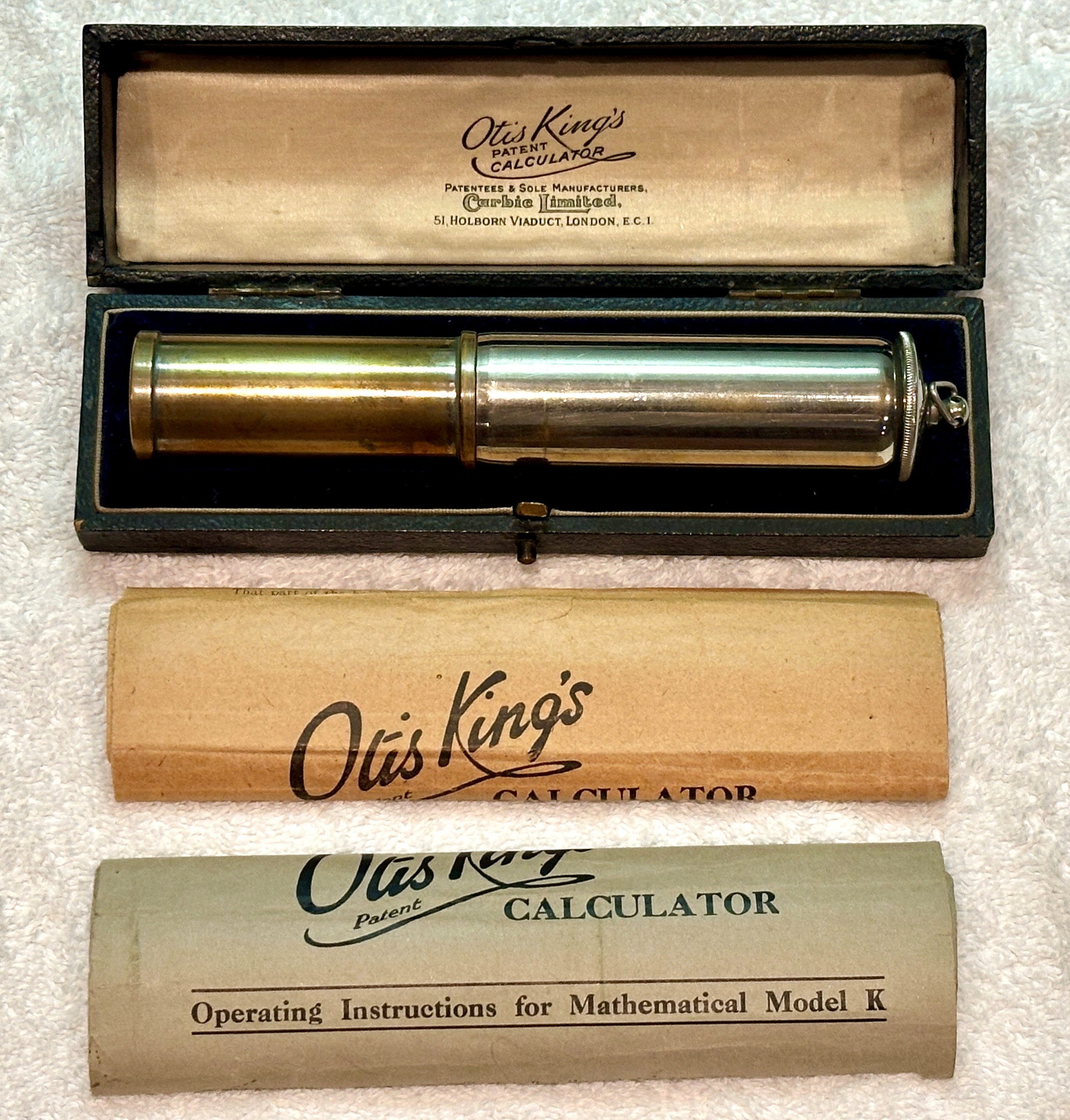
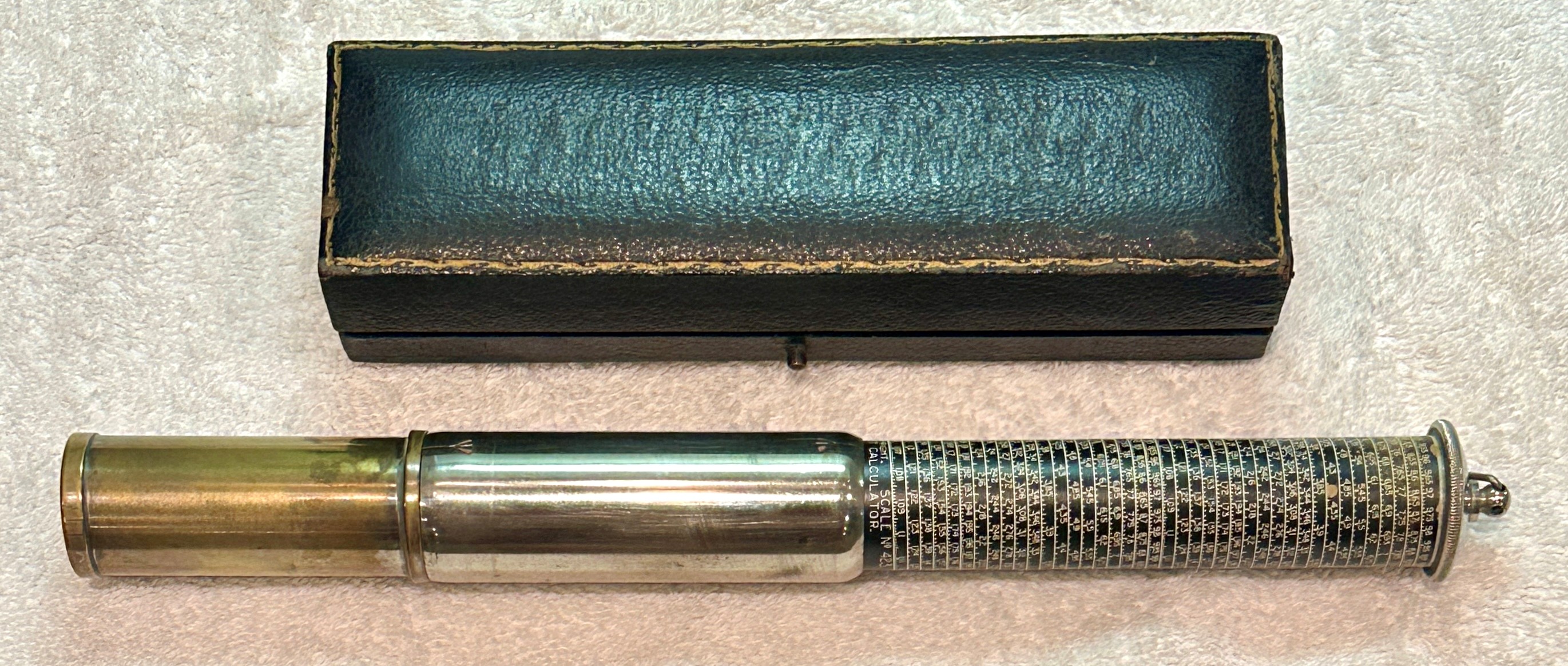
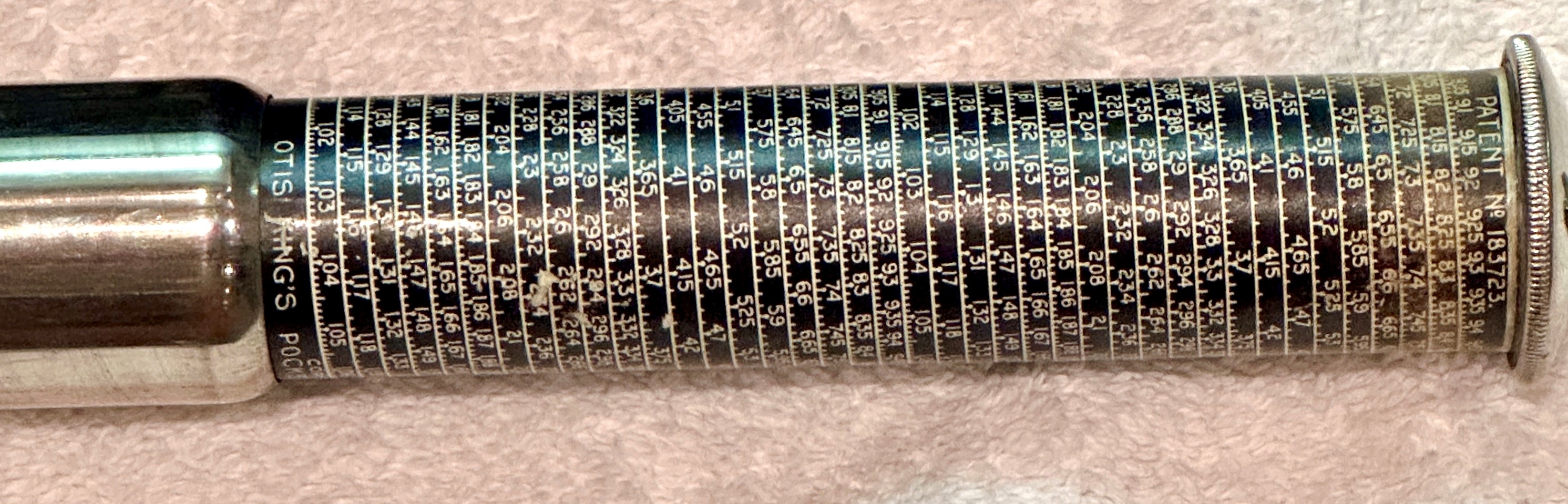
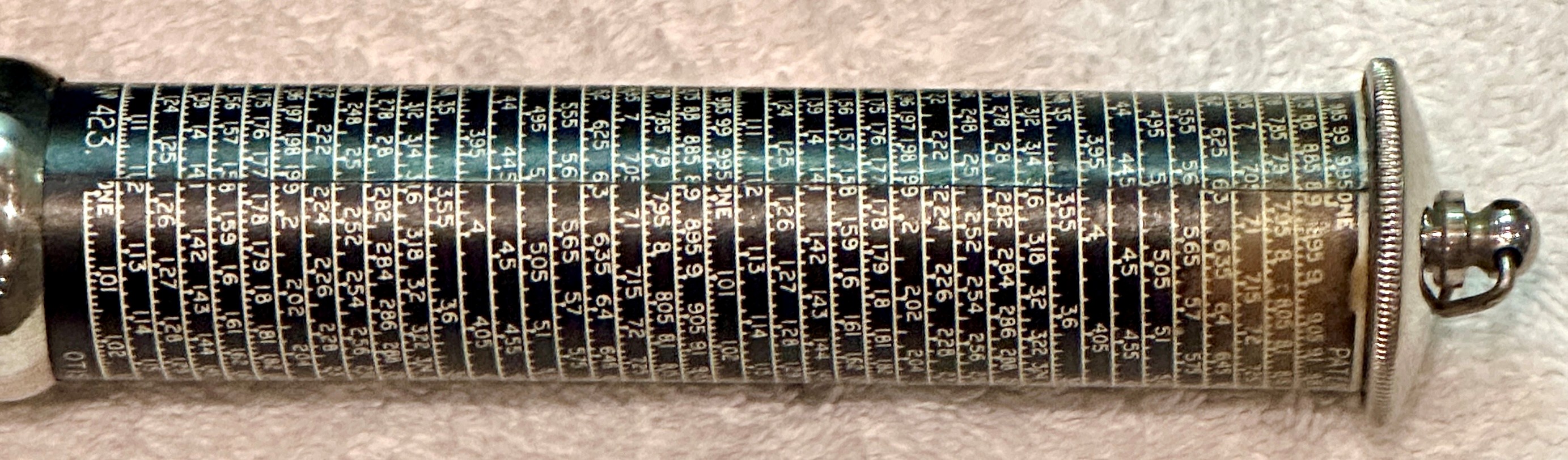
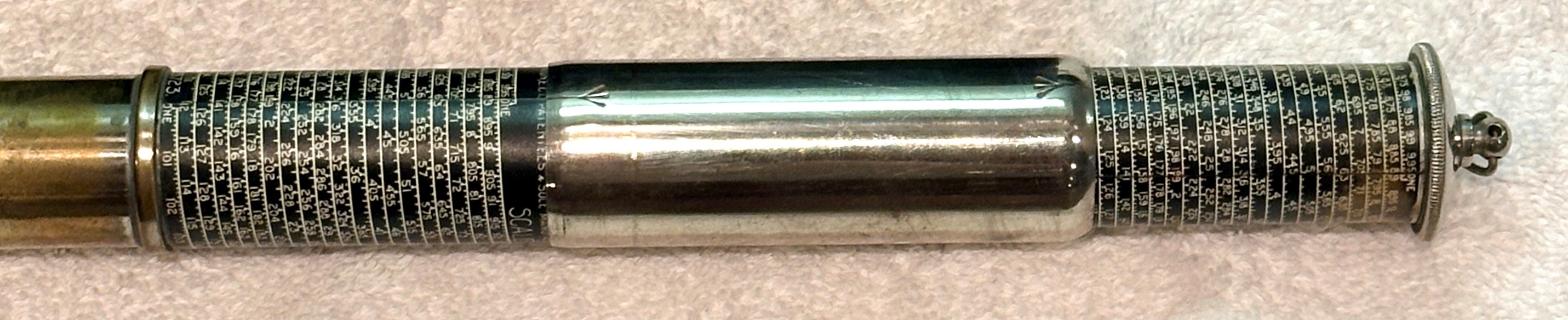
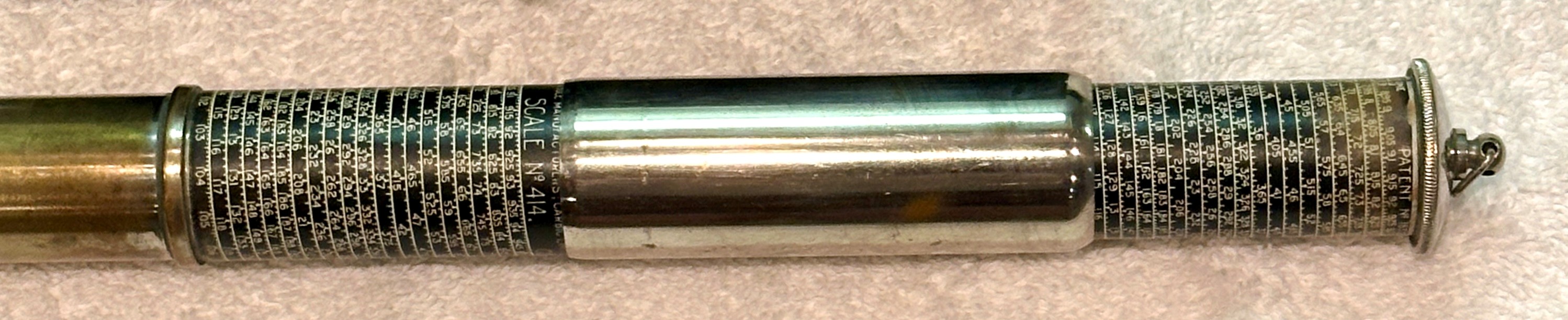
Otis King Calculator, early version with
white on black scales outstanding condition
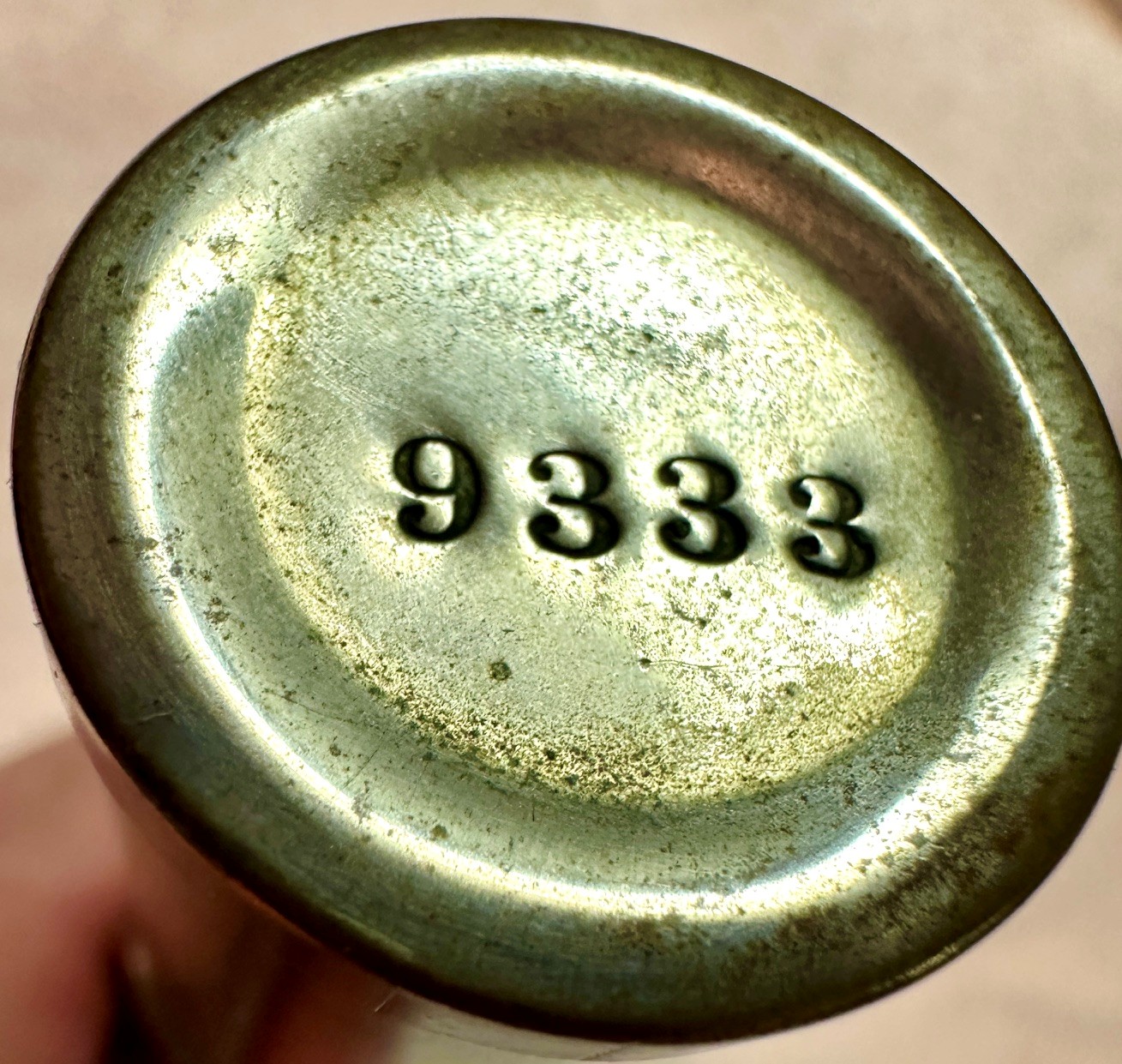
This example of the Otis King is from the earliest years of production when the company initially printed white-on-black scales. The serial No. 9333 predates the later numbers which featured a letter followed by four digits. The scales No 414/423 are in excellent condition (note many of the early white on black scales have suffered from fading over time) and indicate it is an early Model K. Also included are instructions and an advertising pamphlet and the original hinged case. Rule body, rule scales, and hinged case are all in outstanding condition.
|
|
| 04 |
four-sided, four-slide, 6-inch boxwood excise rule
by maker Dring and Fage
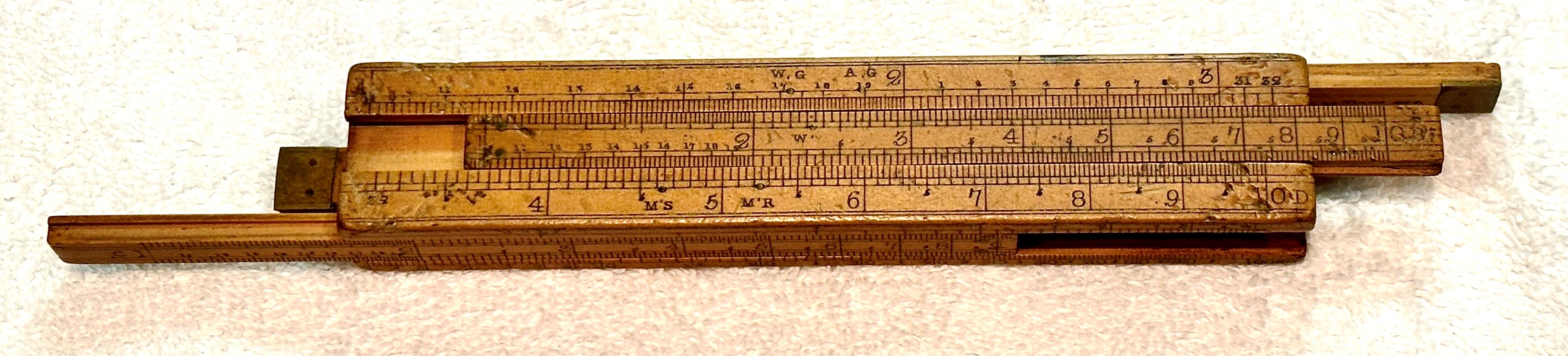
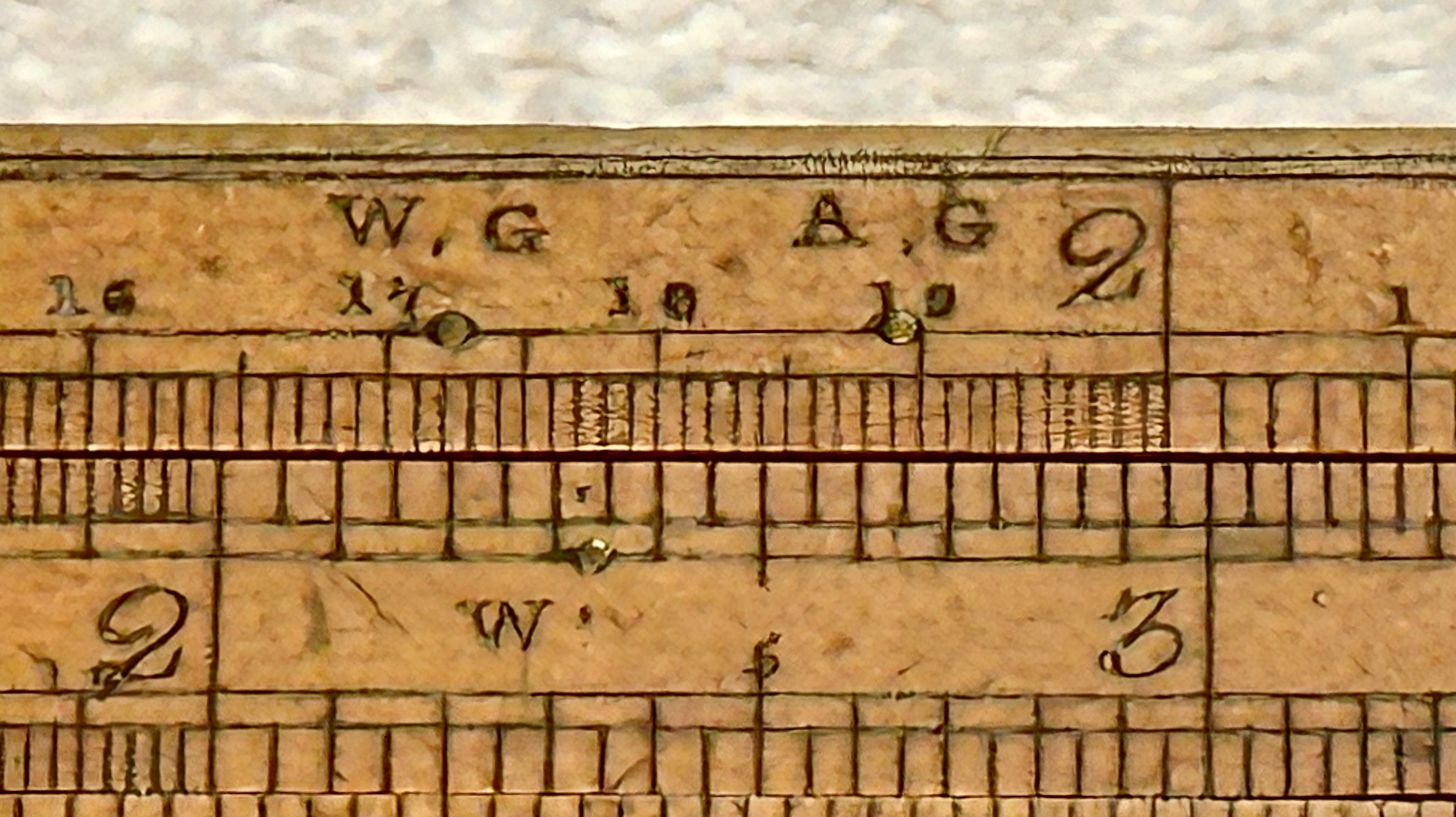
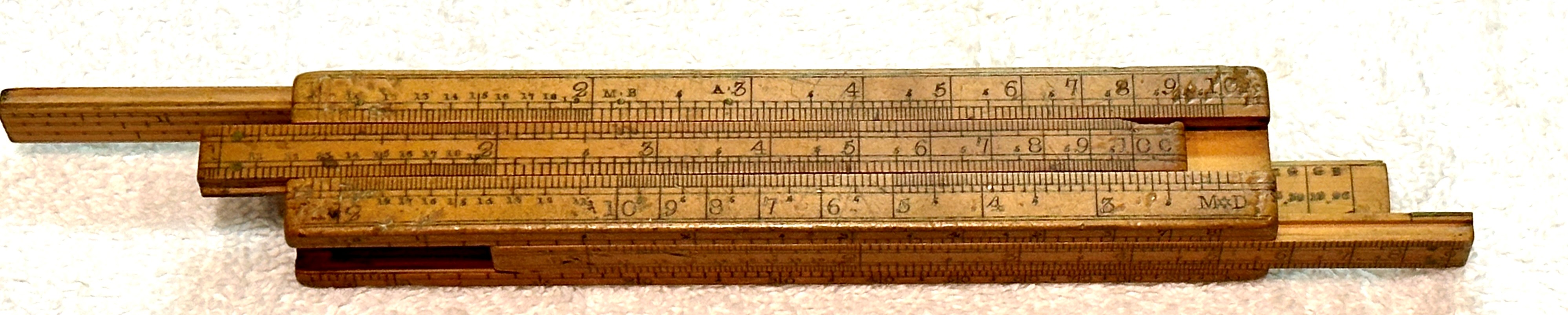
Four-sides rules for excise tax calculations were initially made in the late 17th century as one of the first examples of a practical use for the slide rule. There continued to be made into the 18th and first half of the 19th century when the design moved predominately to the two sided, two-slide rule format. Most of these rules were manufactured at 12 inches in length, with the pocket-sized 6- and 9- inch field models much less common. Twenty-four (24) and 18-inch sizes were also made, again much less common, for office and field use. Even less common is to find an example that is signed by the maker such as this example which reads in one of the wells beneath the slide 'Dring and Fage Makers No. 20 Tooley St. London Bridge.' The end of the two of the faces show some wear in the form of numerous small dents in the wood but all of the scales remain readable. An uncommon, signed 6-inch four-sided boxwood rule found in only the most discerning of collections. Note the AG and WG gauge points, which dates this rule to before 1824.
|
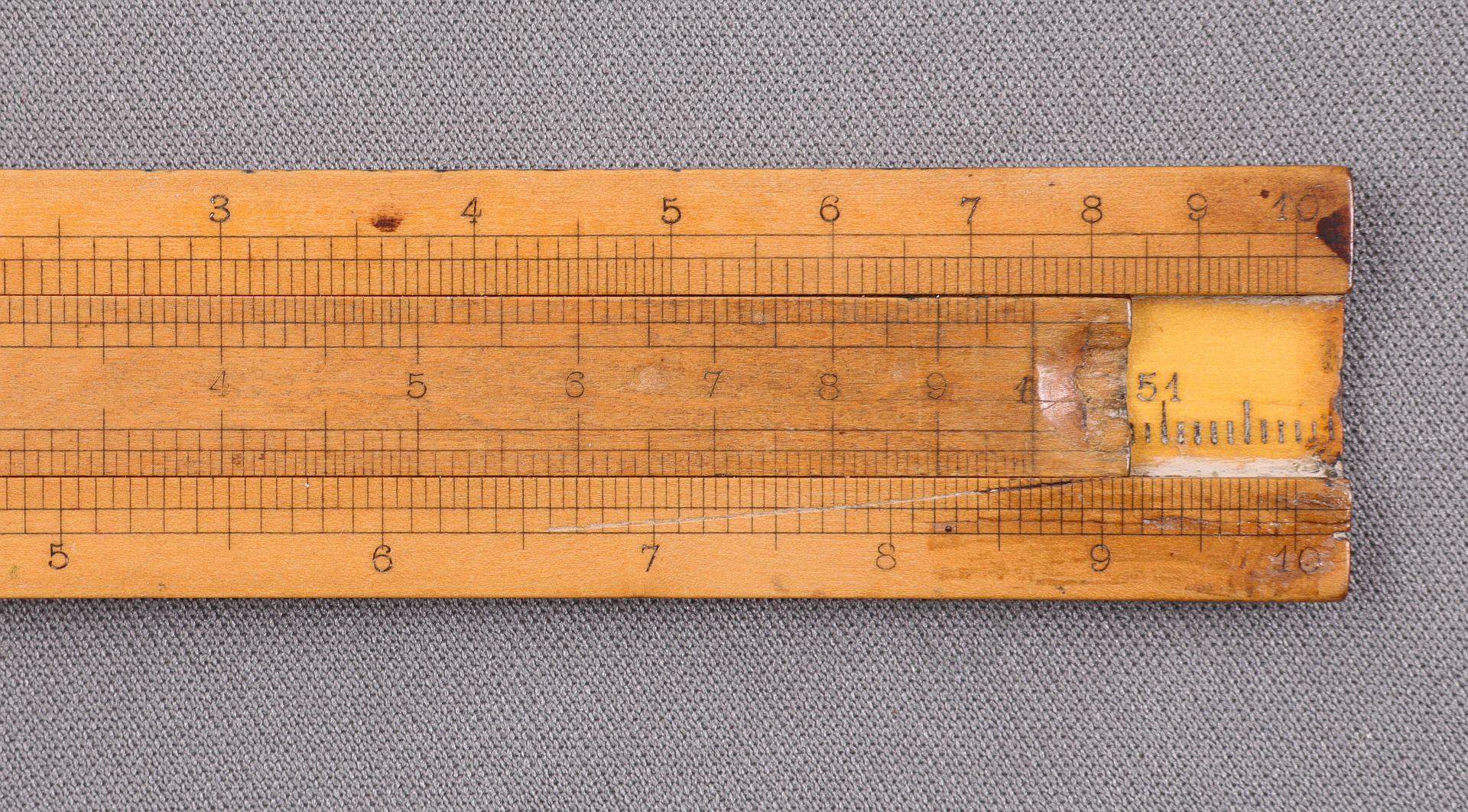
|
| 05 |
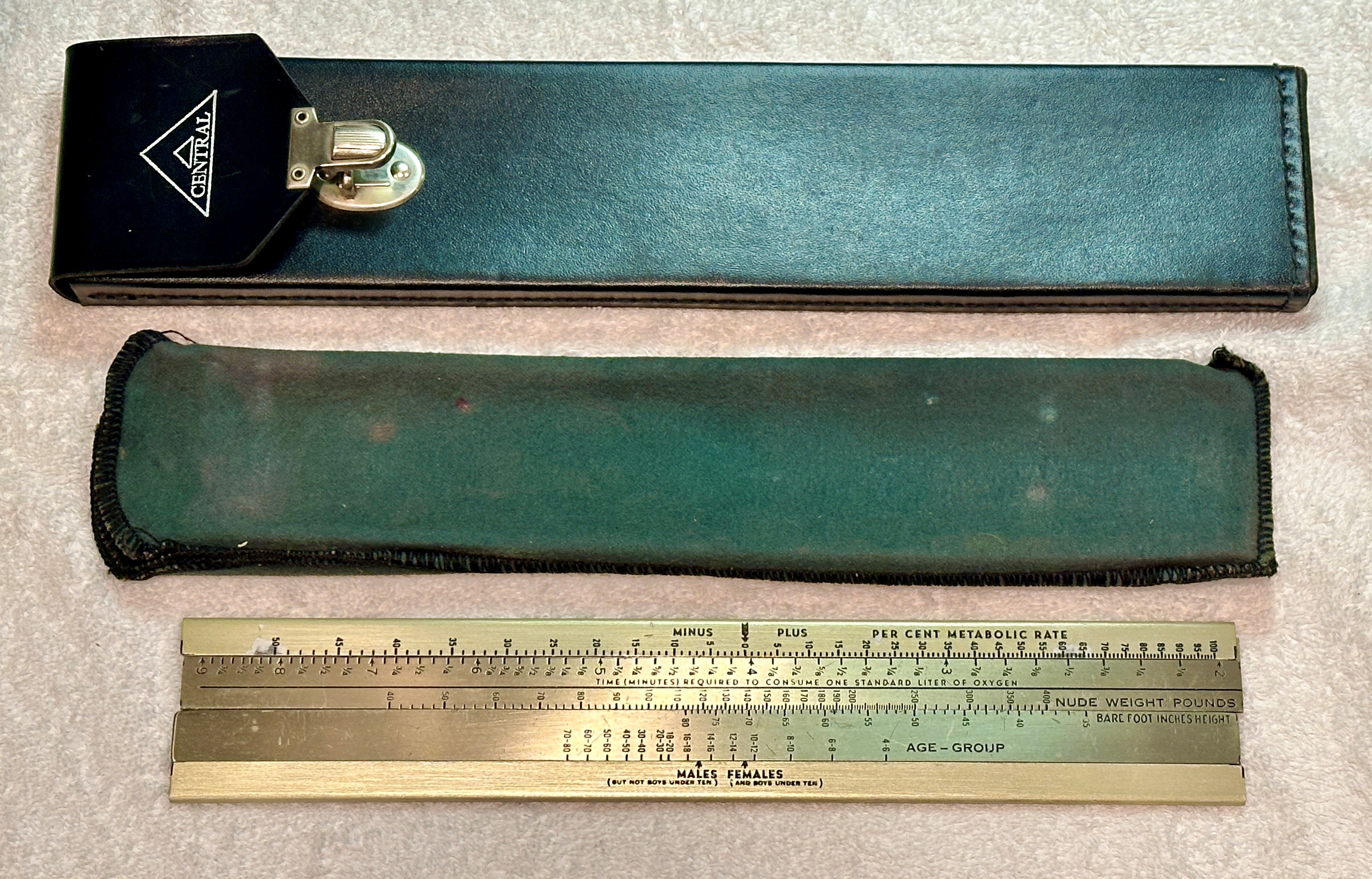
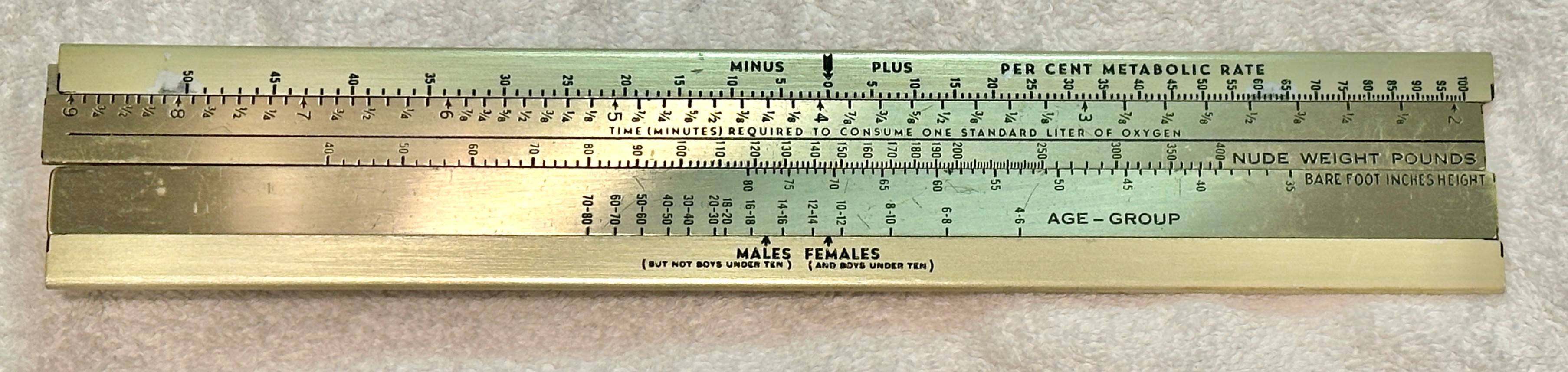
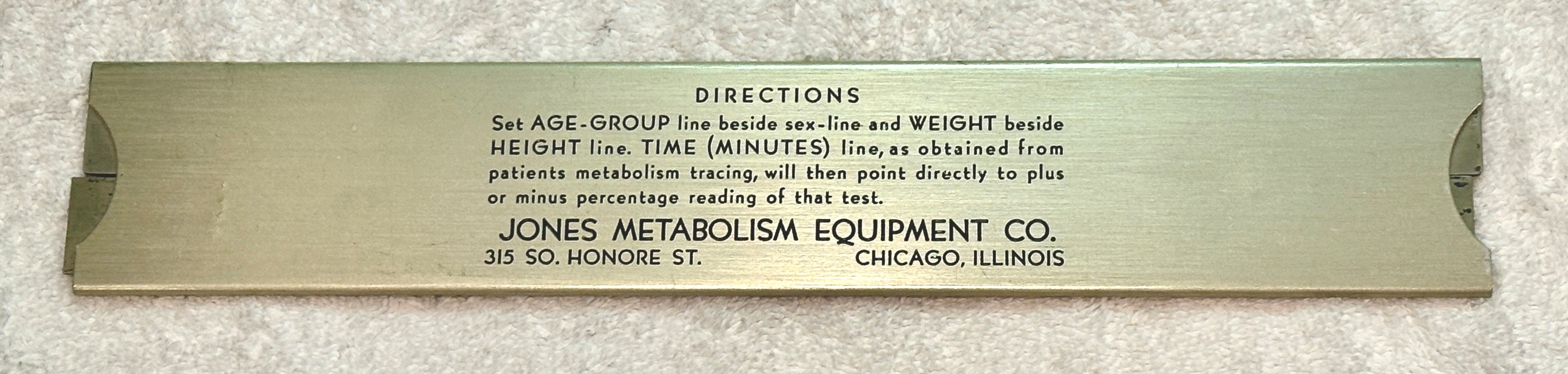
Metal 'Percent Metabolic Rate' 11-inch rule
by Jones Metabolism Equipment Company, excellent condition
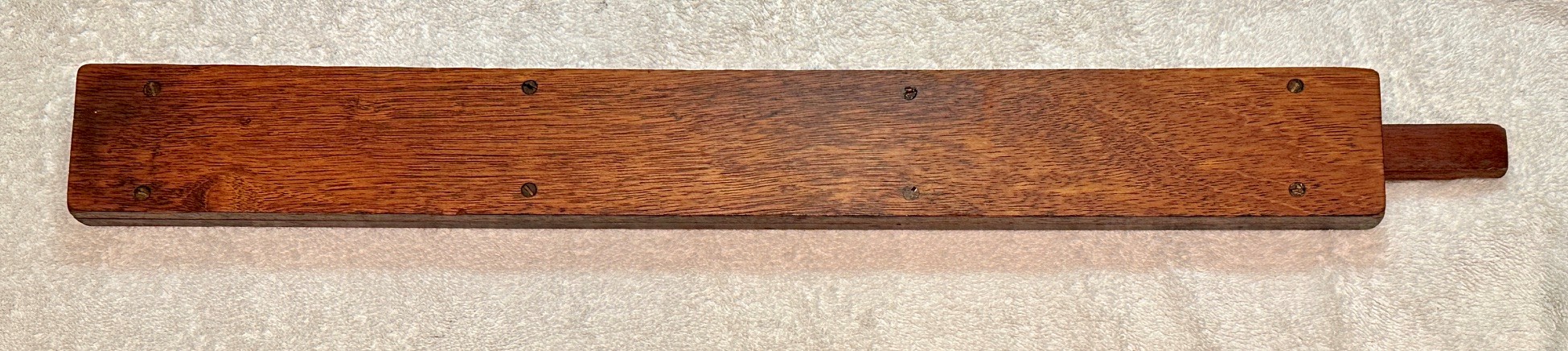
This substantial 11-inch metal rule features two slide and five scales for consuming oxygen organized by male/female and weight and height. Yet another scale organizes the results by age group. The company was founded by Harry Jones, who also developed the Metabolizer, which made metabolic testing widely available. The company continues to operate today out of Oak Brook IL manufacturing equipment used for occupational health and safety medical evaluations. The metal rule face is in excellent condition and comes with a green fabric pouch which is then inserted into a rigid leather case.
|
|
| 06 |
Celluloid-on-mahogany 16-inch rule by
Harold M Pitman Co with unusual scales
This well-made rule (16 inches long by 2 inches wide by ½ inch thick) features logarithmic scales that begin at 1 and end at 24 and are marked in fractions such as eights and sixteenths between major whole numbers. Condition is very good with scales and markings very clear.
|
|
| 07 |
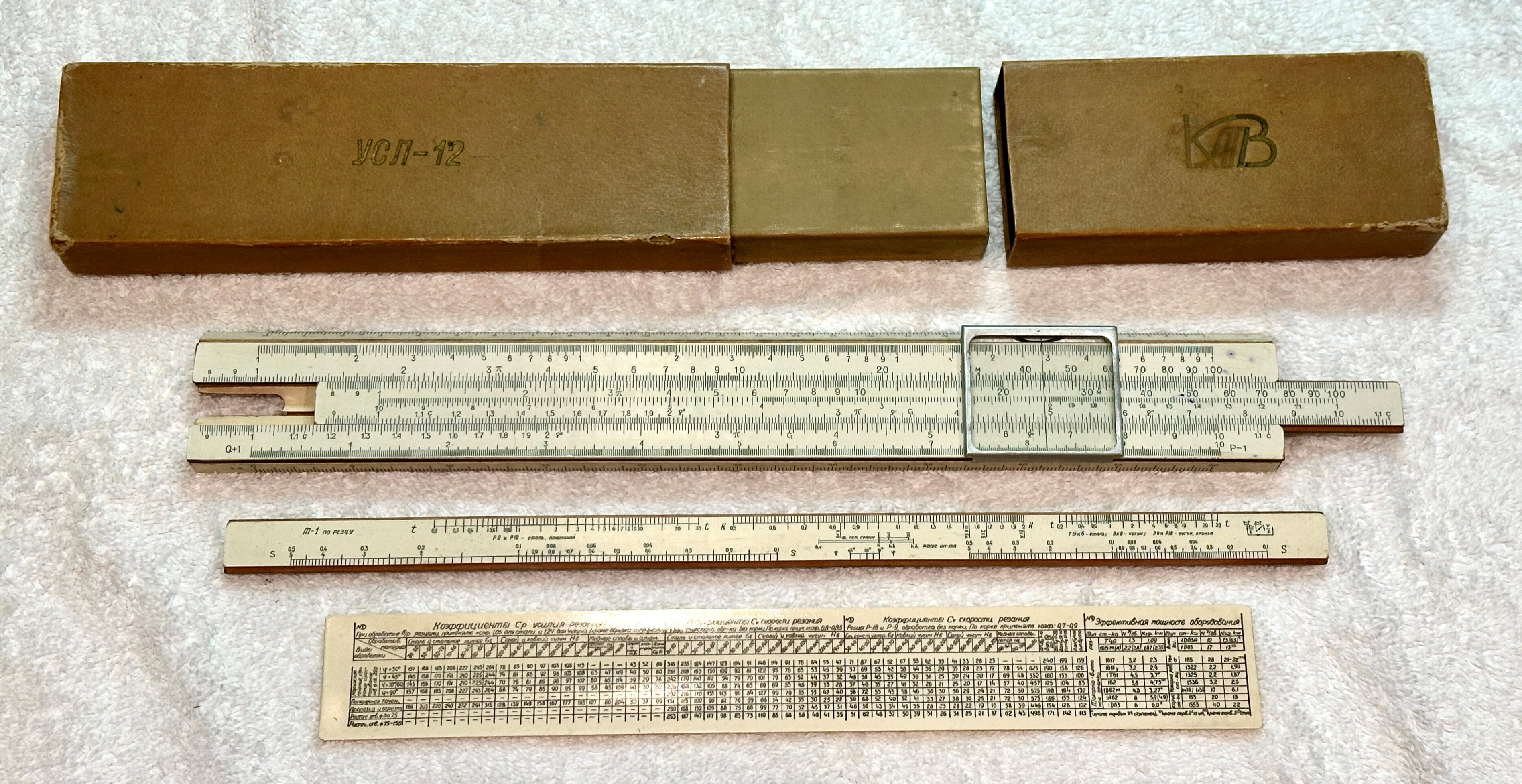
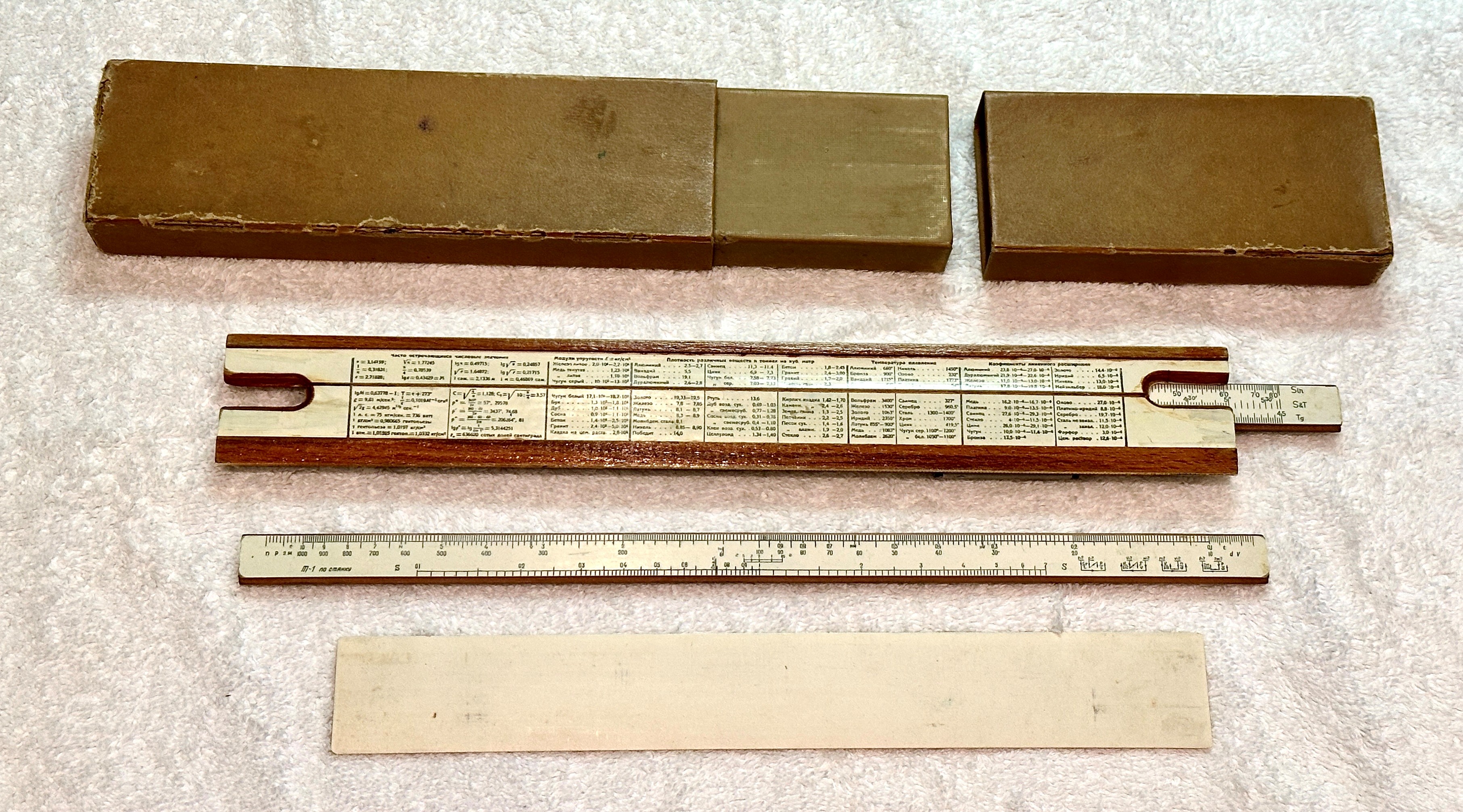
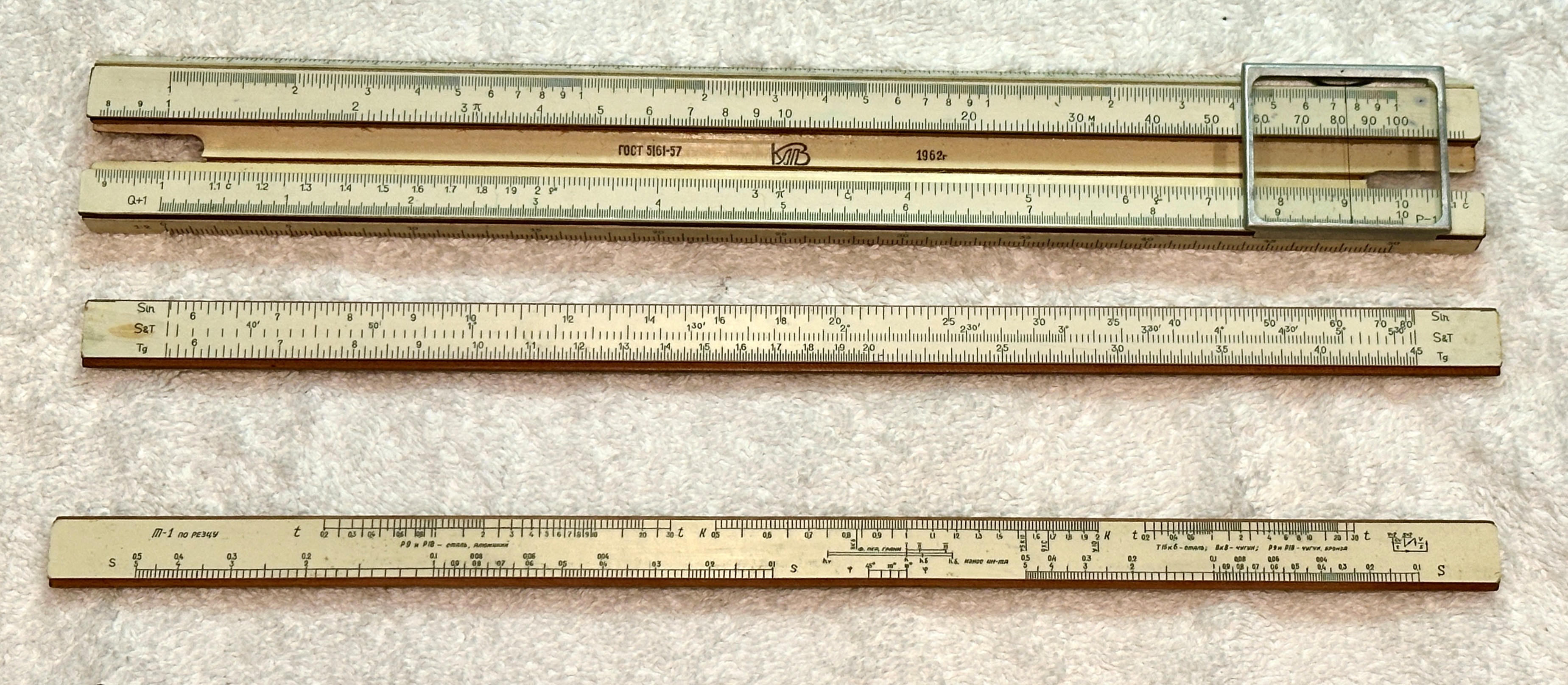
Russian celluloid on mahogany 10-inch rule with extra slide,
Cyrillic lettering.
This 12-inch rule is marked ГОСТ (GOST) 5161-57 in the well beneath the slide and dated 1962. The scales on the body and main slide are standard A,B,C,D and S,L,T on slide reverse along with a cube roots and logarithm scale on the stator. The purpose of the additional slide is more difficult to ascertain as in additional to several scales, it also contains several small diagrams in the margins which are pictured for any interested party, preferably fluent in Russian, to research. Also included is a celluloid insert with a very detailed table of numbers for various angles and other parameters. GOST was the Soviet standardisation office, similar to the US ANSI. GOST 5161 was the standard for general purpose slide rules, here the 1957 edition. The Rule is a Rietz, and the additional slide transforms it to a special purpose slide rule for occasional use.
|
|
| 08 |
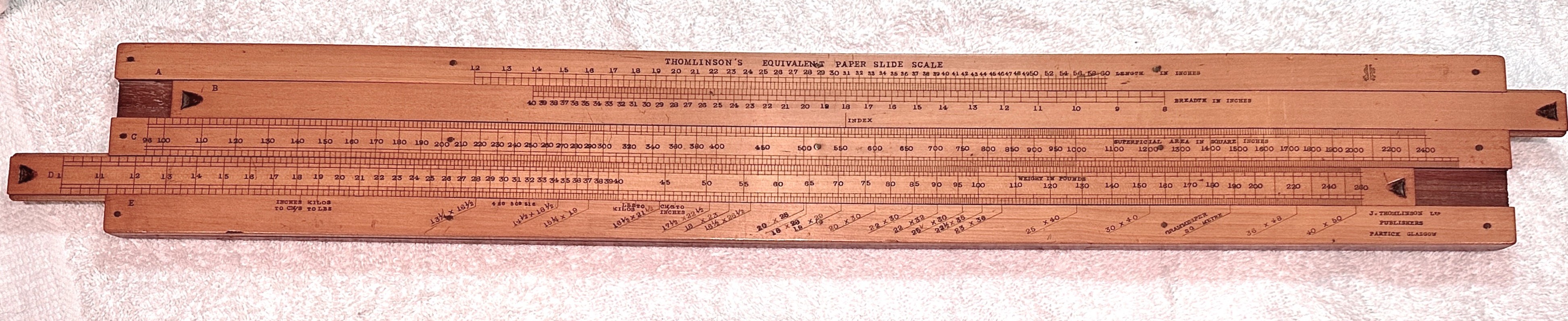
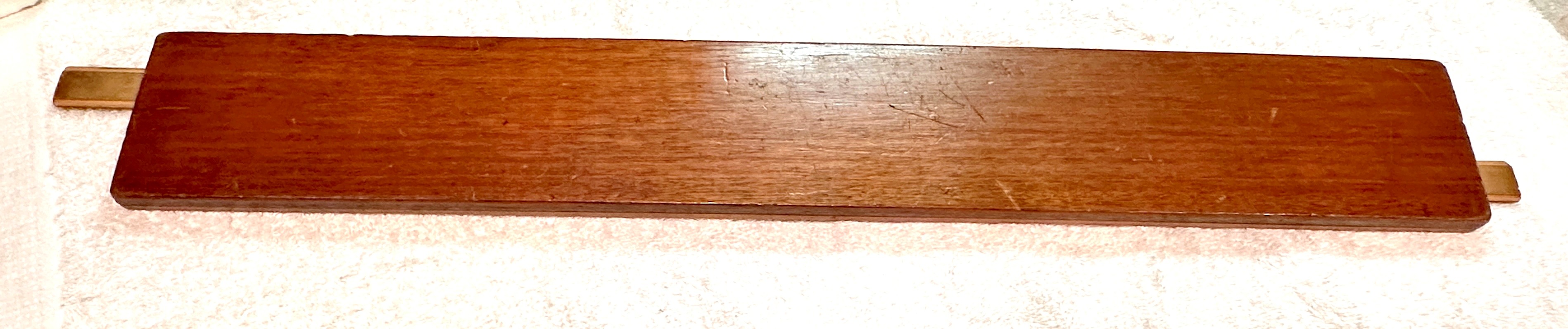
Thomlinson's Equivalent Paper Slide Scale,
boxwood on mahogany,
23-inch length, 2-inch width, half inch thick slide rule This is one very impressive, substantial and heavy calculating tool. This specialized rule was made by J. Thomlinson Ltd in Glasgow, Scotland to calculate paper weights and conversion factors in the printing and paper industry. This was used primarily by printers, paper mills, and government printing offices to quickly convert dimensions into equivalent weights and volumes. The rule itself is signed J Thomlinson Publishers Partick Glasgow features two slides and is in little used condition.
|
|
| 09 |
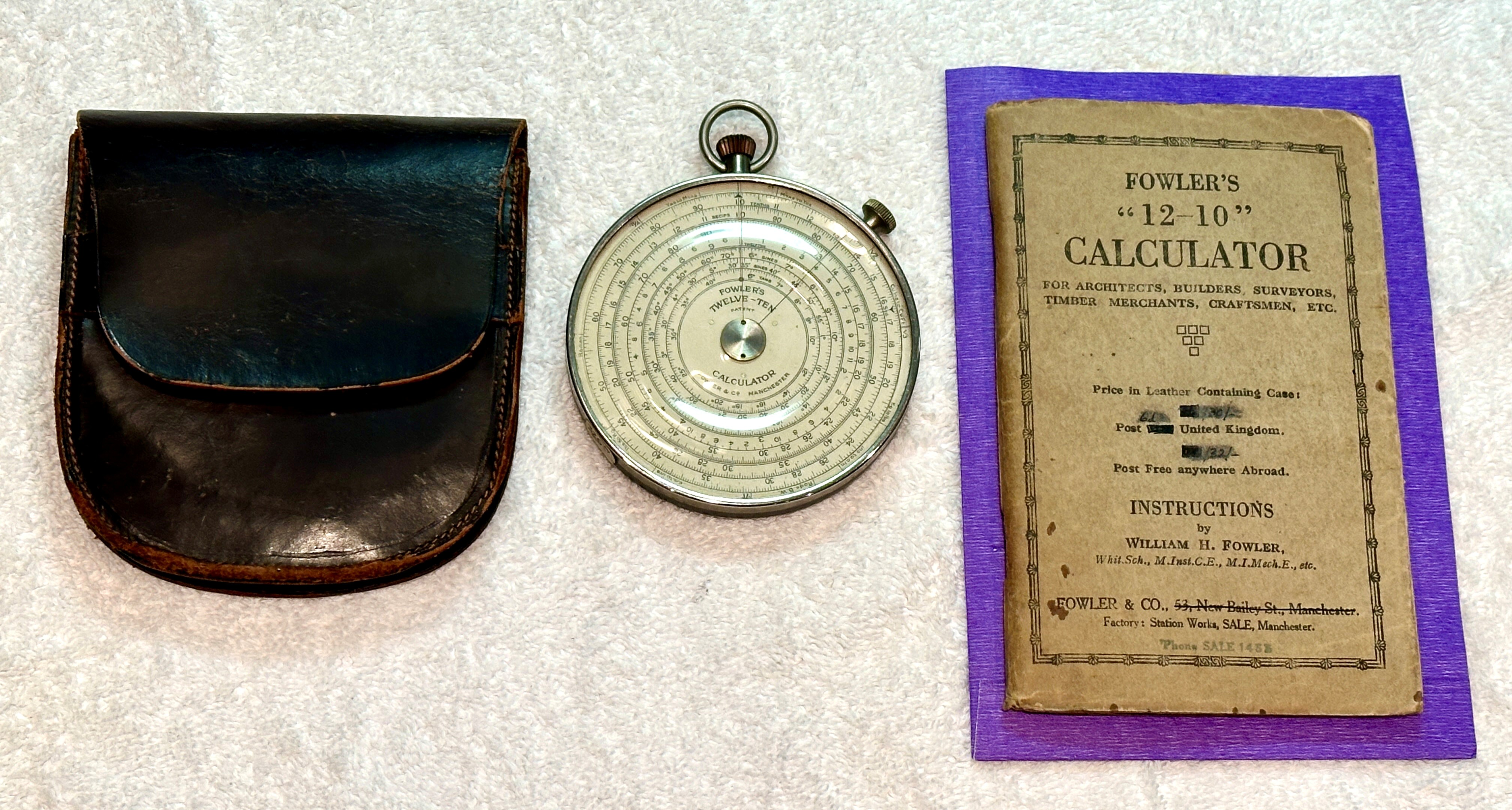
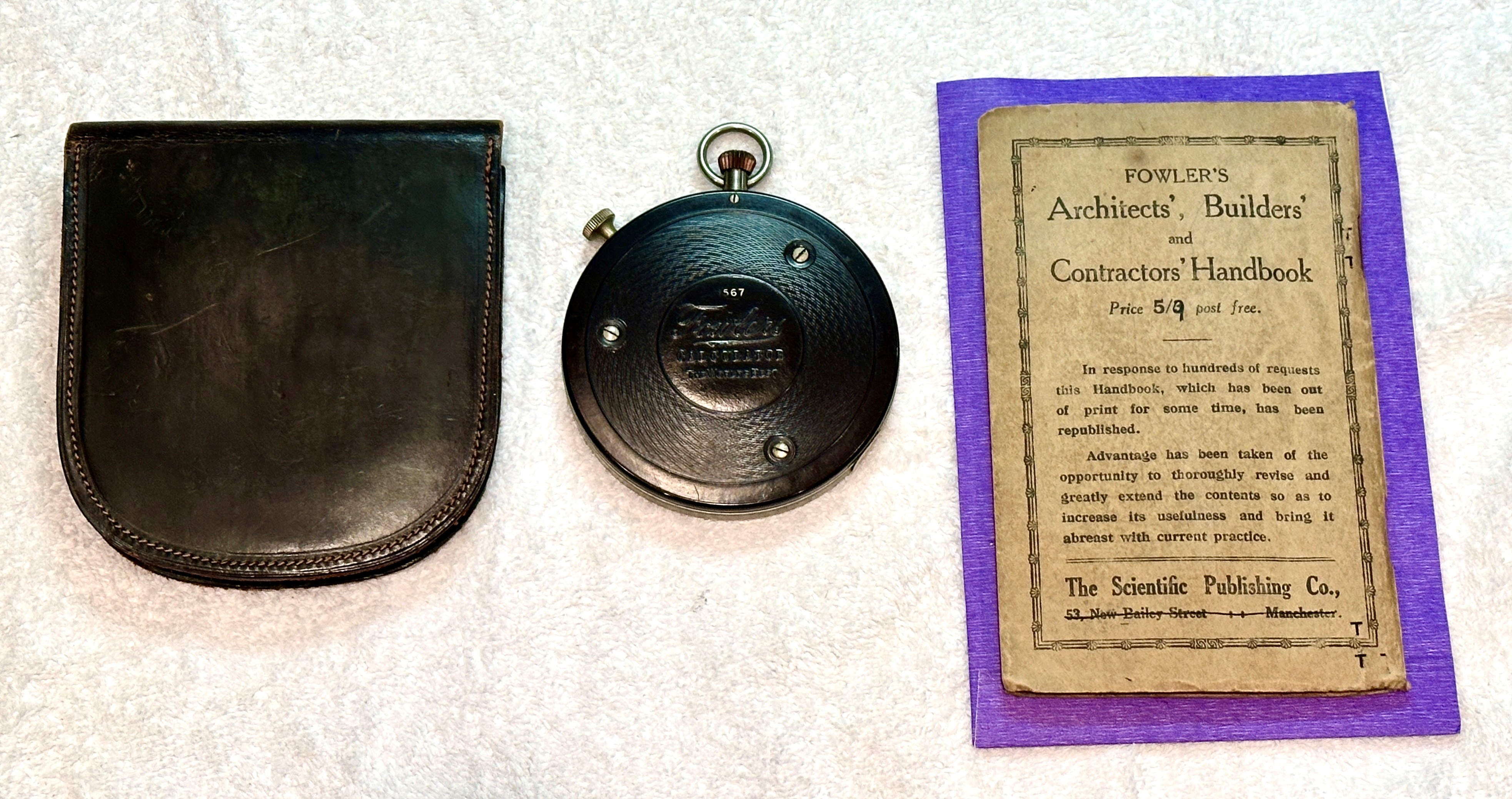
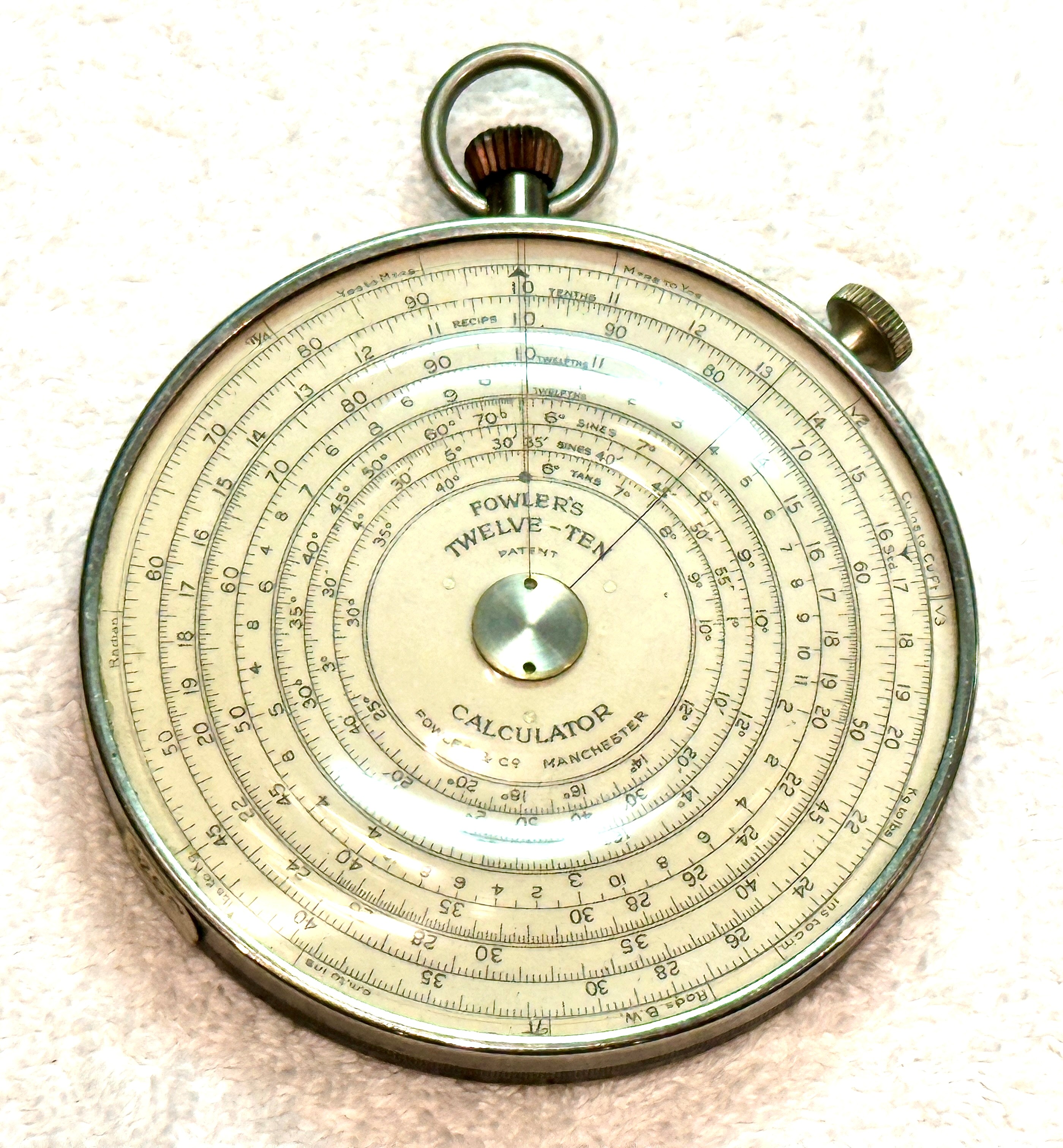
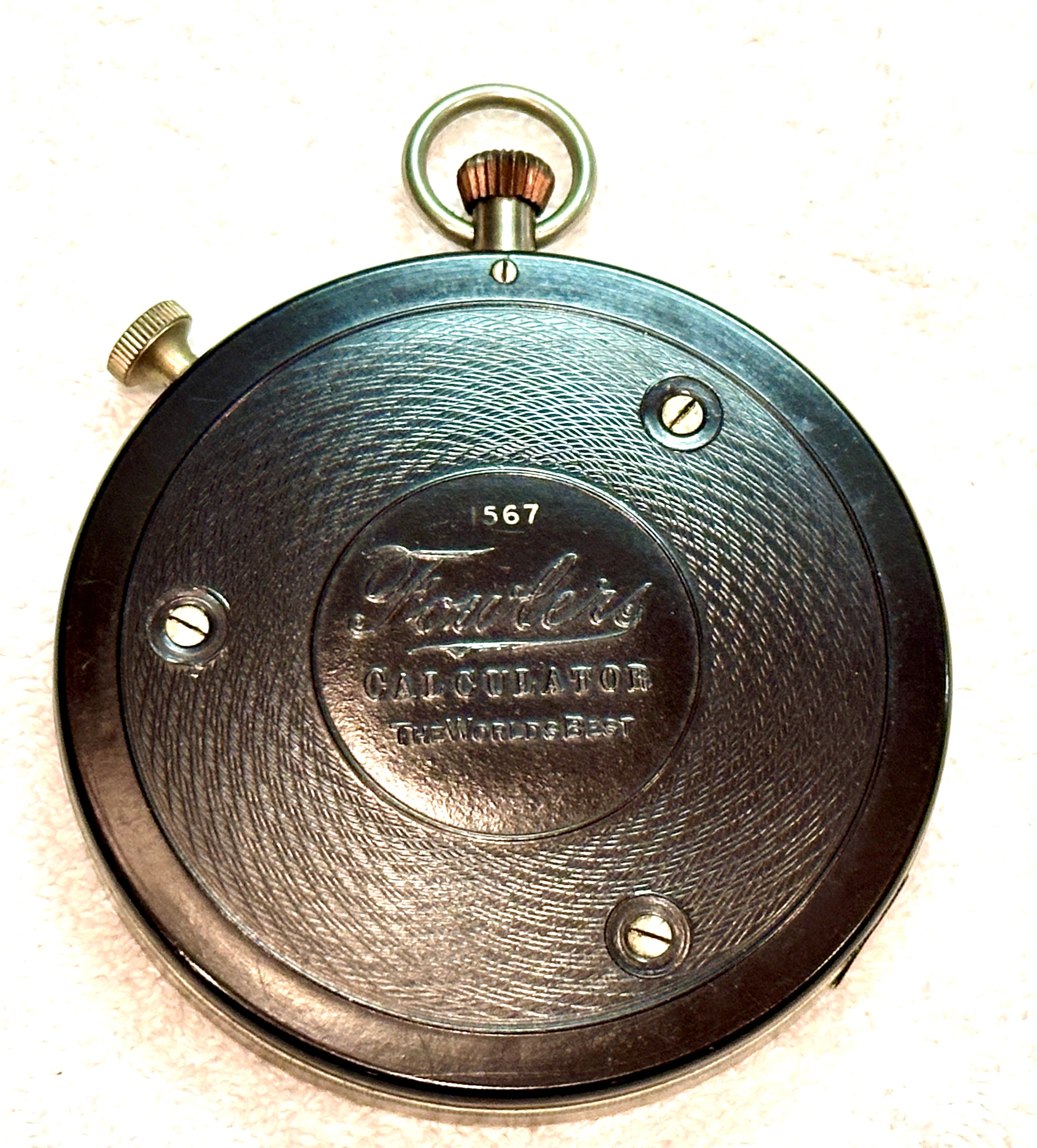
Fowler's 12-10 calculator in excellent condition,
with leather case and instructions
The Fowler 12-10 gets its name from the fact that it has logarithmic scales divided both decimally and duo-decimally (12ths). This is to aid calculations in feet and inches, and also shillings and pence; there were 12 pence to the shilling in old British money. In addition to separate logarithmic scales divided in 10ths and 12ths, the 12-10 has a reciprocal scale (CI), two sine scales and a tangent scale. The Model 12-10 was introduced in 1936, long after the original Fowler Calculator, the Long Scale, the Universal, and the Magnum models.
|
|
| 10 |
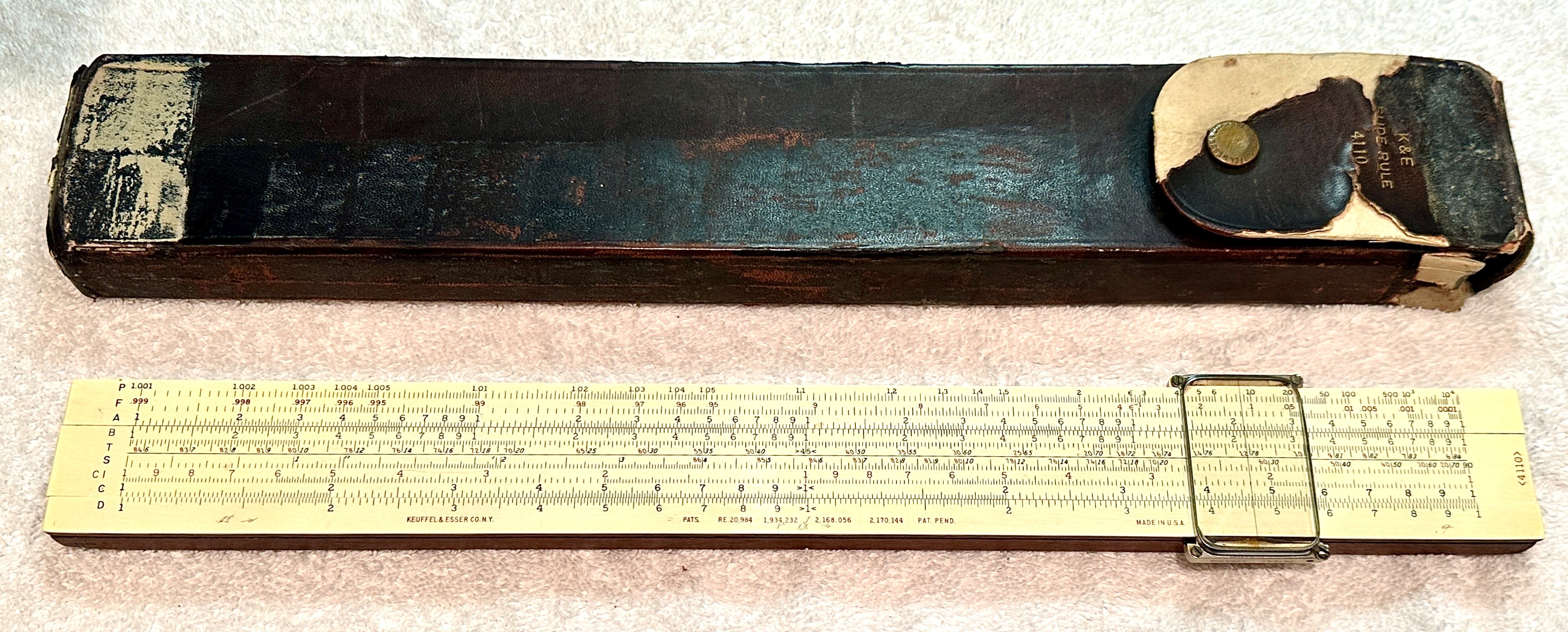
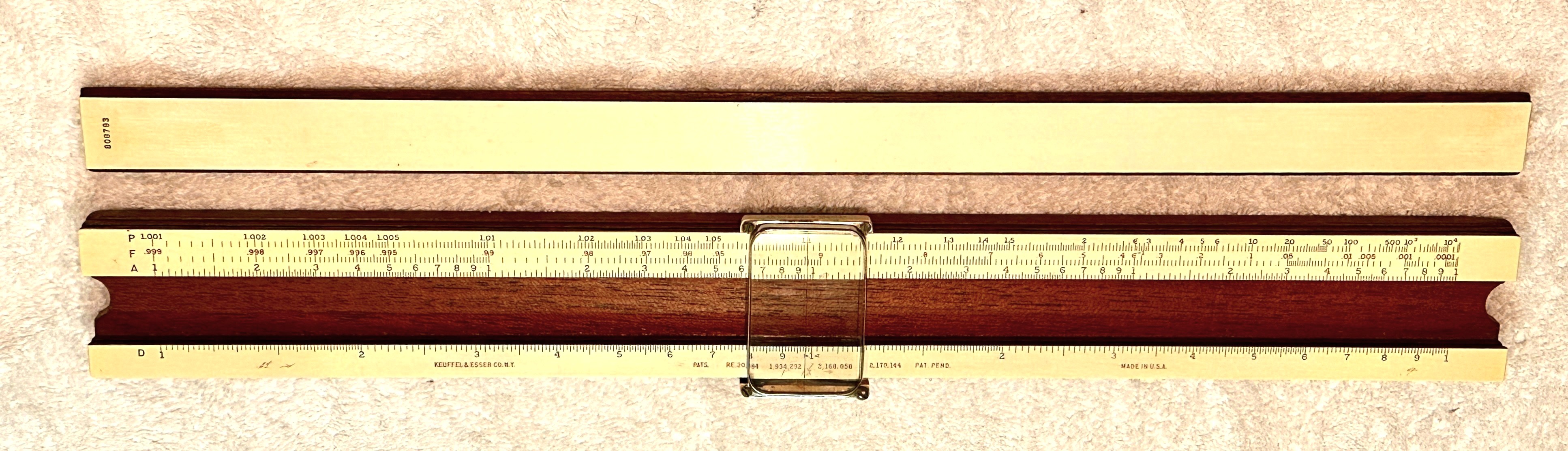
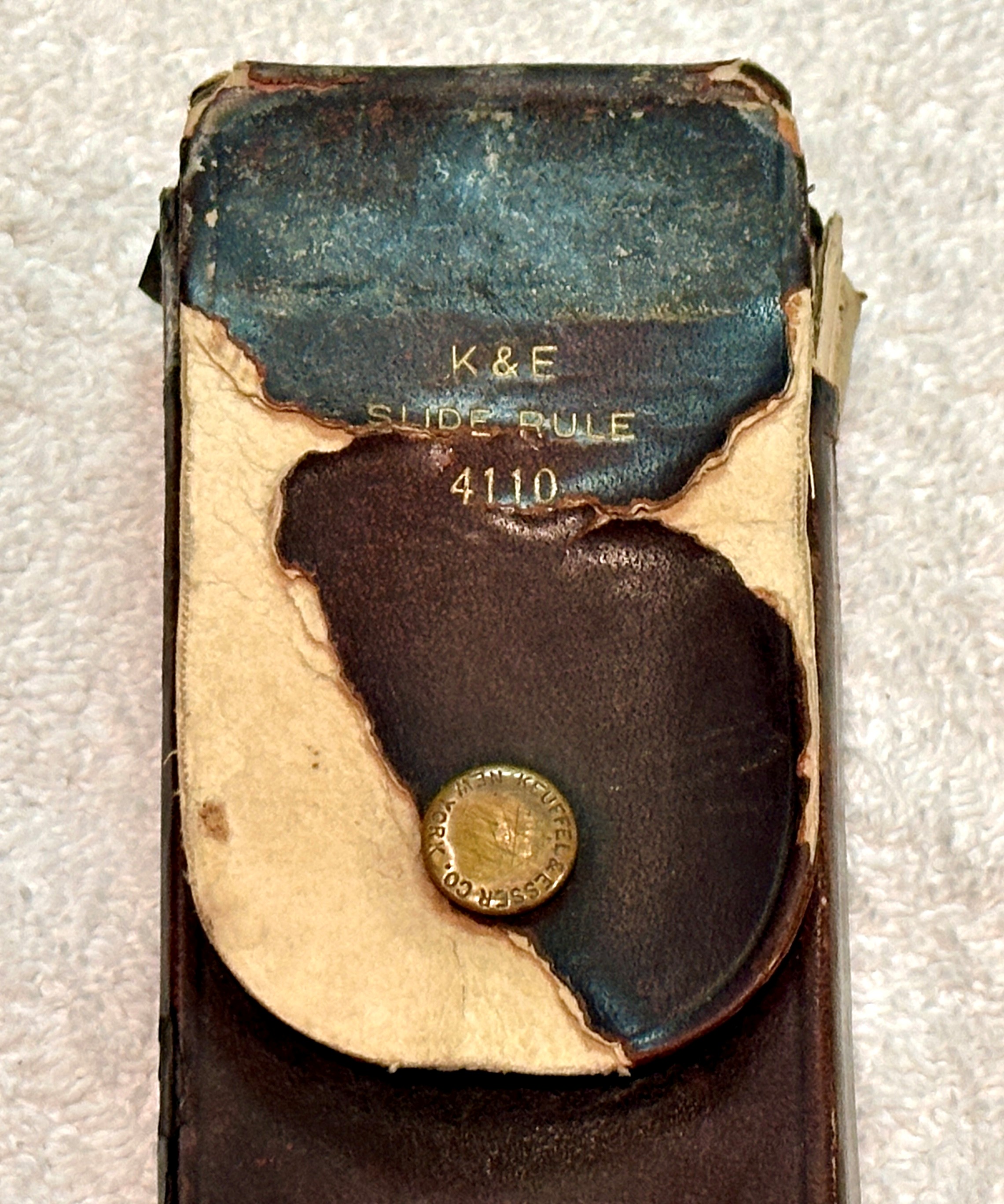
Keuffel and Esser, Model 4110 Power Trig Slide Rule,
also known as the Annapolis Rule, celluloid on mahogany,
with four-decade scale.
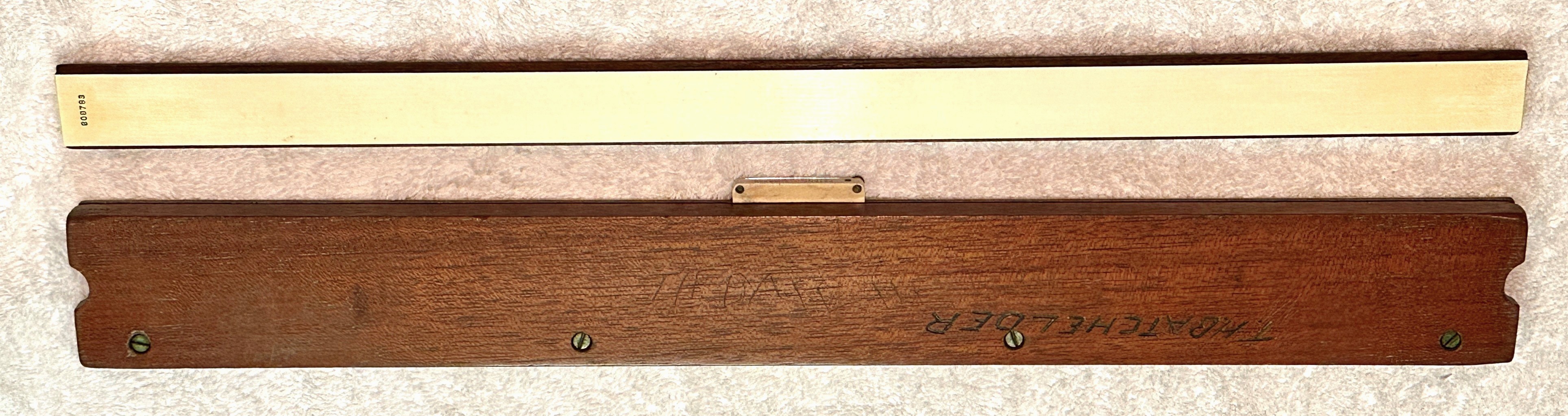
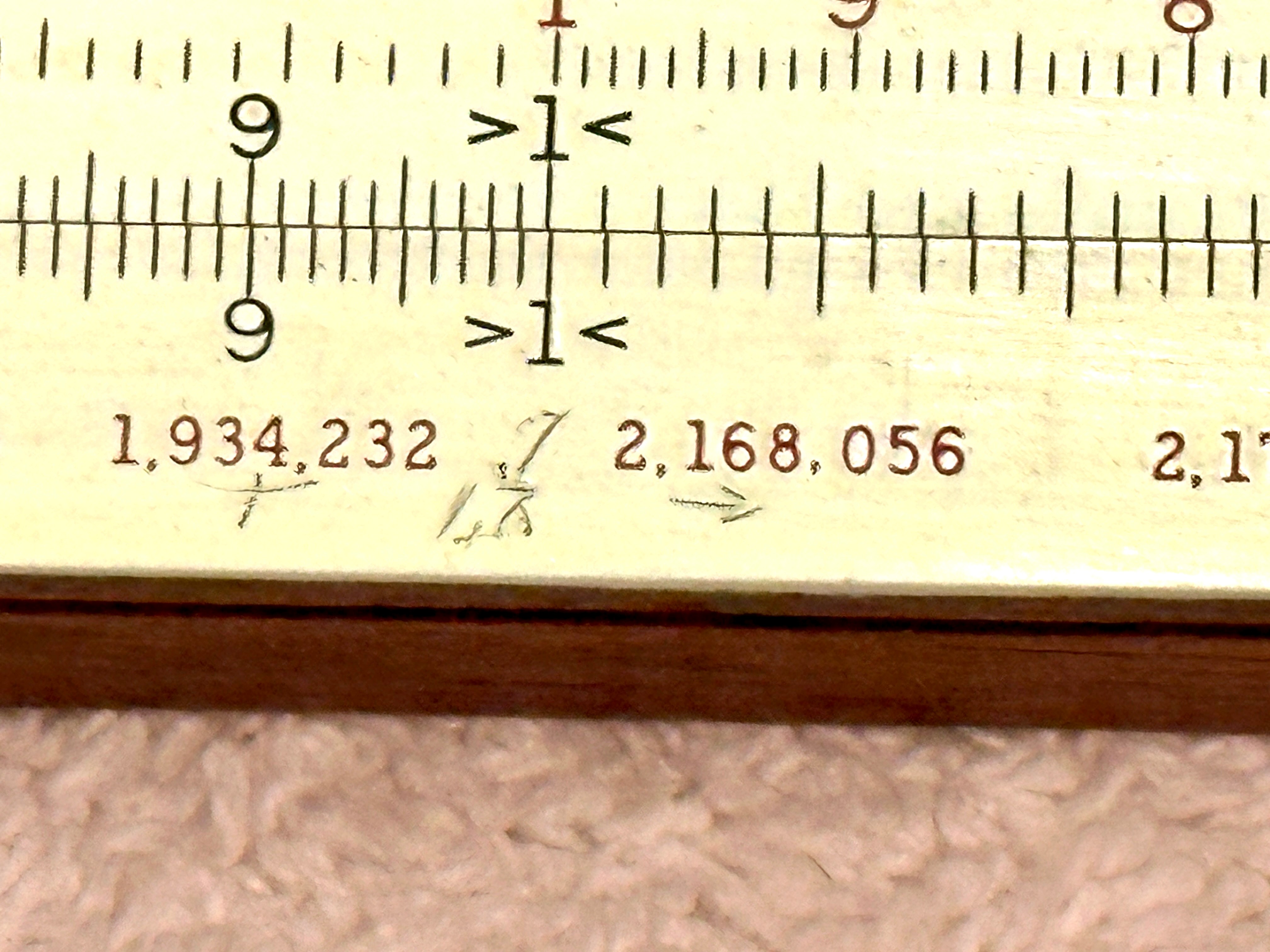
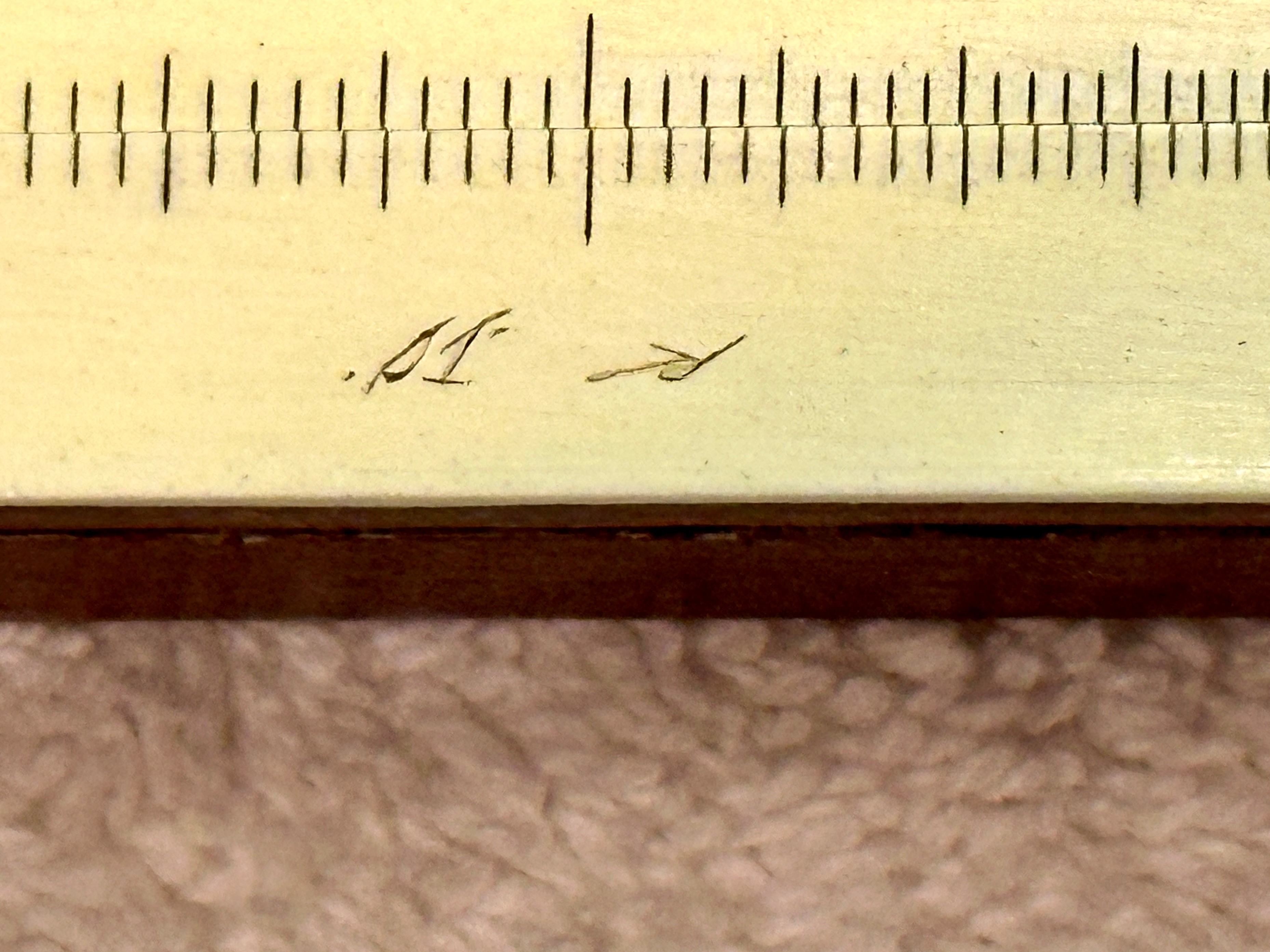
The K&E Model 4110 is a highly collectable specialized slide rule with a very interesting history, covered extensively in Jim Bready's JOS article 'Unsuccessful Successful Slide Rules' (Journal of the Oughtred Society Vol. 29, No. 1, Spring 2020, p. 38). The rule was designed by four math professors at the US Naval Academy in Annapolis, MD, in the early 1940's. Their goal was to create a new design, the 'Power Trig' scale layout that would speed up engineering and trigonometric calculations. The key goal was to increase speed in making calculations and this was achieved by making the C and D scale two decades long instead of the standard single decade. To also maintain a reasonable level of accuracy, rule scales were also lengthened. To maintain consistency, the A and B scales were increased to four decades. Issues such as 'going off the edge' of the rule and having to reset the slide were eliminated and there were also changes to the trigonometric scales which made them easier to use. The new layout successfully met the stated goals of speed and ease of use and was given the 4110 model number, but never offered in a catalog. These rules are quite scarce today as distribution was very limited. The condition of the rule is good with some very small marks at the bottom center of the face as highlighted in the photos and a name has been heavily etched into the back of the rule. The case has done a good job of protecting the rule and is in fair condition; the top flap has been reattached to the rest of the case and the front of the flap has lost about half of the black leatherette covering.
|
|
| 11 |
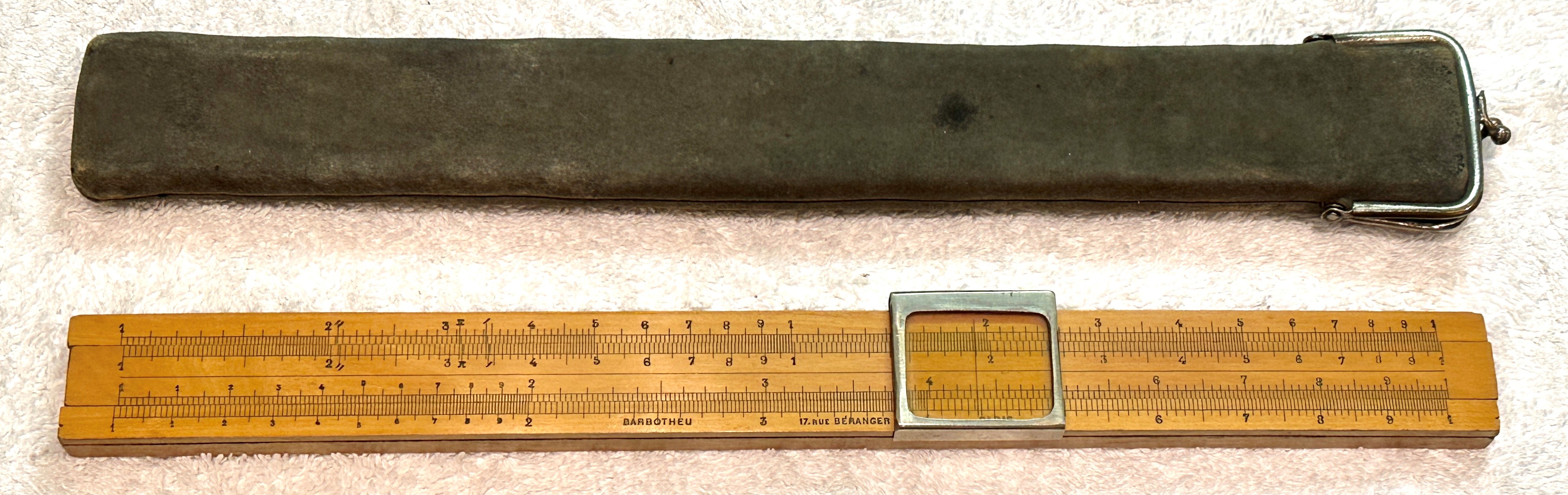
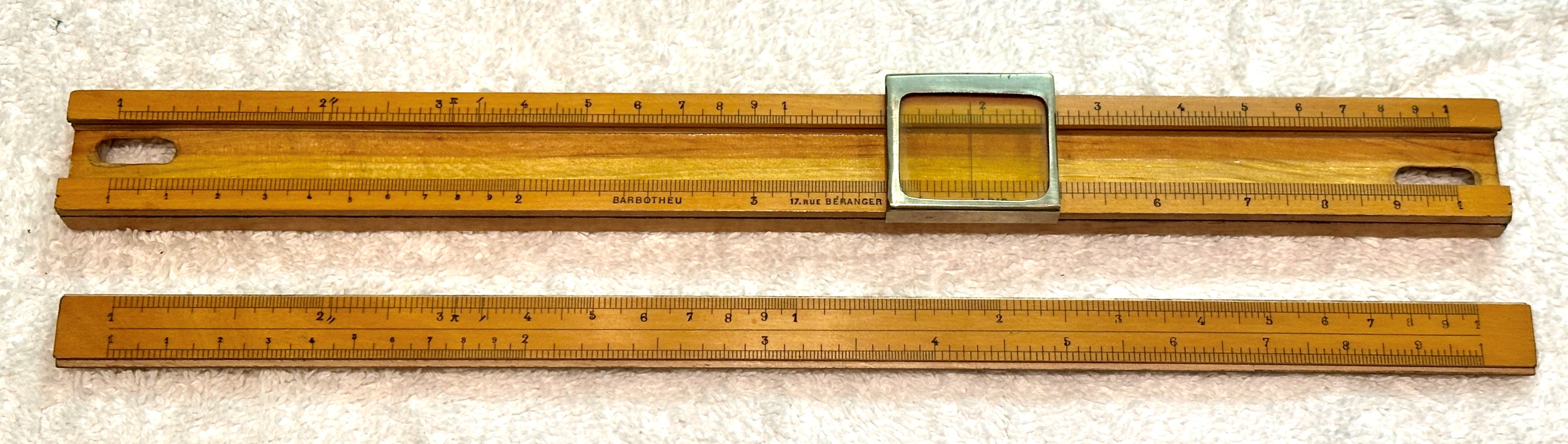
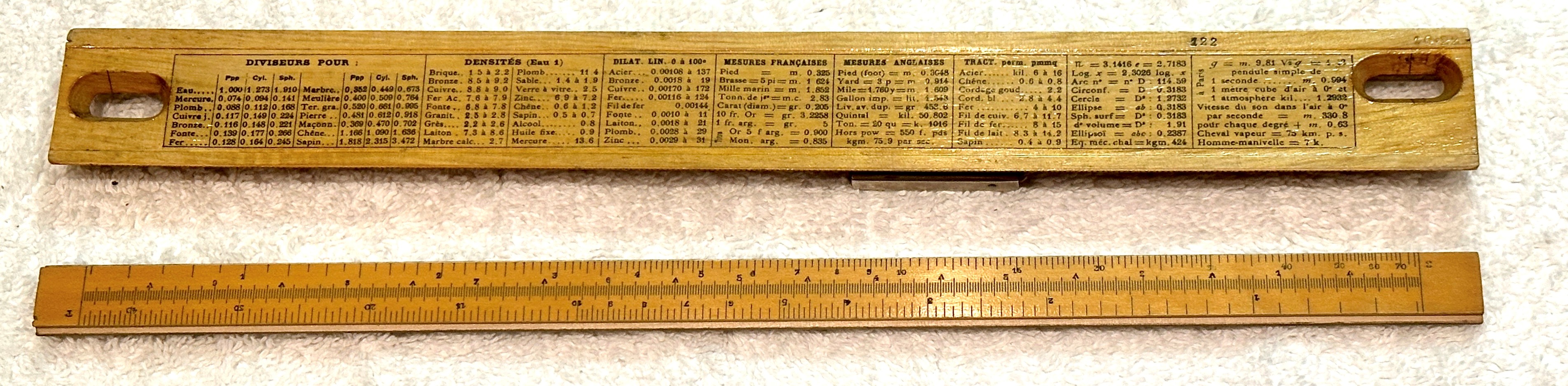
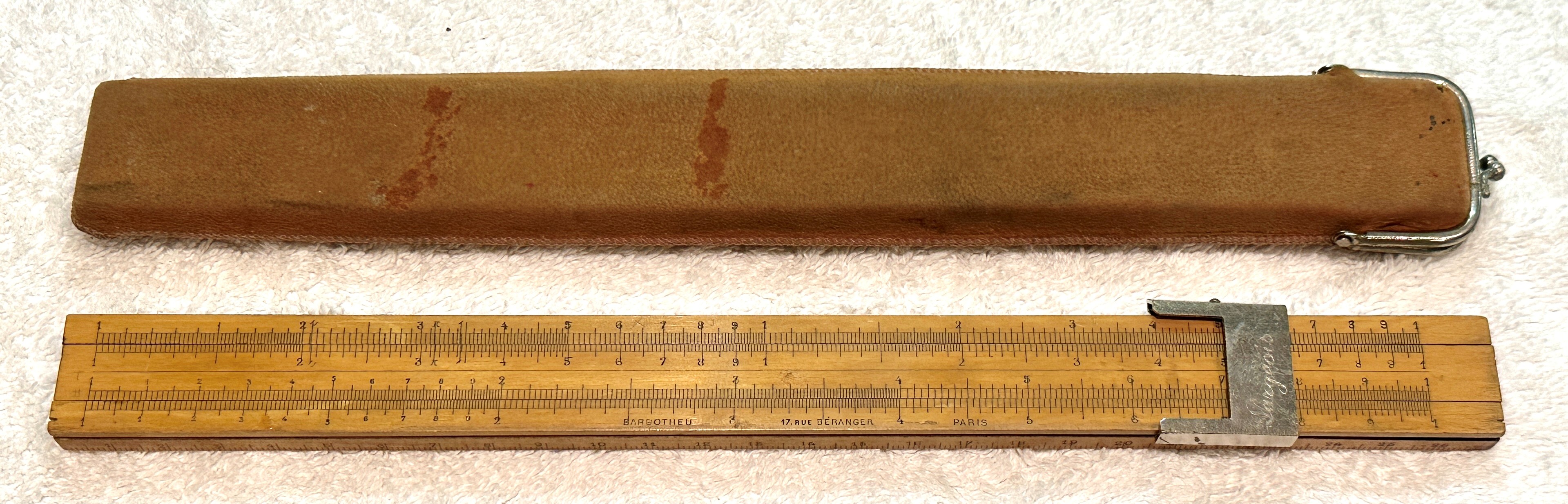
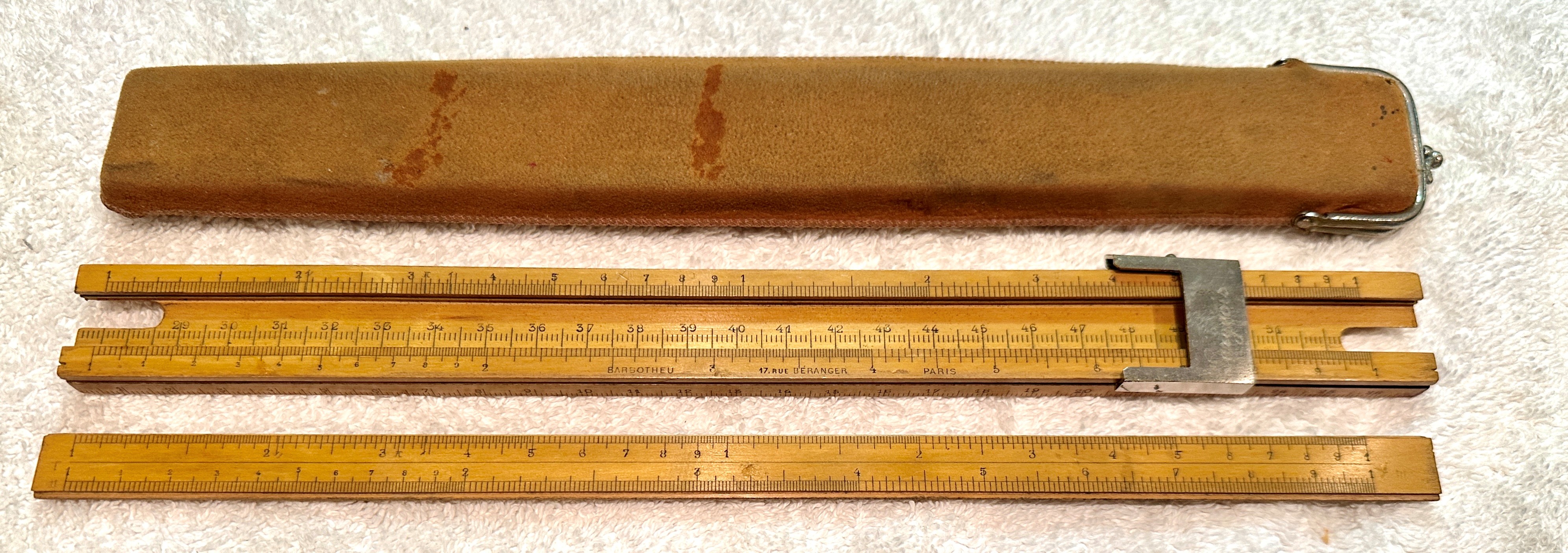
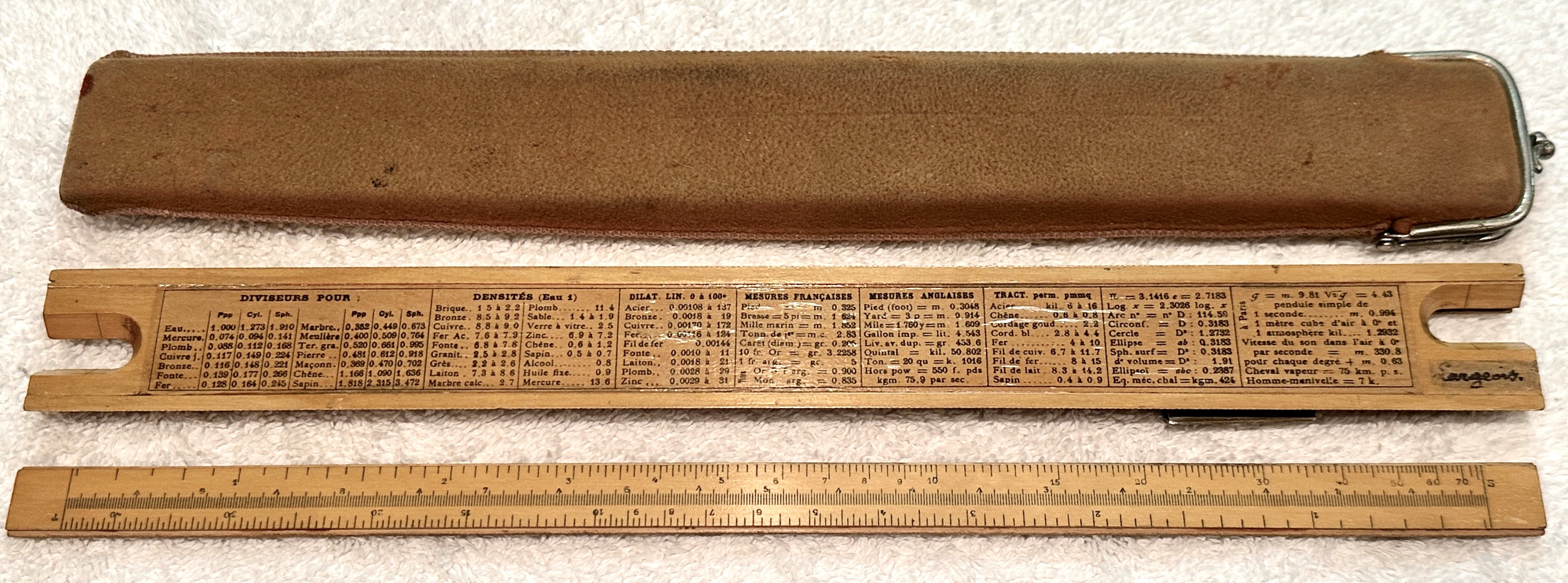
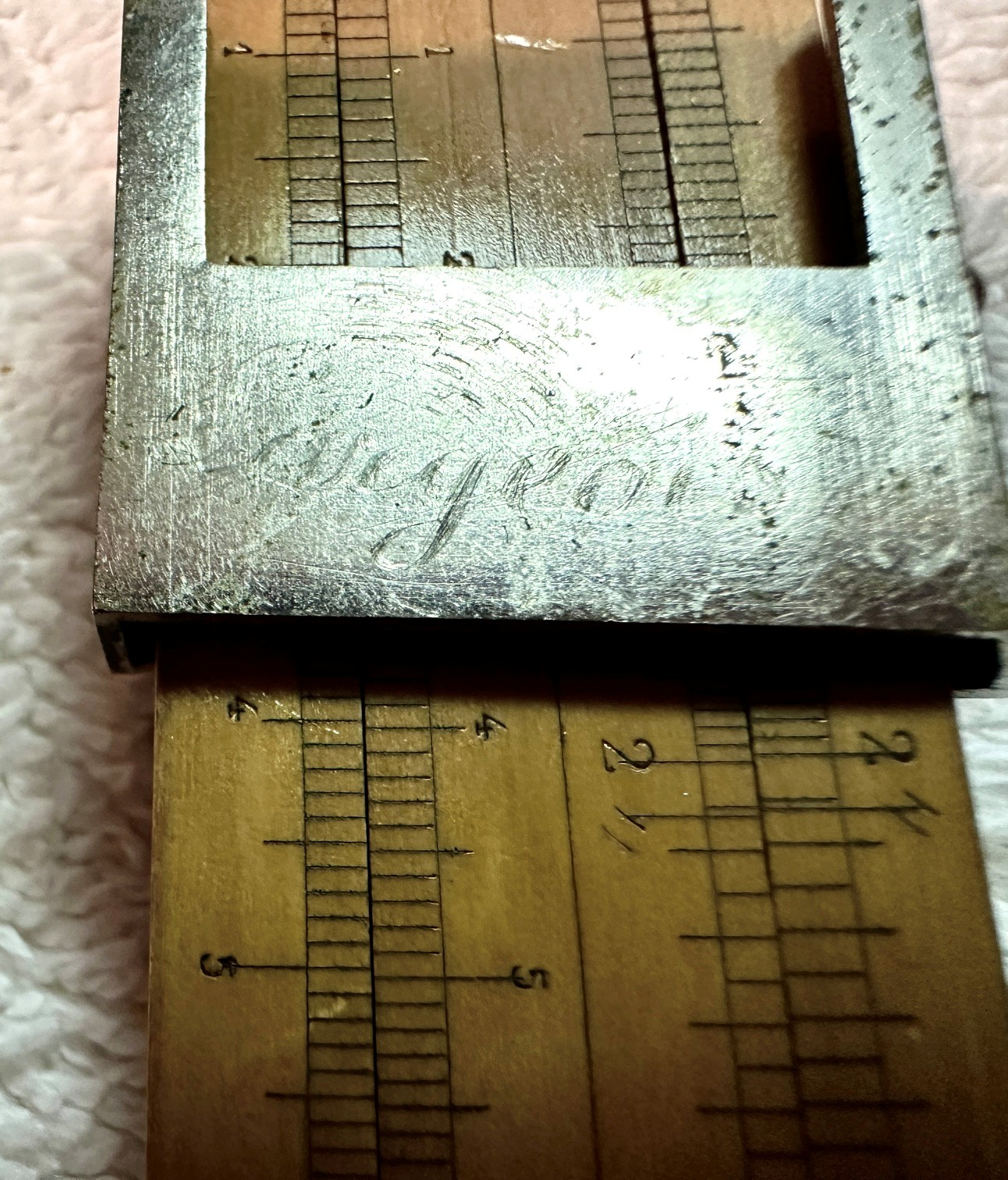
Boxwood 10-inch Mannheim slide rule by Barbotheu,
heavy metal framed cursor
Based on the address 17 Rue Beranger Paris address, this rule can be dated to the period 1893–1913. Georges Barbotheu founded his company in 1885 and it remained under his name until 1938; it was a direct competitor of Tavernier-Gravet during that period. Rule is in outstanding condition with the reverse paper table, which are often damaged on these French rules, in excellent condition. The unusual original case is also included, which is made of fabric with metal clips at the end to close the case securely.
|
|
| 12 |
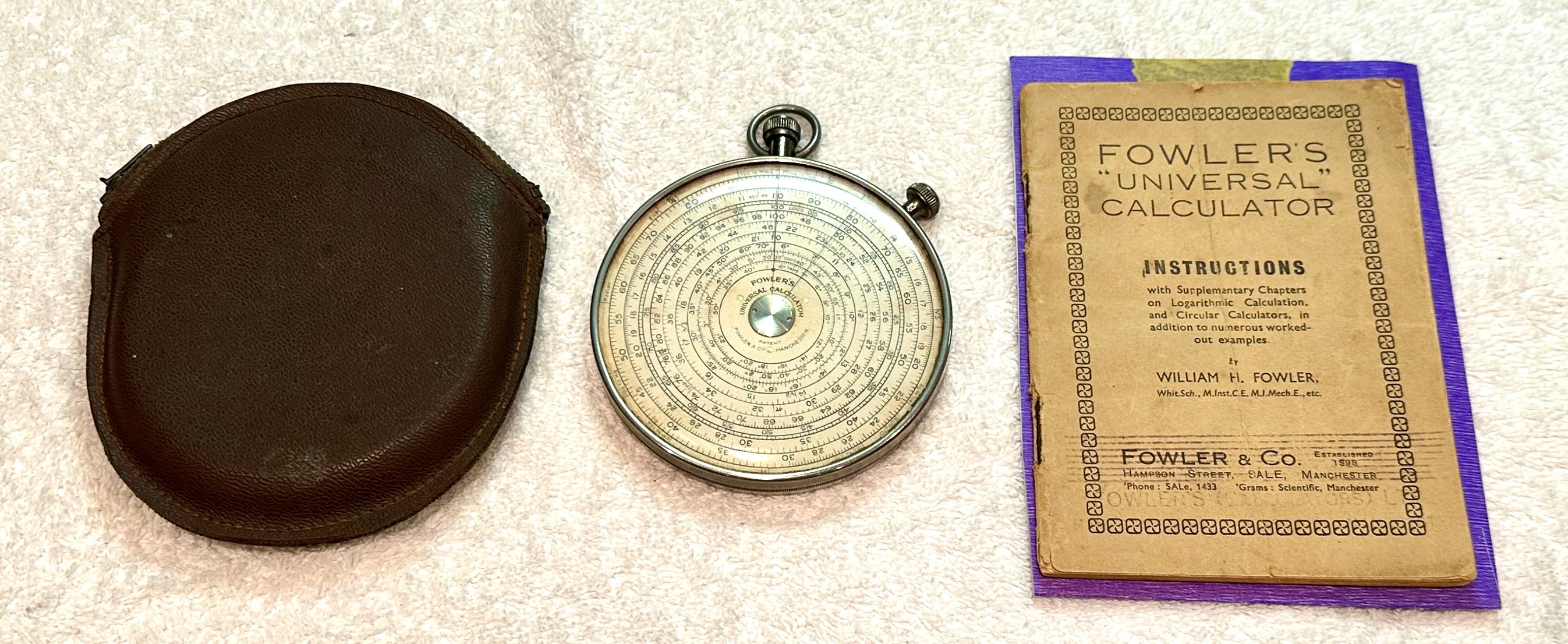
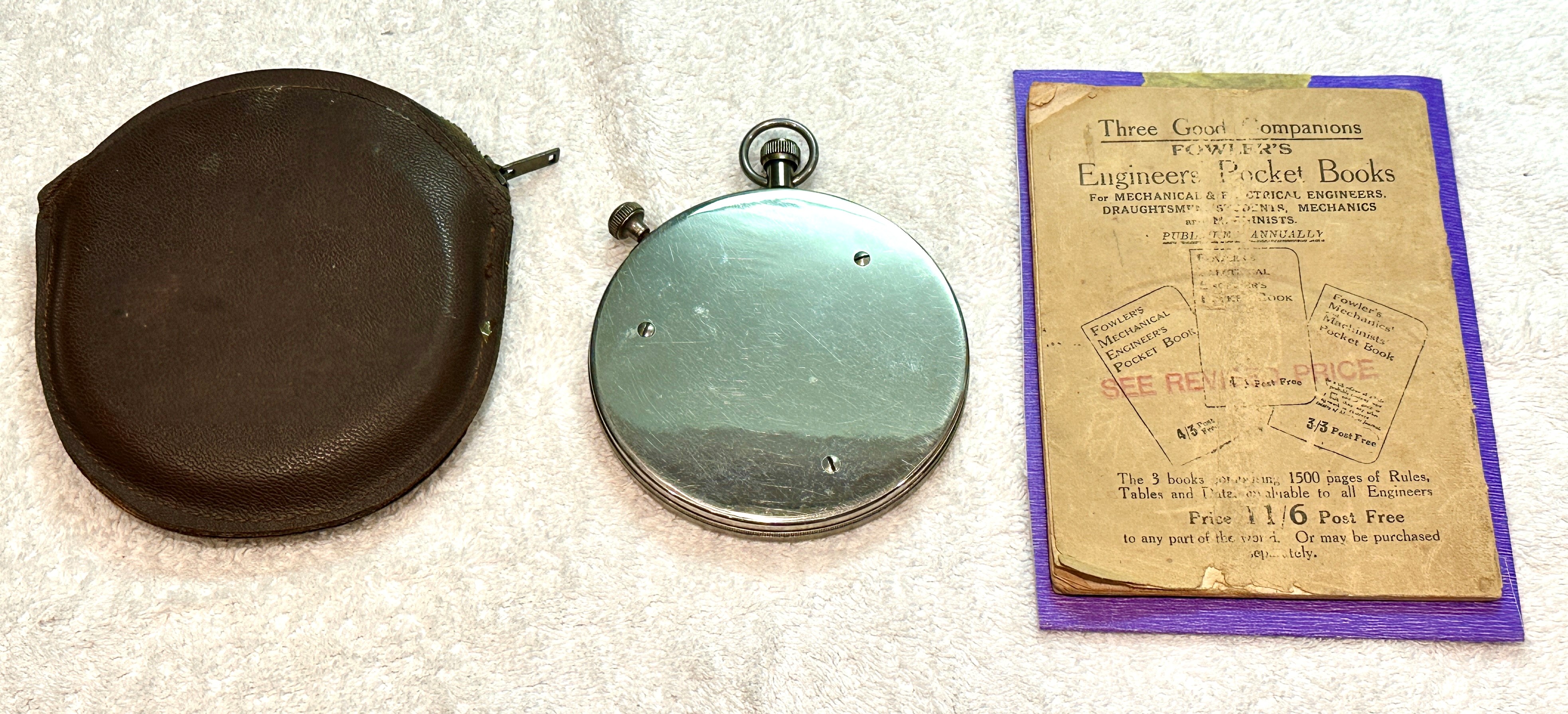
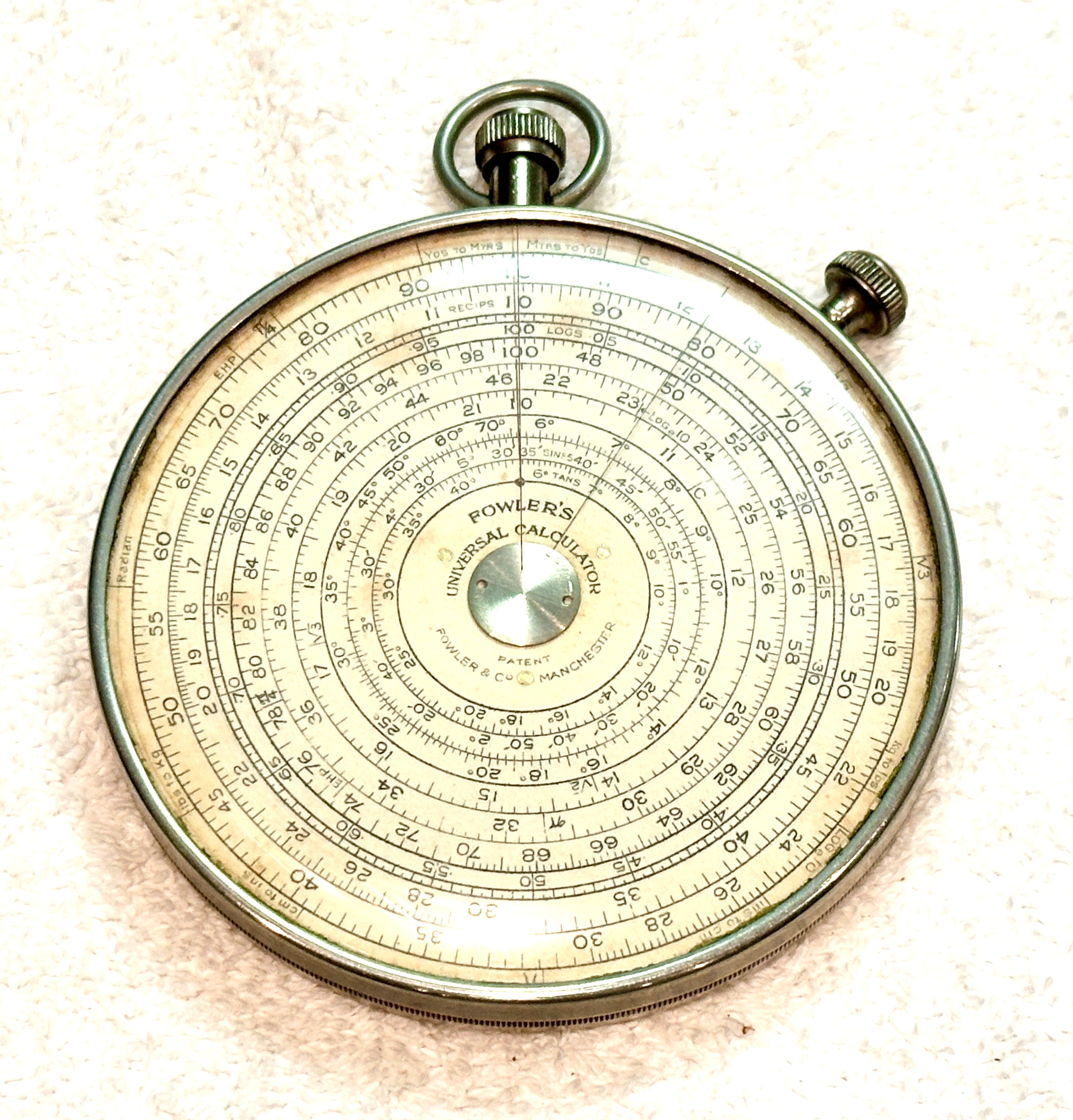
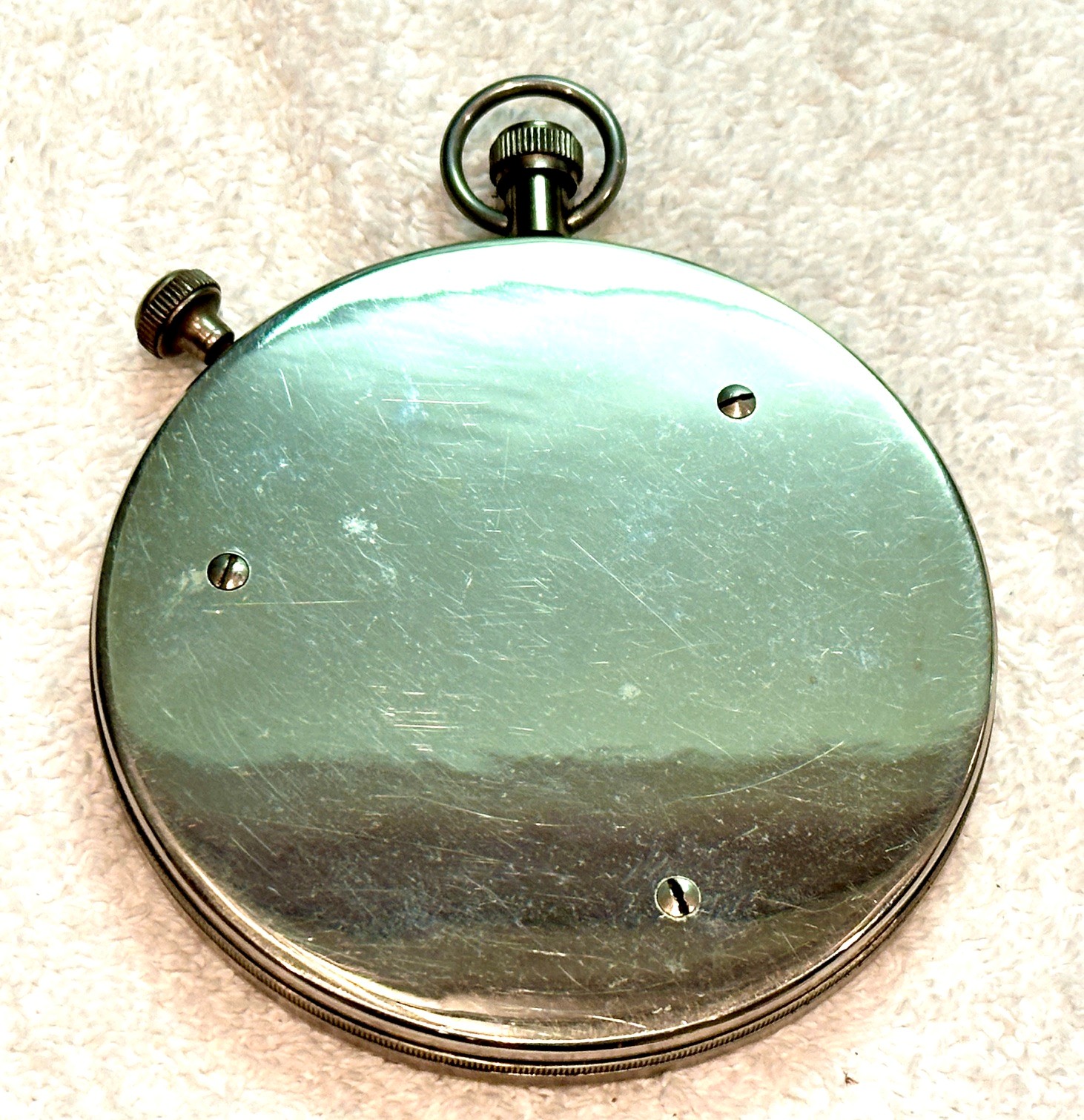
Fowler's Calculator, Universal Model with metal reverse,
in unusual zippered leather case with instruction booklet The Universal calculator is in excellent cosmetic condition with no issues to the glass face or the scales and the metal reverse still a perfect mirror chrome finish. The calculator works well with both the dial and the cursor rotating smoothly and easily in both directions. The leather case is also in excellent condition; it is original as I own an example like this one, but is very unusual in the way it closes with a zipper instead of the more traditional flap. The original 50-page instruction booklet shows some wear but is in good condition.
|
|
| 13 |
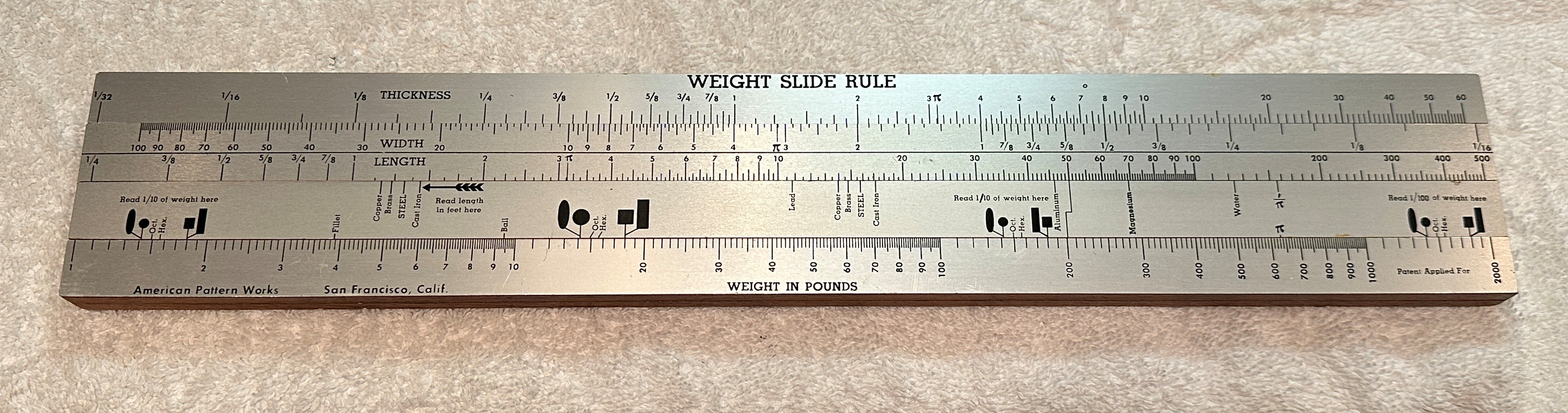
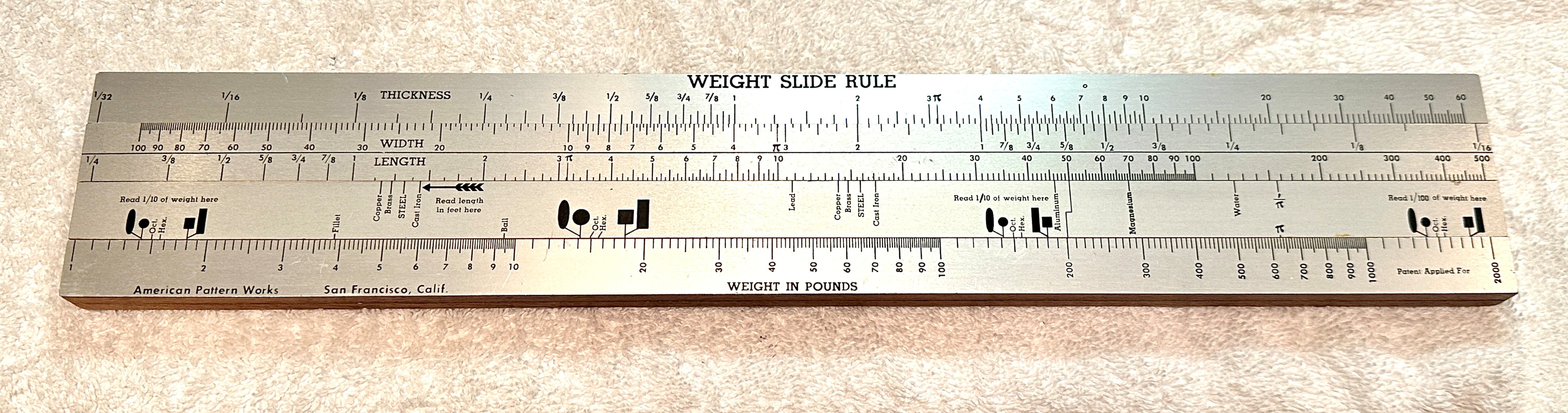
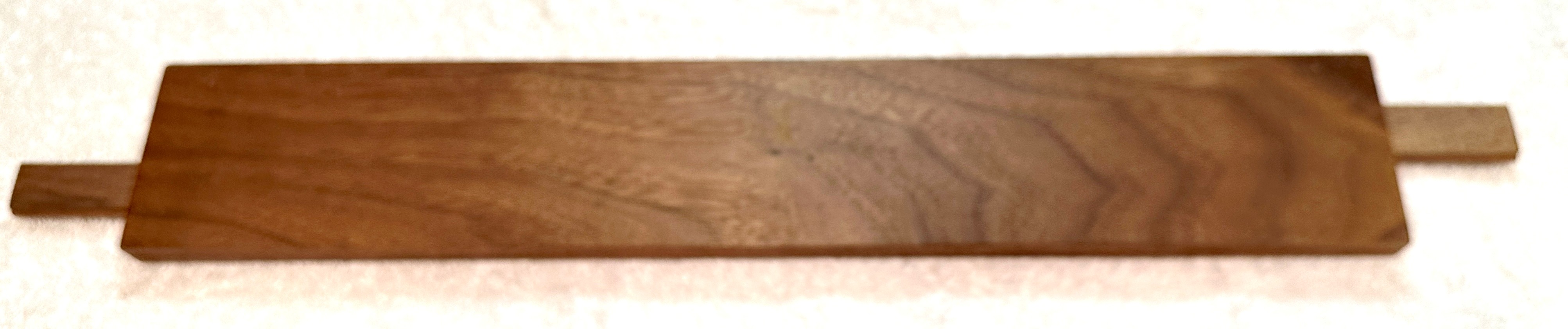
Aluminum on Wood Weight Slide Rule by American Pattern Works
This relatively large rule (15 by 2½ by ½ inch) is made of printed aluminum on a light-weight wood. Made by American Pattern Works of San Francisco CA, the Weight Slide Rule features scales labeled thickness, width, length and weight in pounds, and has gauge points for copper, brass, steel, and cast iron. This rule was used to predict the weight of different materials during the modeling phase, or pattern phase, of creating a metal part. By inputting the shape and dimensions of a piece, and specifying the metal, a user could quickly calculate the estimated total weight of the finished casting. The condition of this rule is excellent with the printed lettering clear and the metal face very reflective — an interesting rule to add to one's collection.
|
|
| 14 |
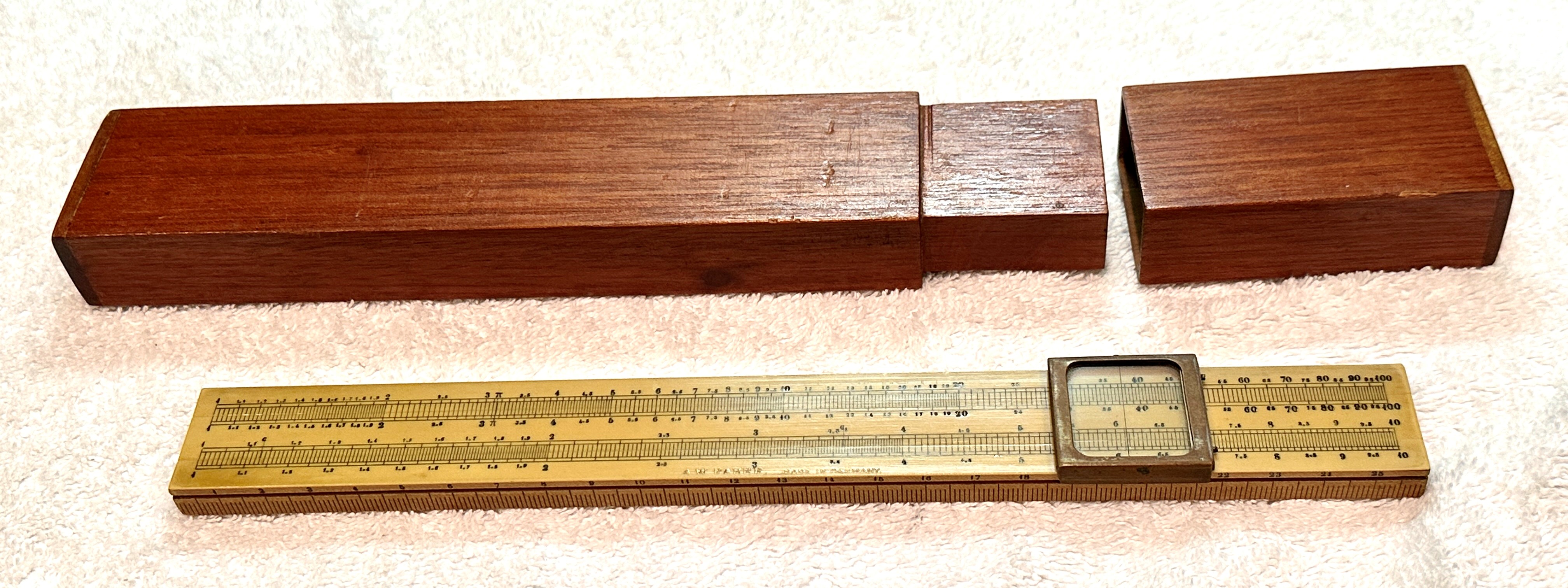
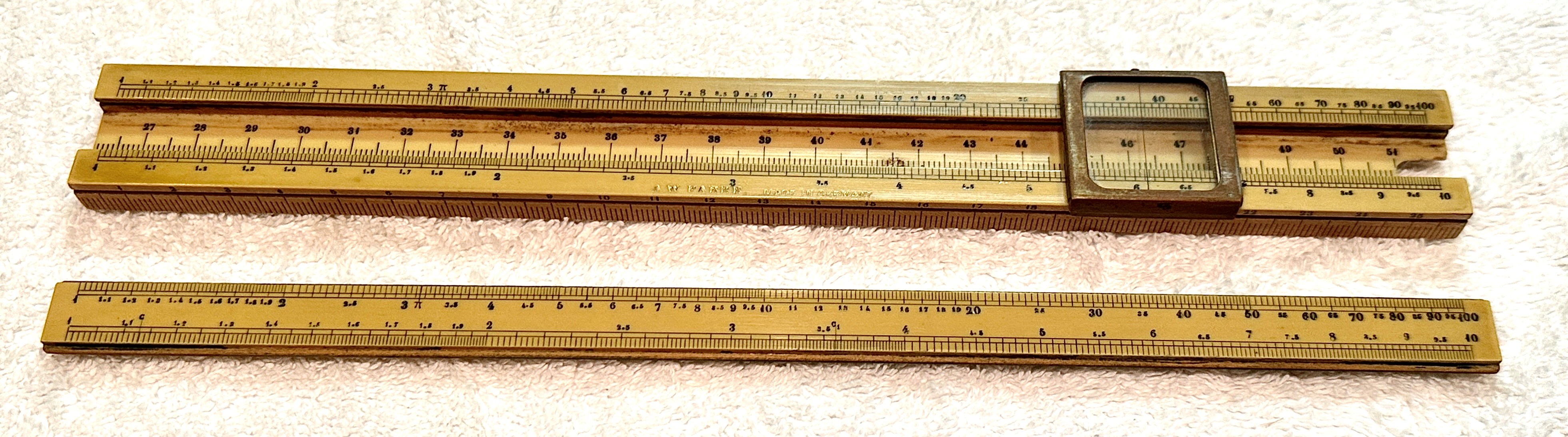
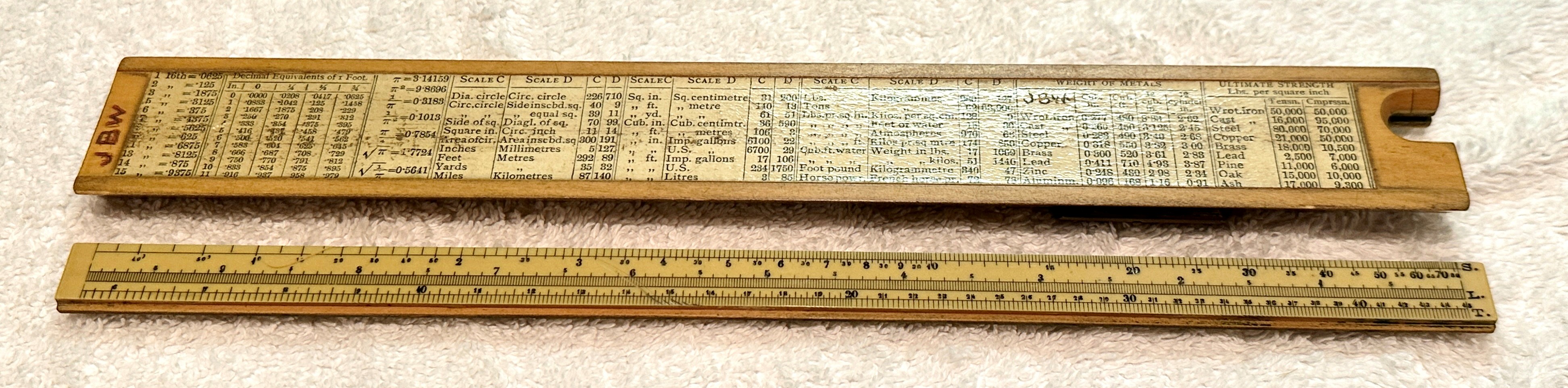
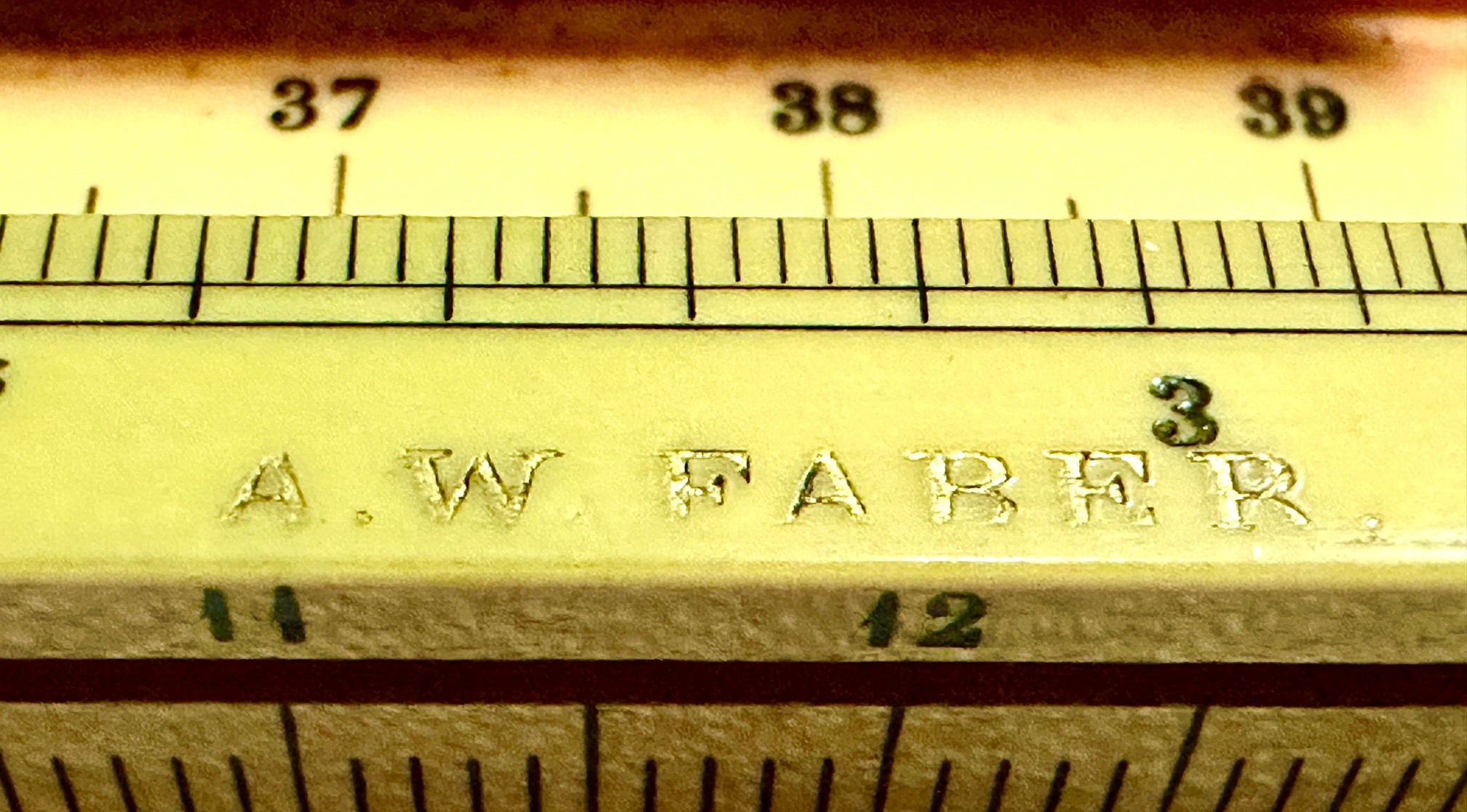
Celluloid on Boxwood 10-inch rule by A. W. Faber,
early model with unusual wooden two-piece case This rule is an early A. W. Faber Mannheim rule with printed tables on reverse. The celluloid and boxwood are in excellent condition. The heavy metal framed cursor shows some oxidation with several areas where the brass is starting to show through the original chrome plating. The initials JBW are written on the back end of the rule. The rule comes with a very well-made two-piece wooden case that is not labeled with any name and may not be original. A. W. Faber (today Faber-Castell) is one of the world's oldest continuously operating pencil and stationery manufacturers. It was founded in 1761 in Stein, near Nuremberg (Nürnberg), Germany and has been under family control for eight generations.
|
|
| 15 |
Celluloid on mahogany 10-inch loglog duplex rule
by Relay Model 150, Made in Japan. The rule, made of celluloid on bamboo, features all of the scales one would expect on a high-quality loglog slide rule. The rule endpieces show some signs of light oxidation and the cursor spring needs to be tightened against rule so it stays firmly in place. Rule is marked Relay Model 150 and the cursor also shows the Relay name. It comes with a tan leather case marked Lafayette Japan.
|
|
| 16 |
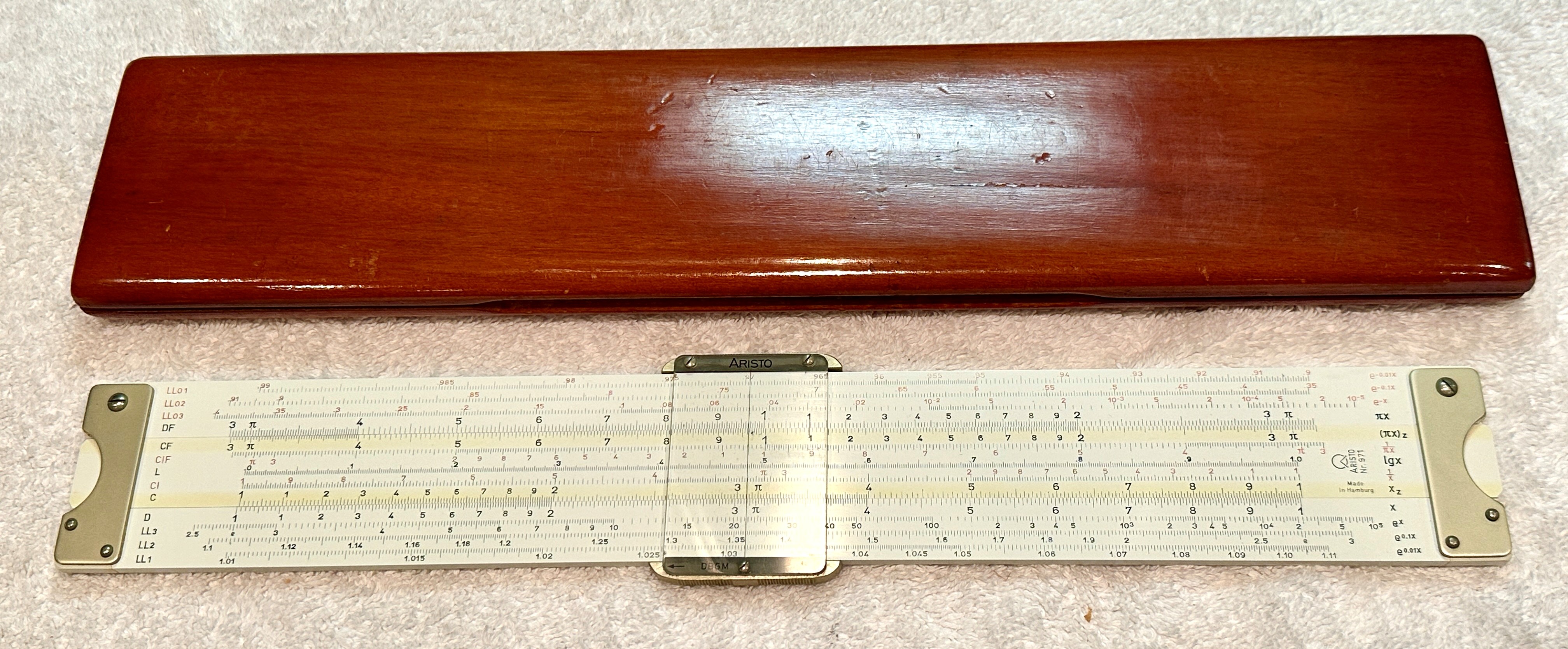
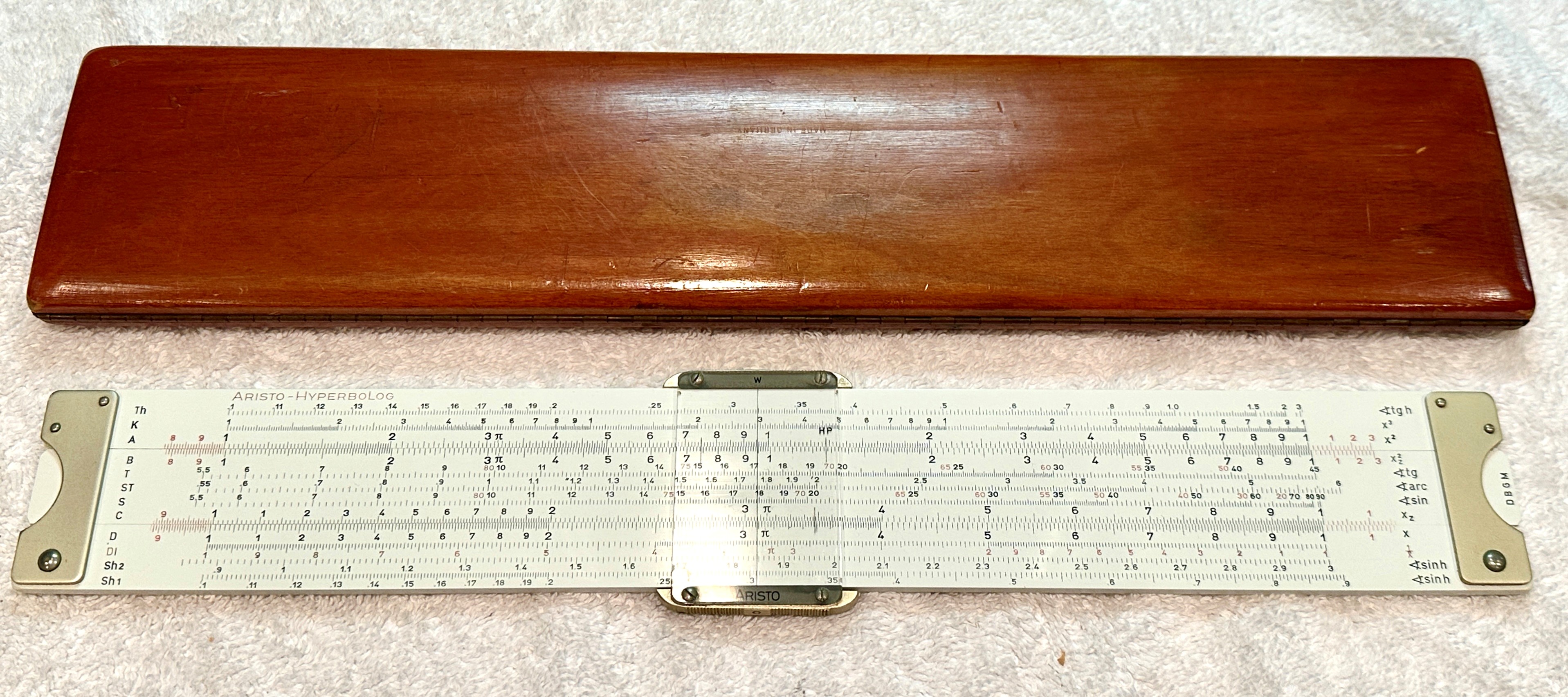
Aristo 971 Hyperbolog, loglog duplex slide rule
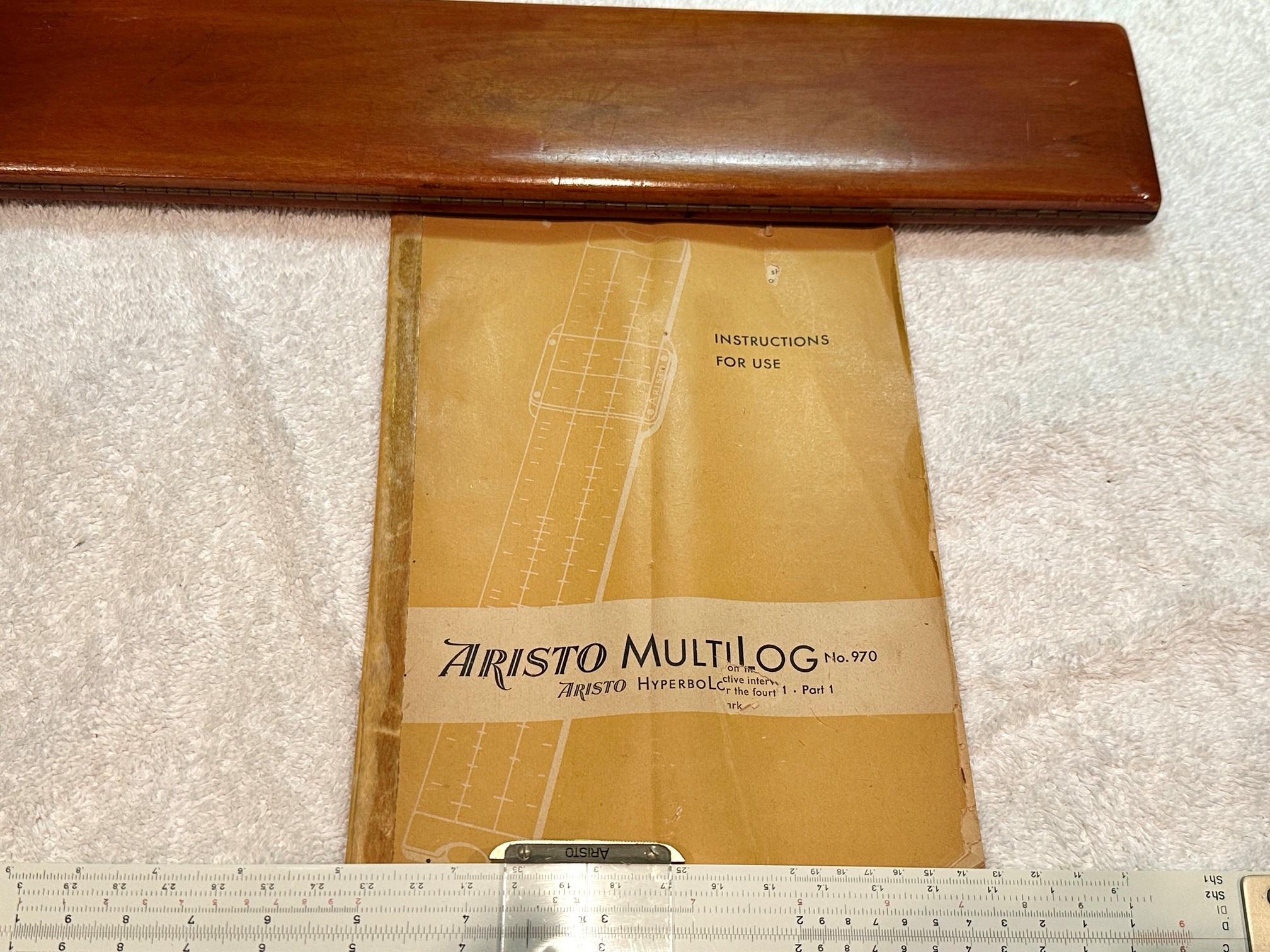
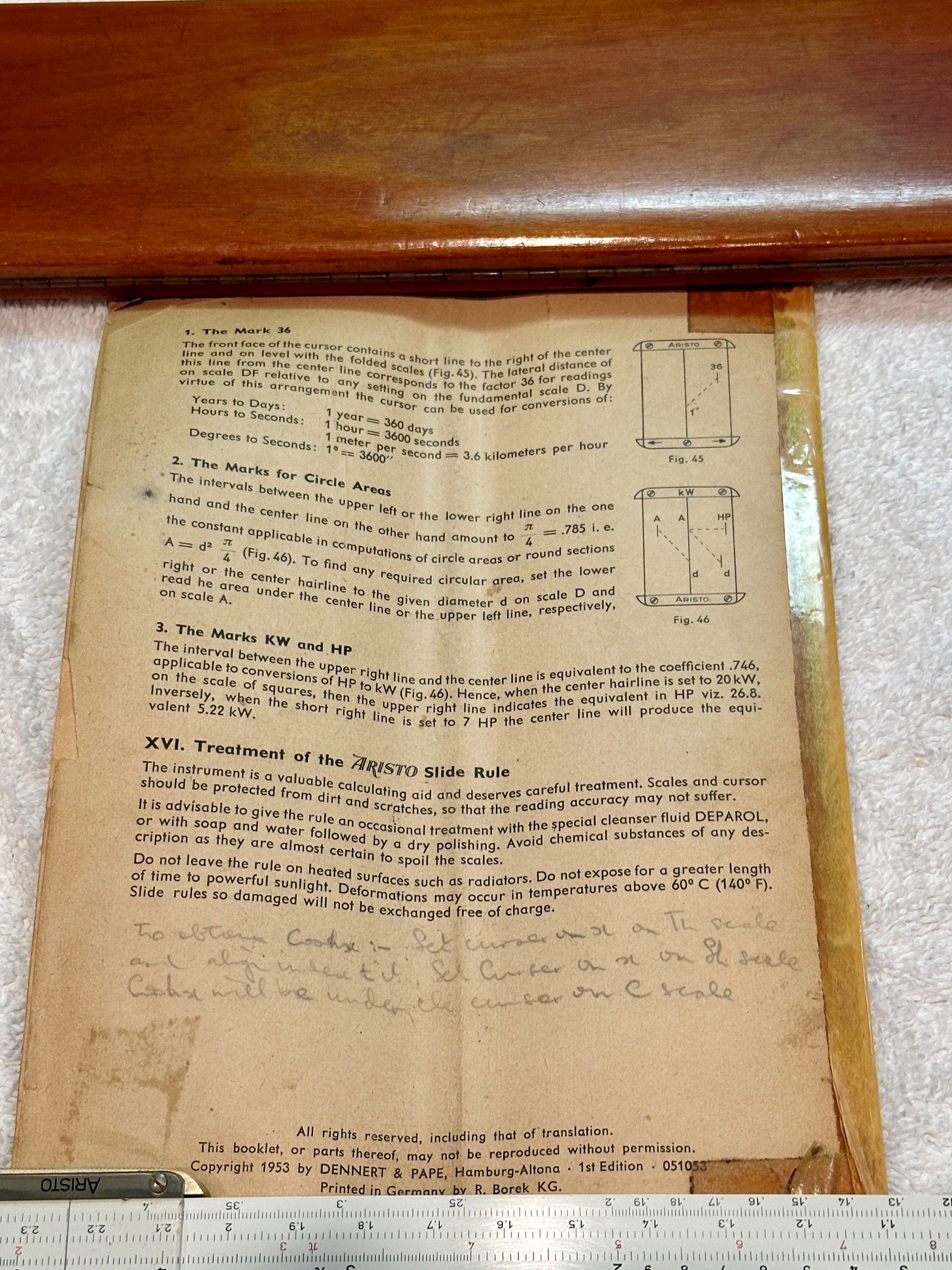
with additional scales for hyperbolic sines and tangents This plastic slide rule is in near new condition and contains all of the standard and loglog scales found on a high-quality loglog slide rule. In addition, this rule features scales labeled Sh1 and Sh2 for calculating hyperbolic sines and Th for hyperbolic tangents. The rule comes in a fitted, hinged polished wooden case that is original since it has a slot for fitting the cursor. Also included is an English language Aristo 970 Multilog instruction manual with Hyperbolog section, that has been taped at the spine and missing the back paper cover and is in fair condition.
|
|
| 17 |
Boxwood 10-inch Mannheim slide rule by Barbotheu,
17 Rue Beranger Paris. with inverse C-shaped metal cursor Georges Barbotheu founded his company in 1885 and it remained under his name until 1938. The address on this rule dates it to the period 1893-1913. The rule is in outstanding condition with the reverse paper table, which are often damaged on these French rules, also in excellent condition. The glass from the inverse C-shaped cursor is missing and needs to be replaced. There are some very small marks on the rule in the right margin of the slide as shown in the final picture. Once again, as in Item 11, the same unusual original case is included, made of fabric with metal clips at the end.
|
|
| 18 |
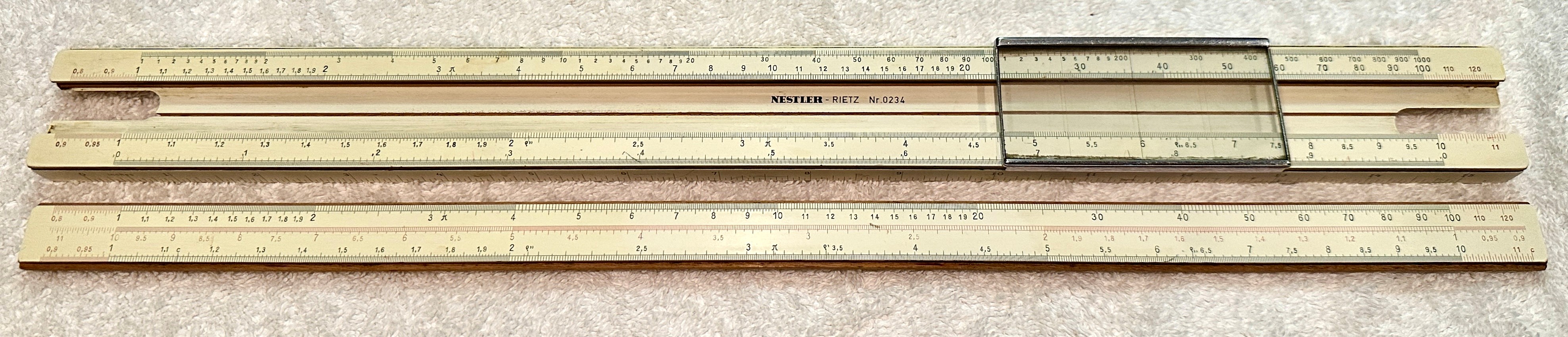
Nestler Rietz, Model Nr. 0234,
16-inch celluloid on mahogany slide rule
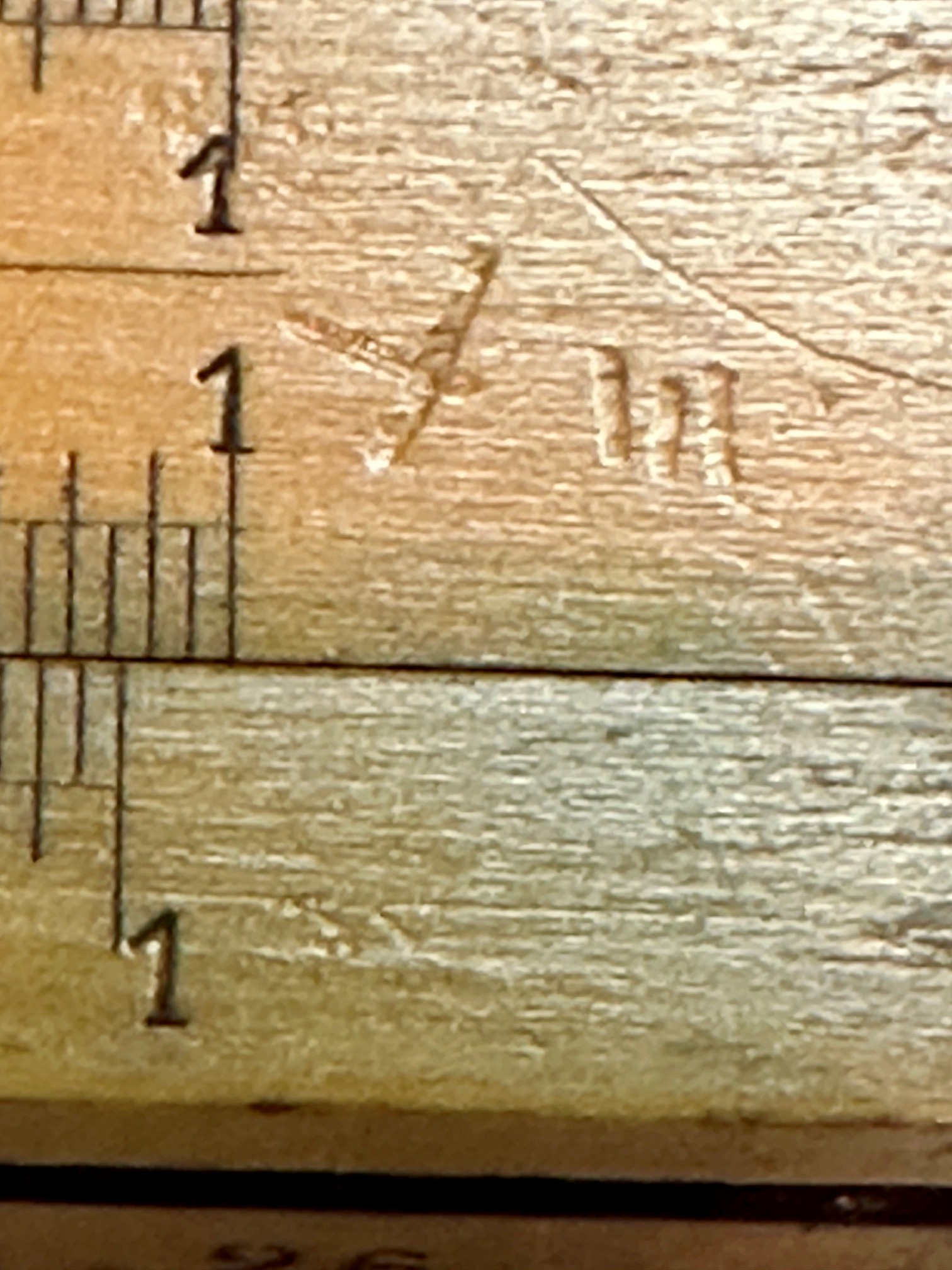
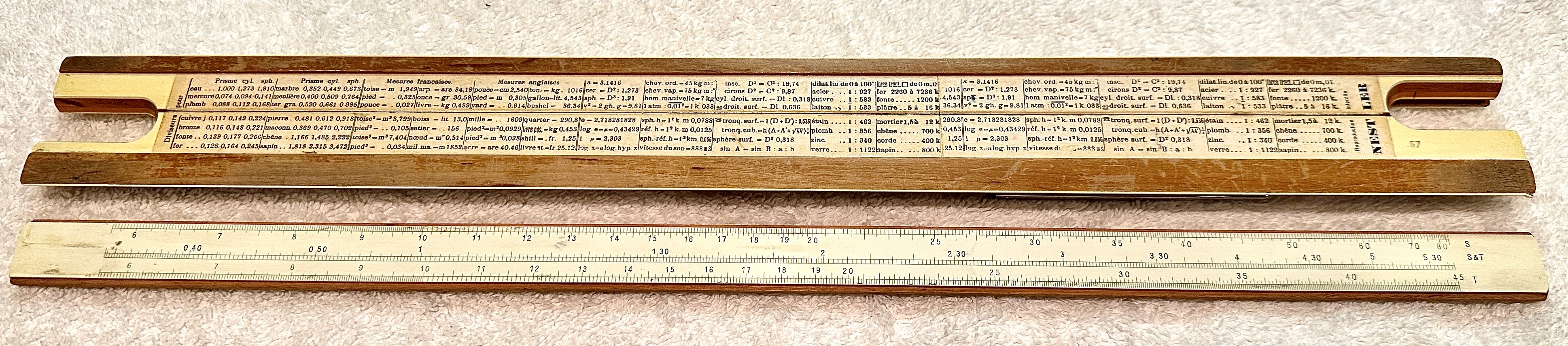
This 16 inch celluloid on mahogany Mannheim slide rule is finely divided features all of the standard Mannheim scales and a wide metal-framed cursor with three hairlines. The rule is in very good condition noting; it would be in excellent condition if it were not for a corner bump to the upper-most scale on the upper right corner of the beveled rule edge which has bruised the wood and celluloid with no impact to the cm scale. Reverse paper table in very good condition.
|
|
| 19 |
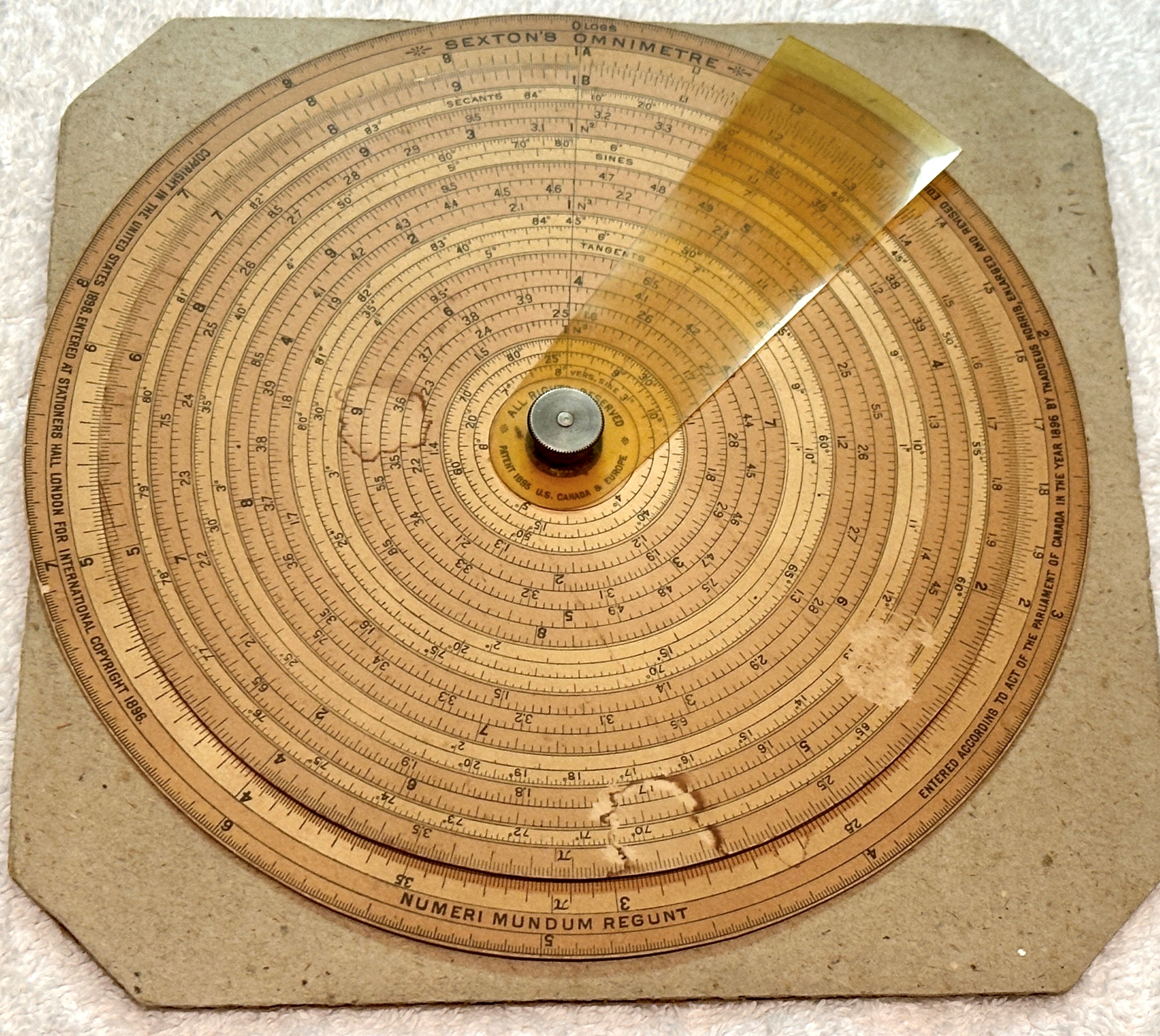
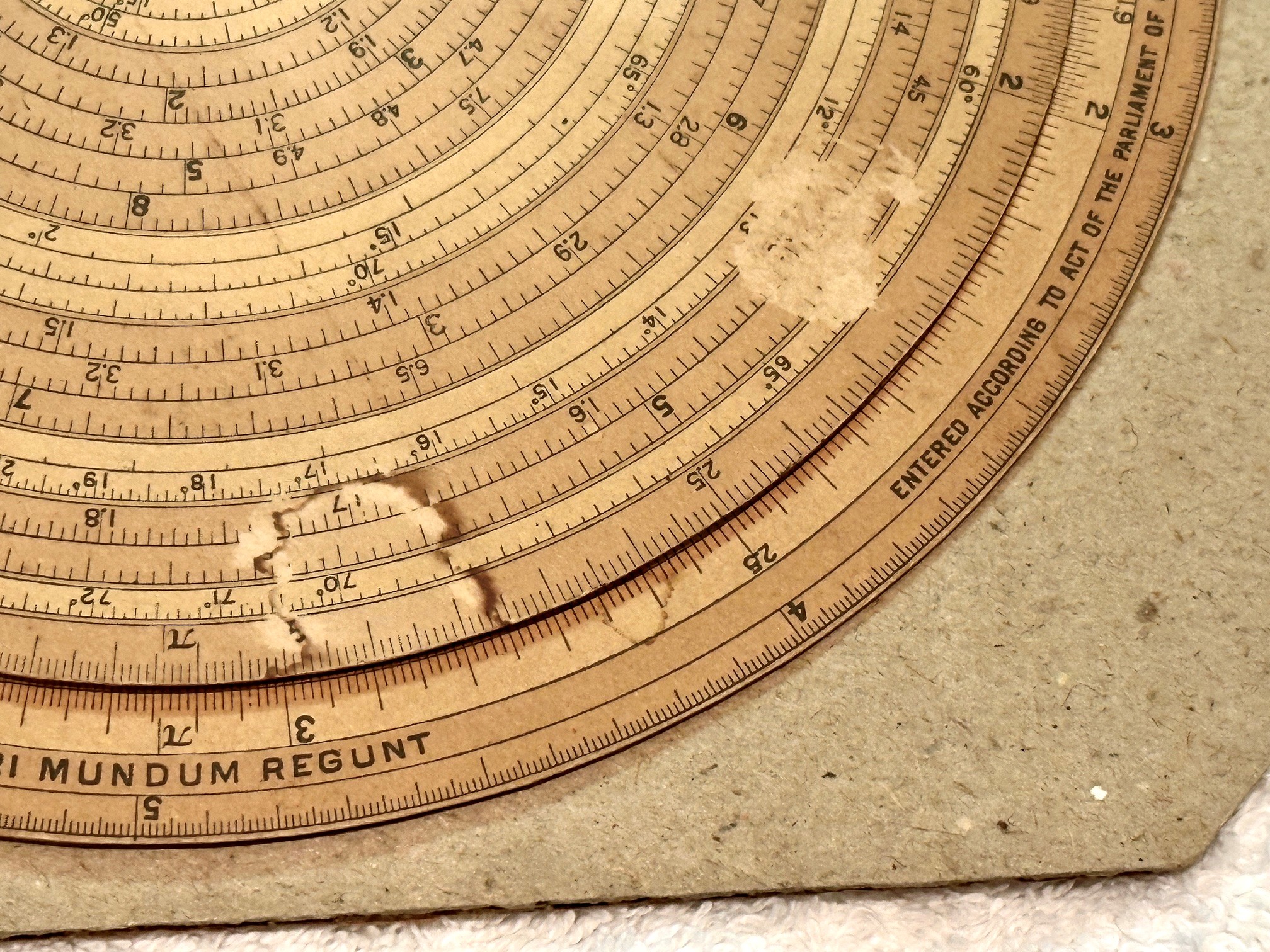
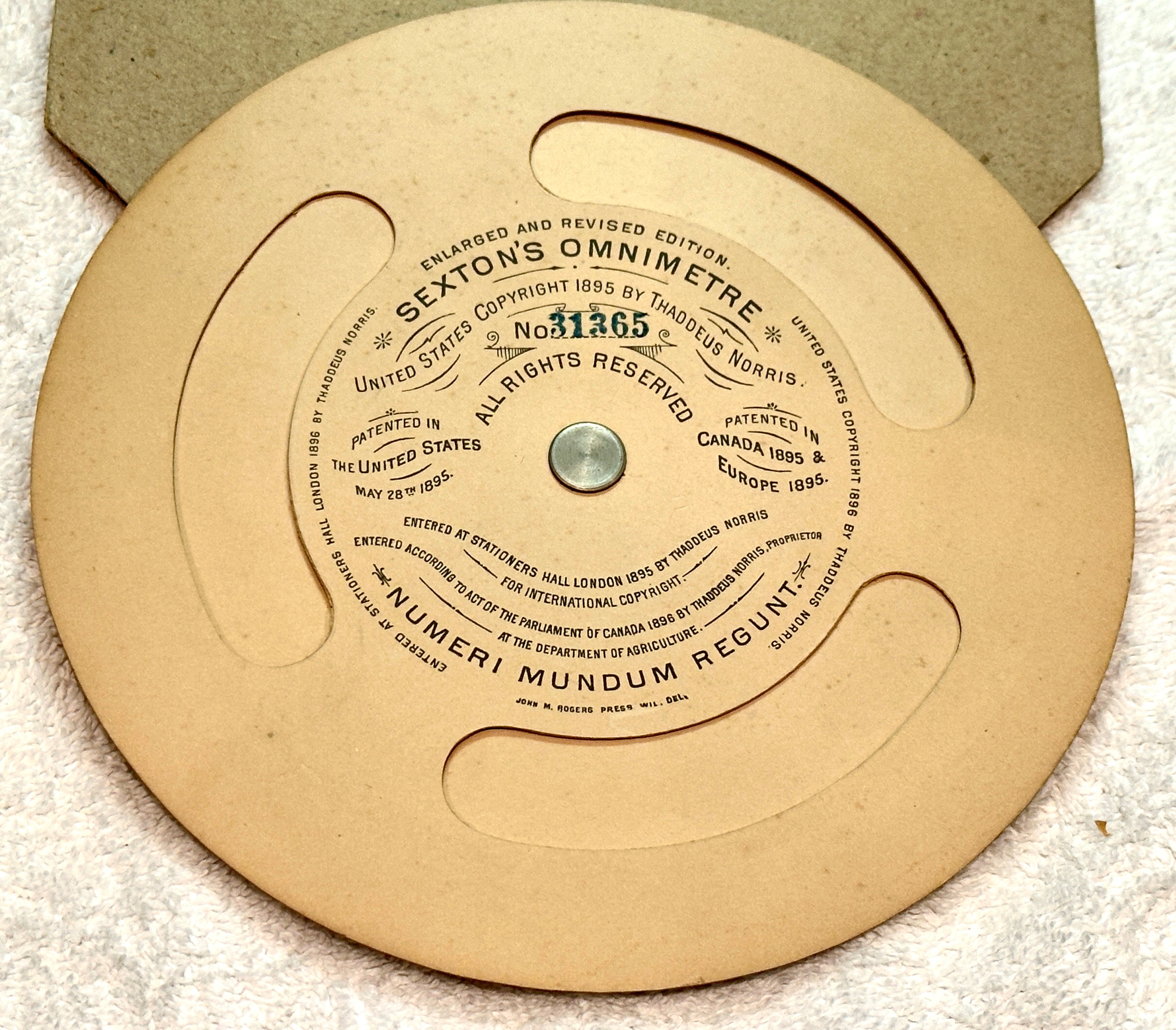
Sexton's Omnimetre Paper Card circular slide rule,
No 31365, marked US patent May 28 1895 by Thaddeus Morris This cardboard circular slide rule is 7 inches in diameter and contains 9 scales, many of them folded between 2 and 5 times for a total of 21 circular scales on the face of the rule. The scales include A and B scales on the outer edge (19 inch, or 48 cm, effective length), an L scale, scales for squares, cubes, and fifth powers, sines, tangents, secants, and versed sines (1 - sin x) and was manufactured by Theodore Alteneder & Sons. The logo on the reverse "Numeri Mundum Regunt" translateas from Latin as "Numbers Rule the World." Three areas on this example indicate some staining from possible moisture damage with one area (½ × ⅜ inch) where the scales and numbers have been washed out. This slide rule was invented by Philadelphia mechanical engineer Albert Sexton as a compact and inexpensive device designed for a wide range of mathematical and engineering calculations.
|
|
| 20 |
Two-side, two-slide 9-inch boxwood excise rule
with standard scales
for Proof, Seg St, Seg Ly, IMG gauge point, post-1824 A nine inch example of the two-side two-slide excise rule that was used from the late 18th to the late 19th century for calculating the taxes on alcohol and also on the manufacture of alcoholic beverages such as ale and wine. As noted in Item 01 of this list, this type of rule was a standard in the trade with scales for measuring barrels that were standing on end (Segment Standing) or lying on their side (Segment Lying). Additional scales include those that are used to gauge the tax of beverages with different concentrations (proof) of alcohol. This example also includes the gauge points IMG and IMB indicating it was manufactured after 1824.
|
|
| 21 |
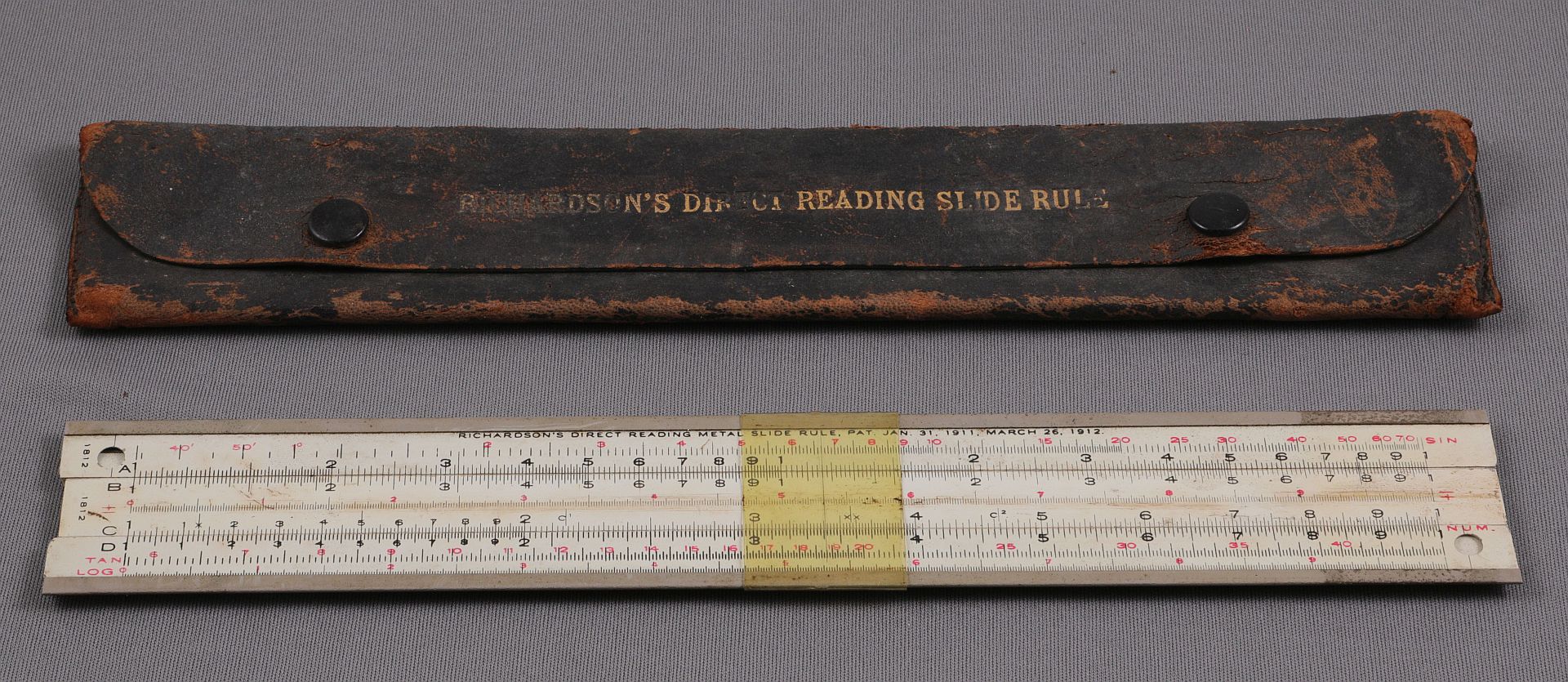
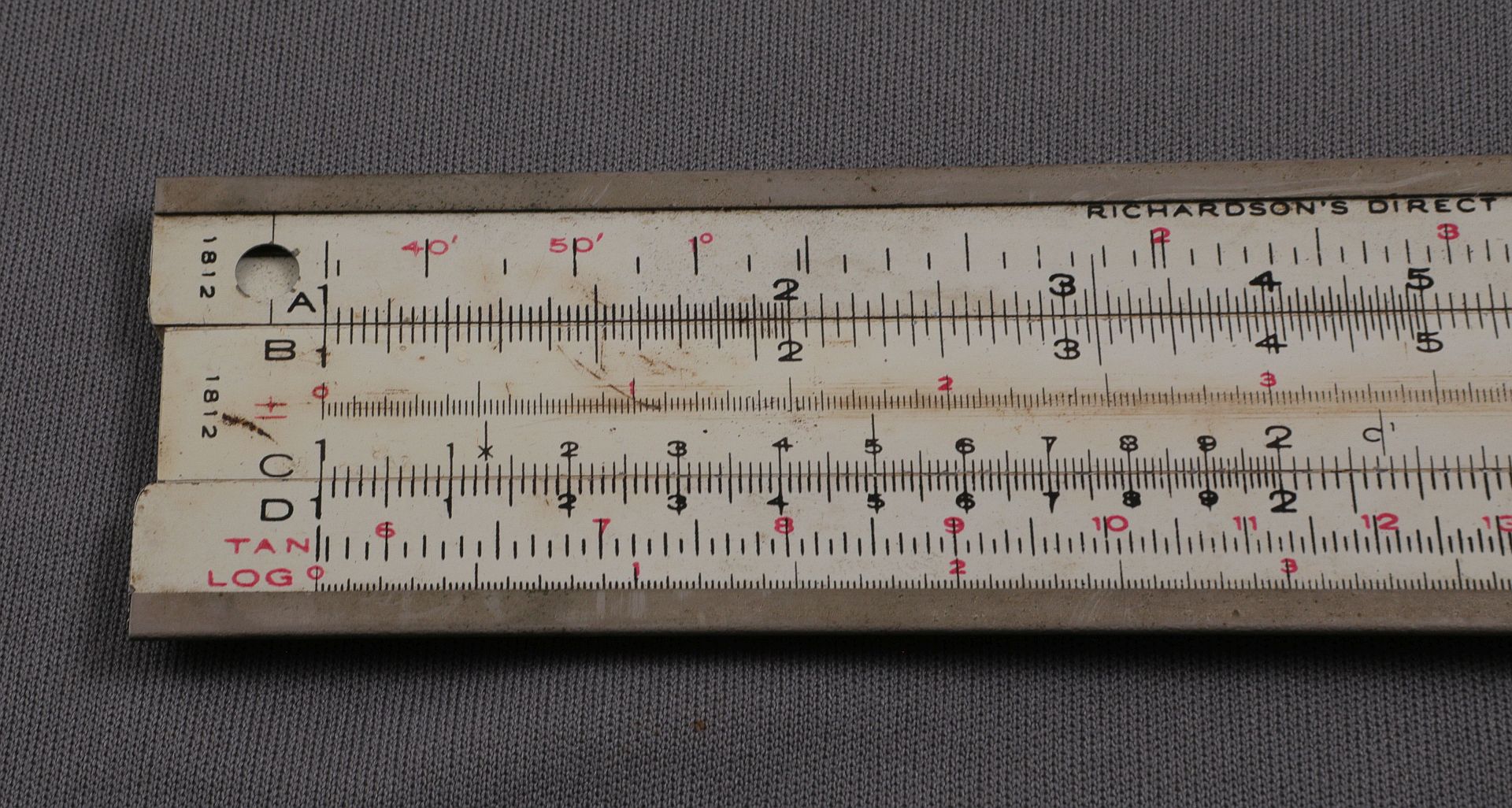
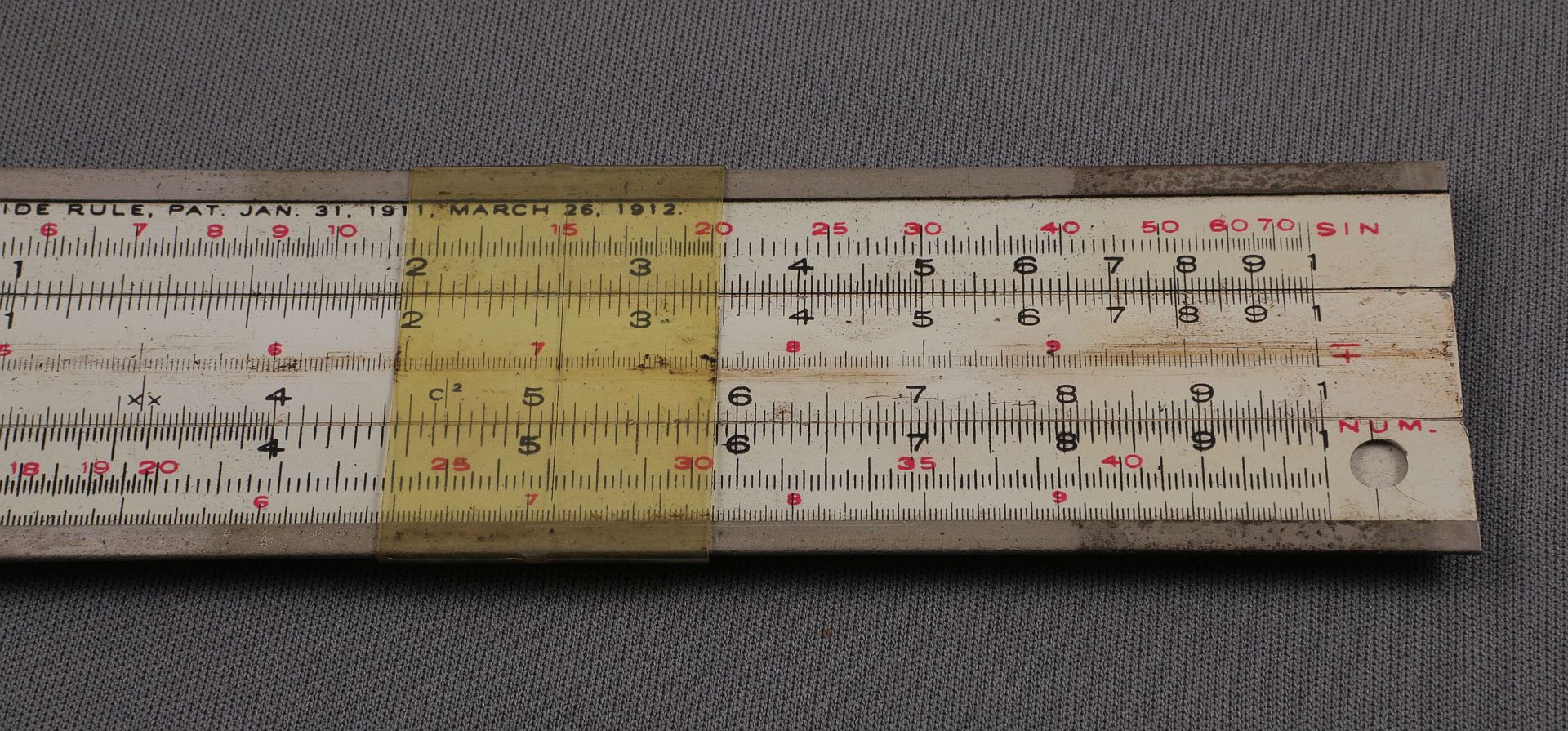
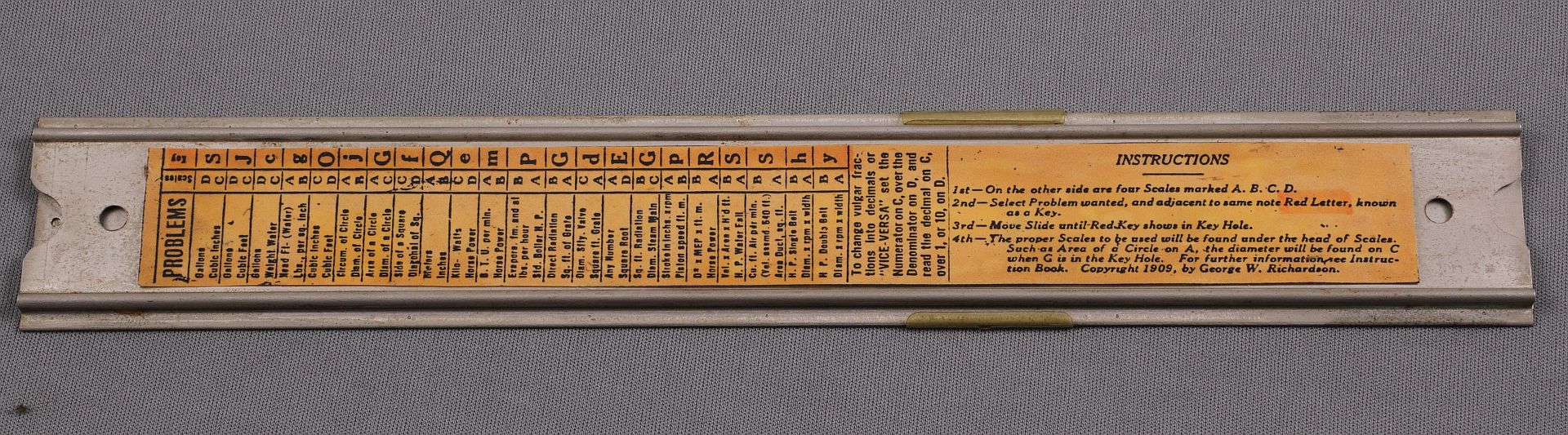
Richardson model 1812 slide rule with leather case
The Richardson model 1812 is a Mannheim slide rule constructed of stamped steel. Richardson referred to the 1812 as the "add and subtract" slide rule. This could possibly be because of the +/- scale down the middle of the slide, which in conjunction with the L scale could be used for adding and subtraction. This example is a bit dirty and has a few scratches, but is in very good condition overall. The 2-snap leather case is included.
|
|
| 22 |
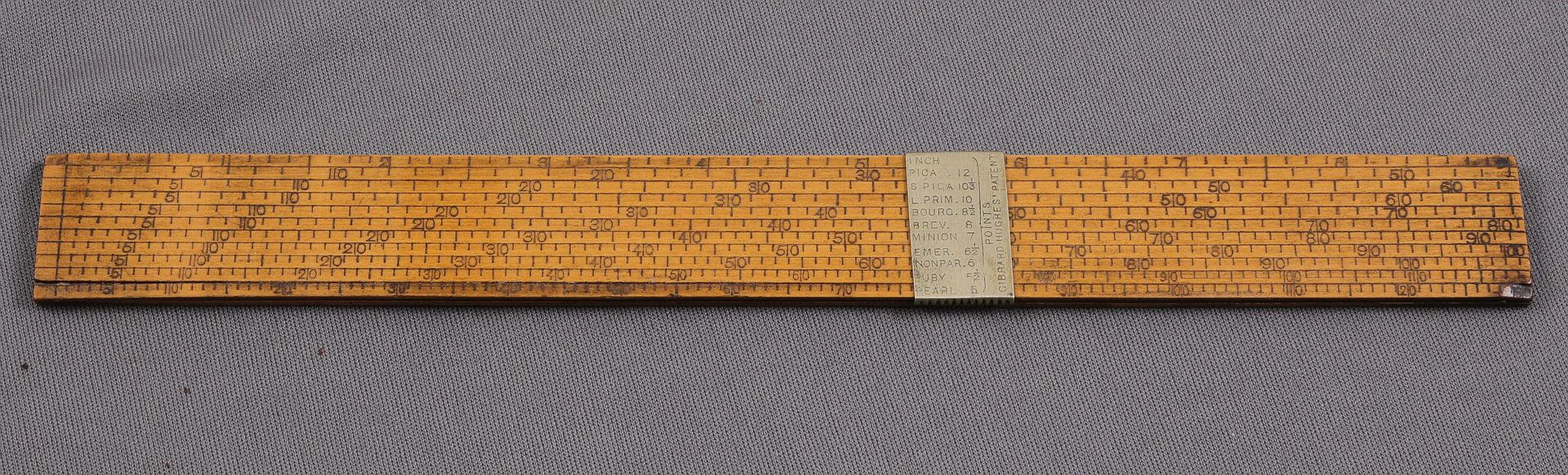
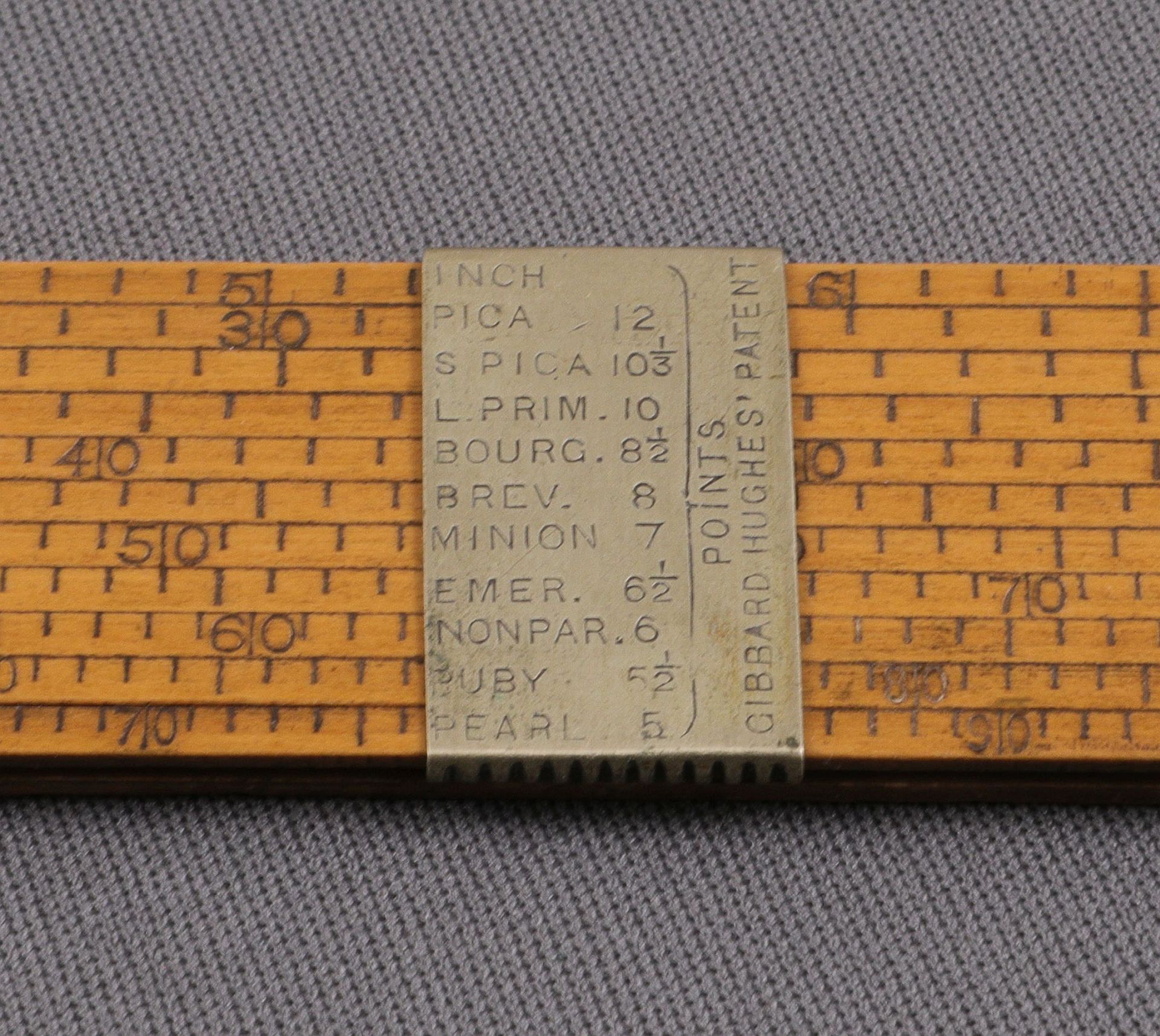
Type composing ruler, Gibbard Hughes Patent
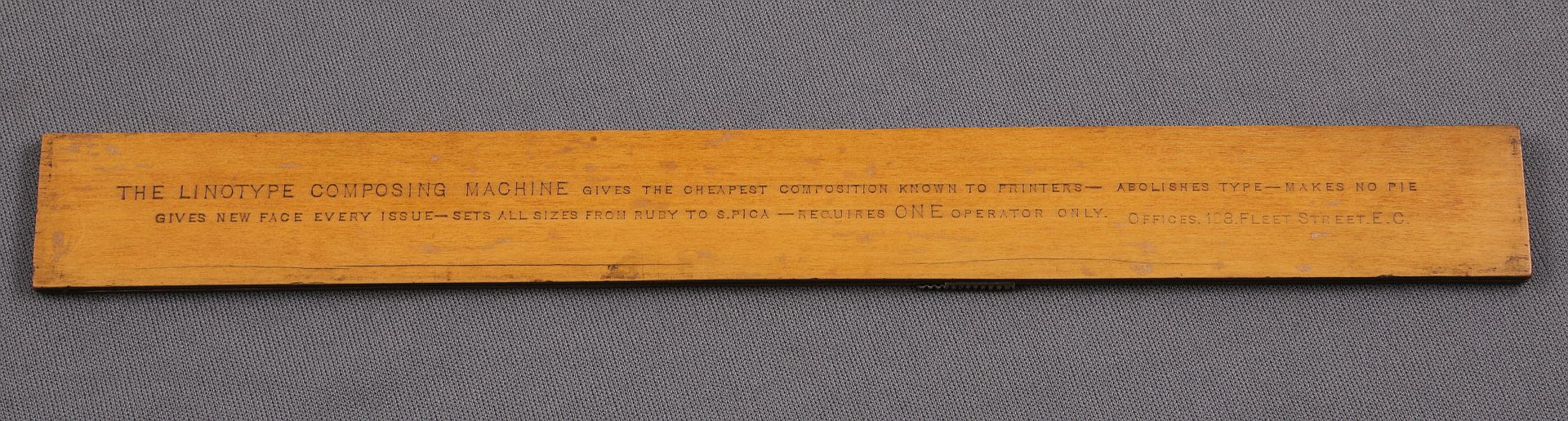
This ruler, 9.2" long, was an important tool for the process of 'copyfitting' in the times of typesetting in lead. You had to determine the space you need for a text in a particular font size, or you wanted to know the best font size to fill a given space. No such thing as writing a text on your computer and then change the font size to see how it fits. You literally made a hard choise selecting a font size when you started typesetting a text. Furthermore, your print shop had to own sufficient metal type letters of a given font and font size. This ruler helped significantly in copyfitting. The space was given by the cursor position. The brass cursor carries ten classic / traditional (abbreviated) names for common font sizes (not font names) together with their size in Didot points, and also the size of one inch for the corresponding scales under under it given the lines of text. There is advertising on the back for the Linotype Composing Machine.
|
|
| 23 |
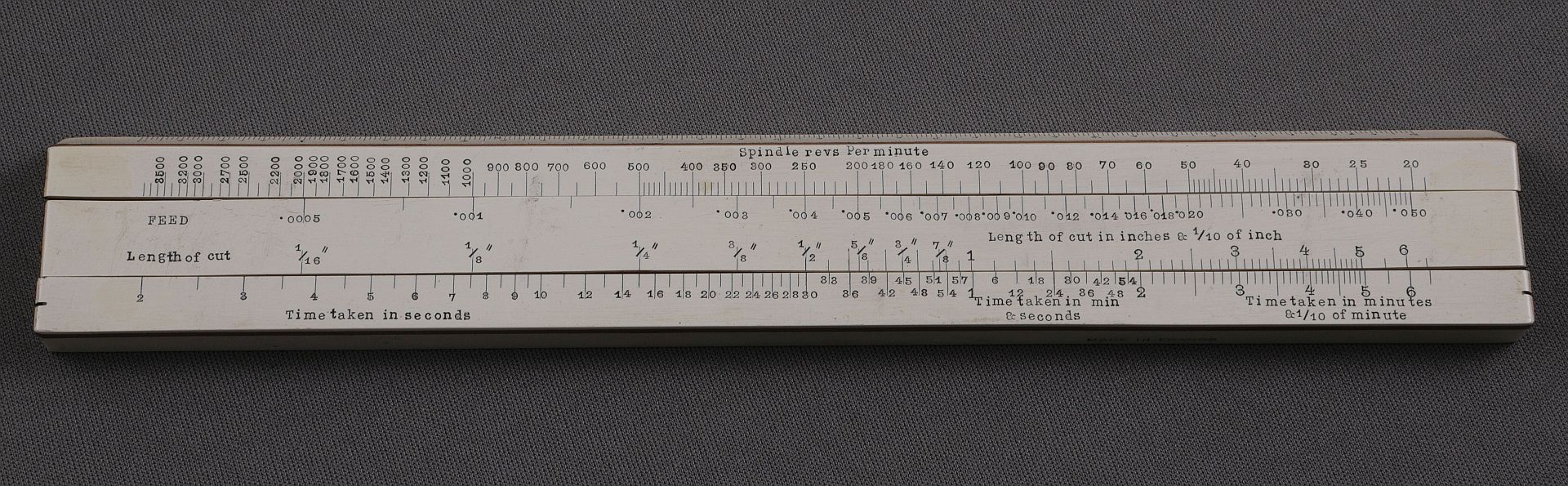
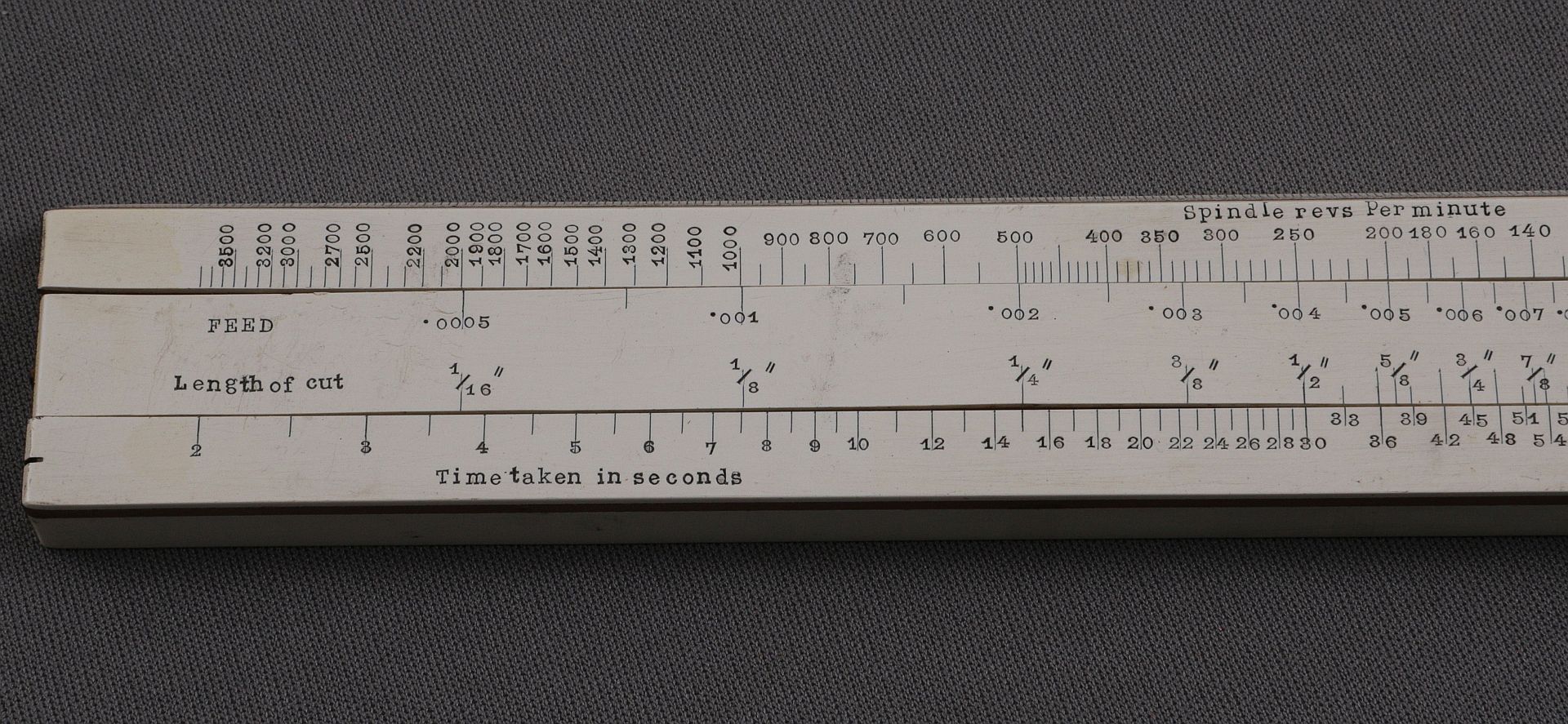
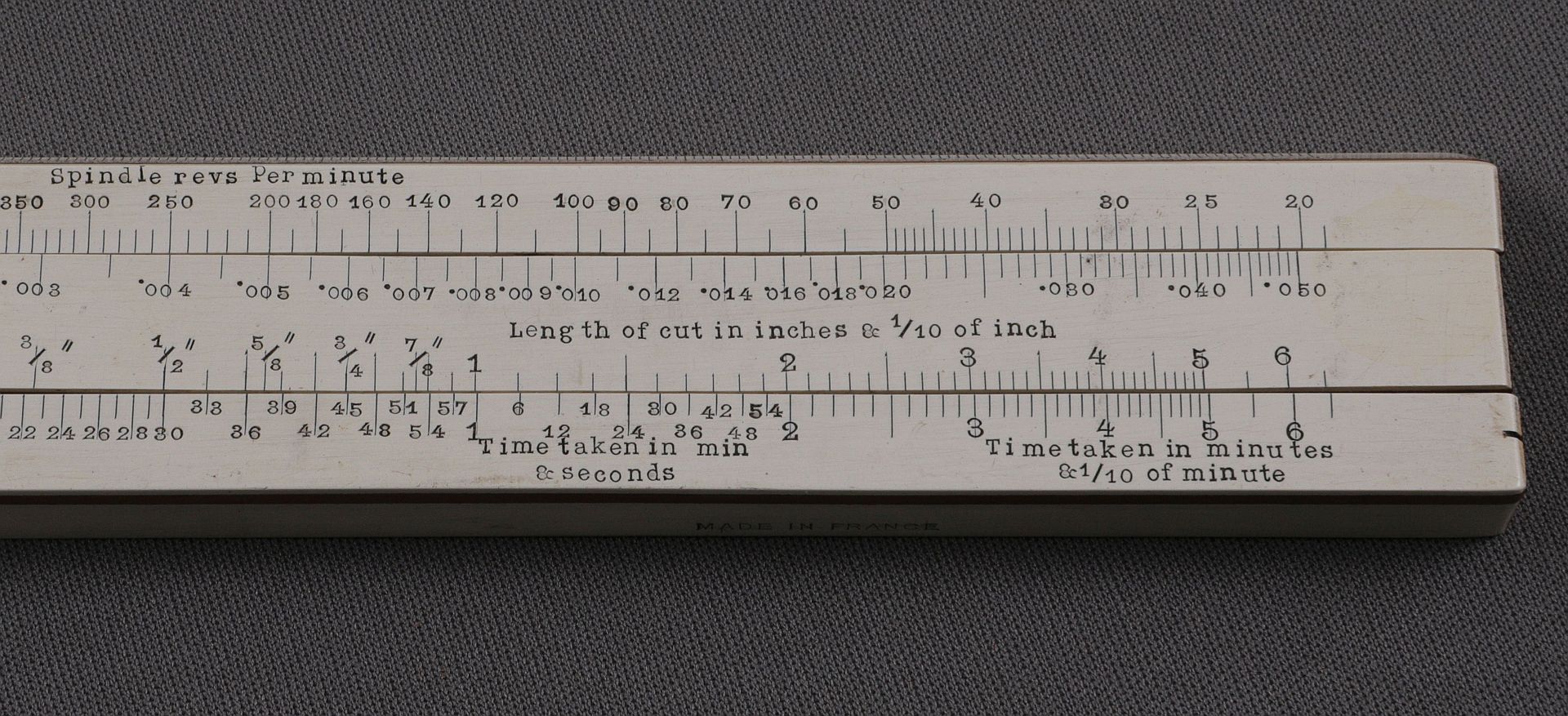
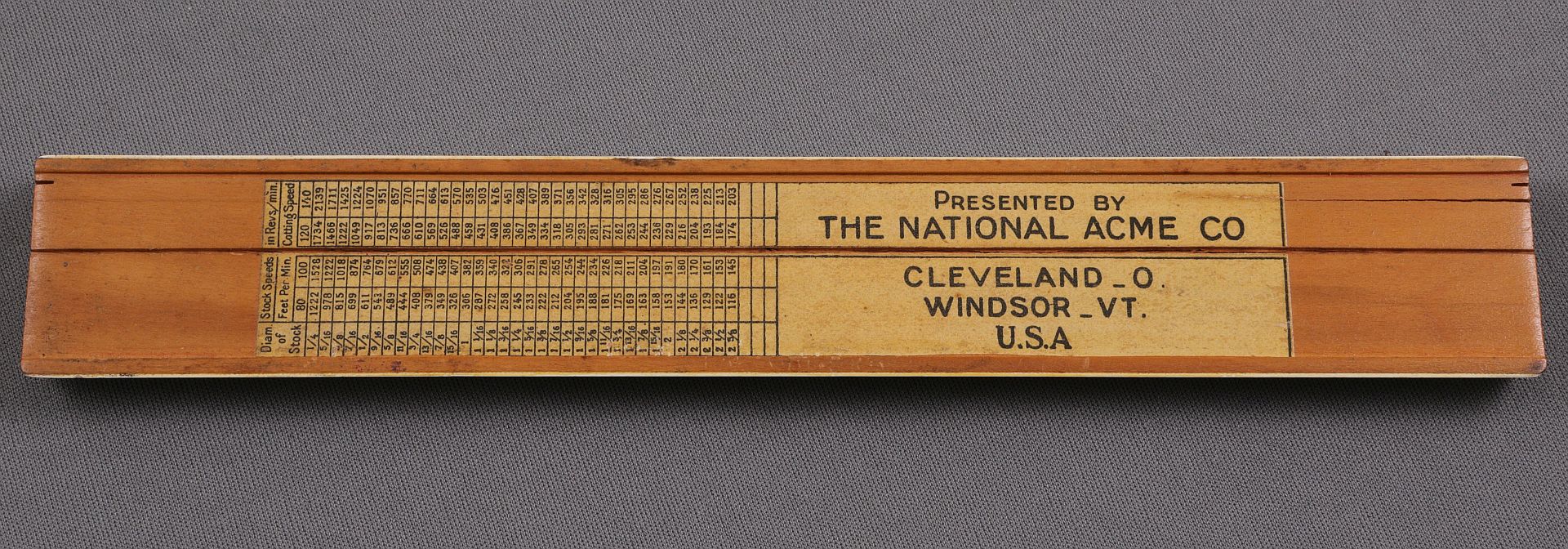
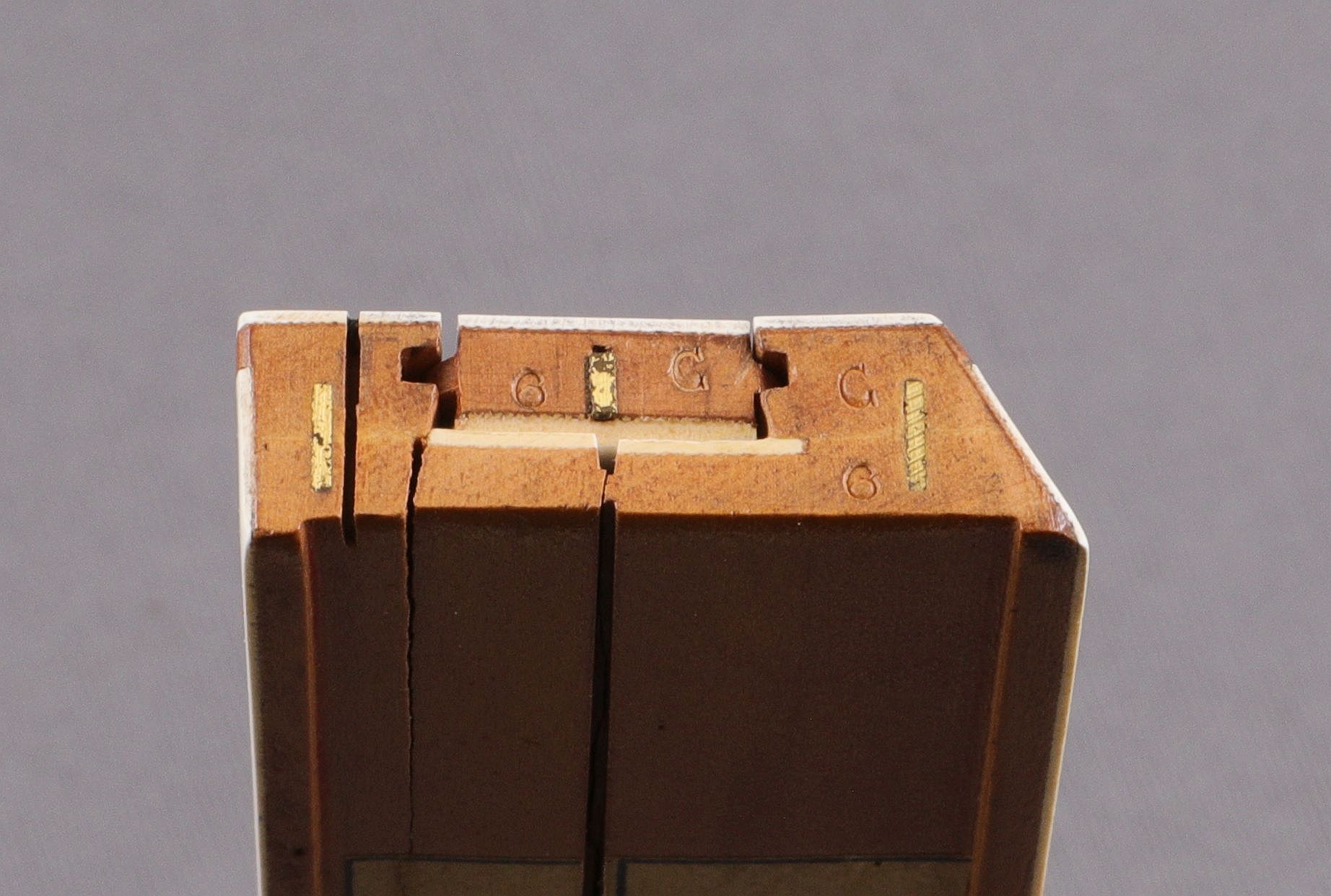
French slide rule for determining the duration
of machining operations
My first impression was that this is a regular "speeds and feeds" calculator for lathe work, but after closer examination, I have no idea what it is. The scales are predominantly concerned with length of cut and time taken in minutes or seconds. Broaching maybe? The construction is quite robust, with three brass bars embedded in the stators and slides, looking very similar to Faber Castell's heavy duty construction. "Made in France" is stamped on the lower vertical edge, and neither that vertical edge or the upper beveled edge are grooved for a cursor. The slide rule is exactly 9" long.
|
|
| 24 |
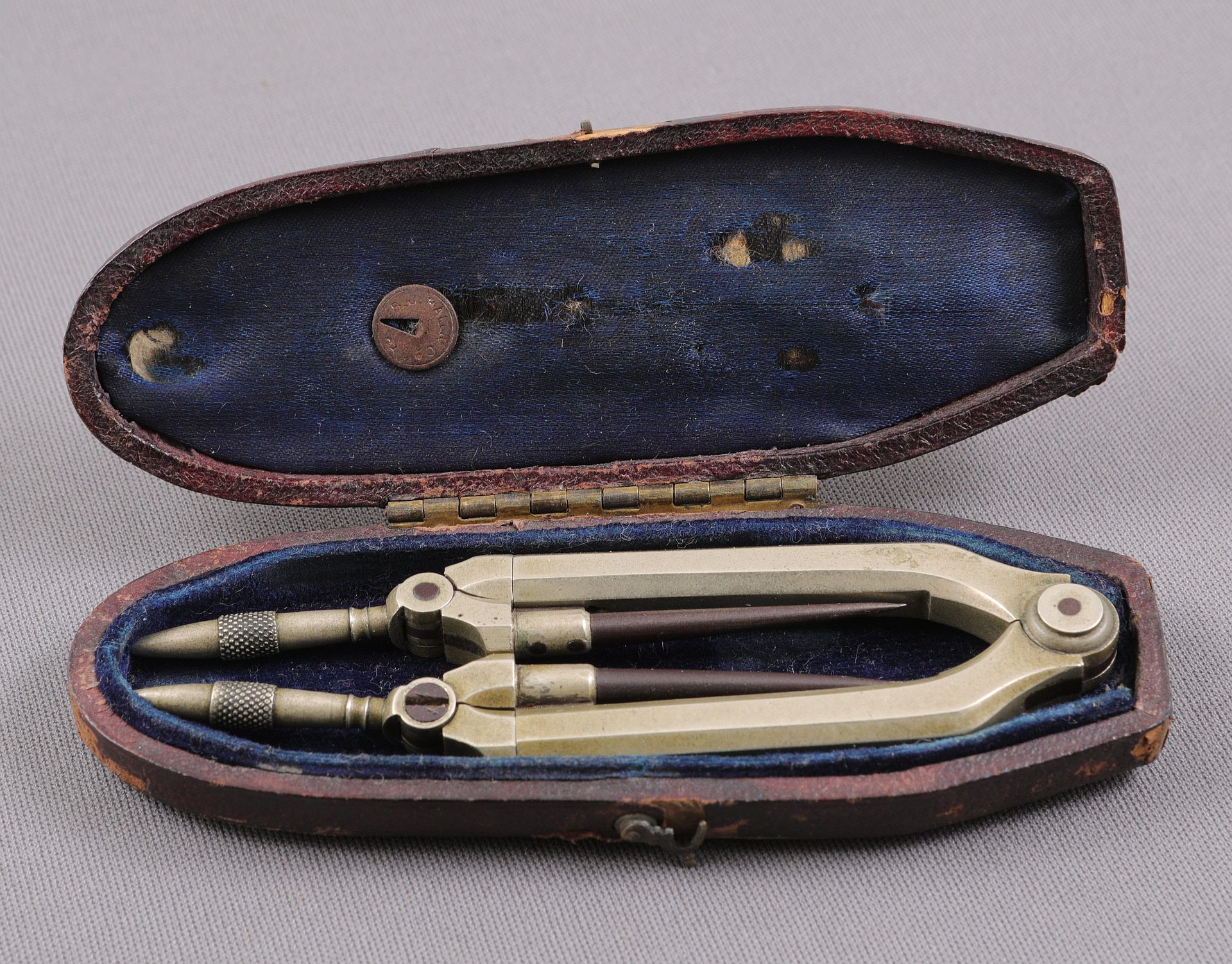
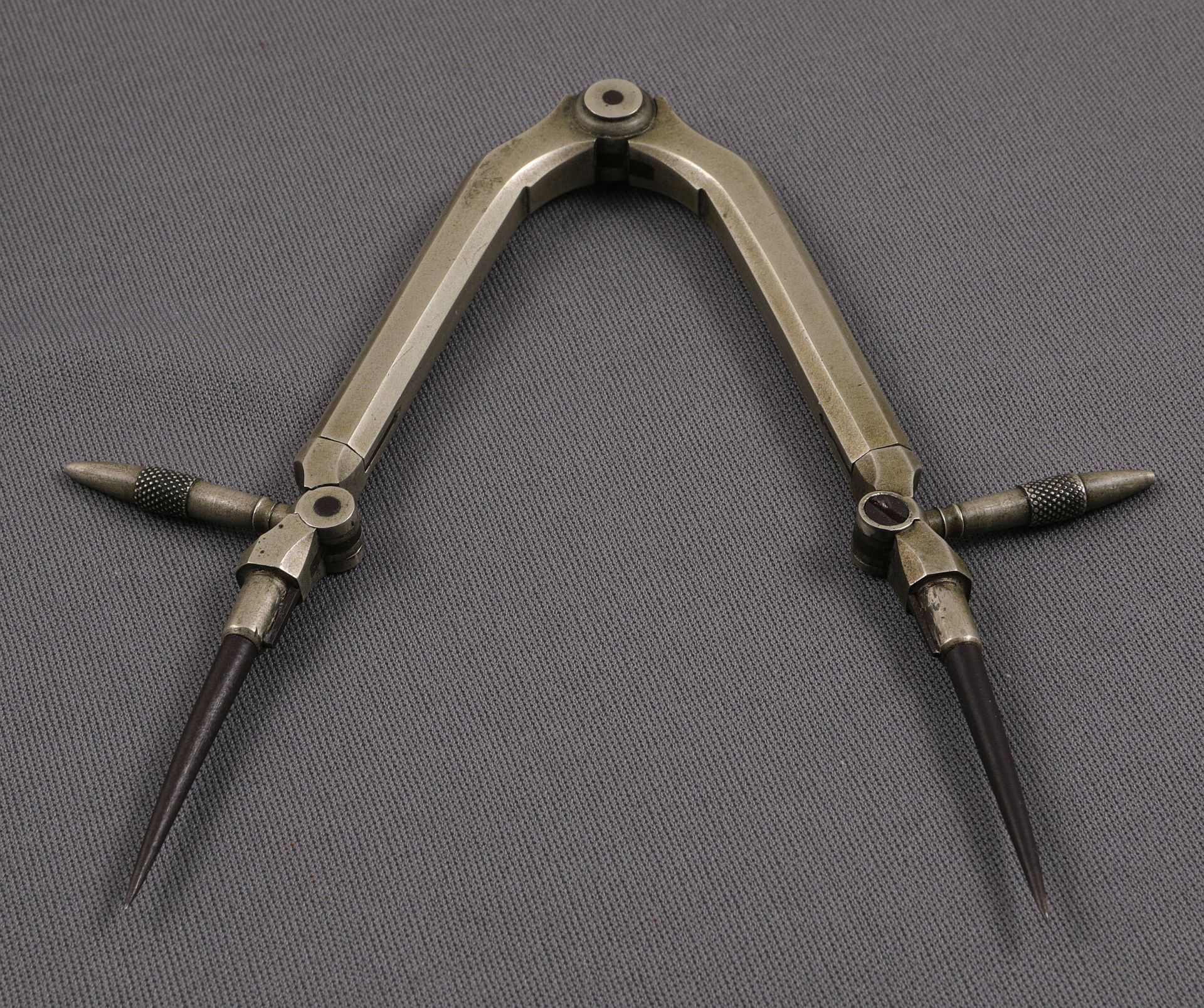
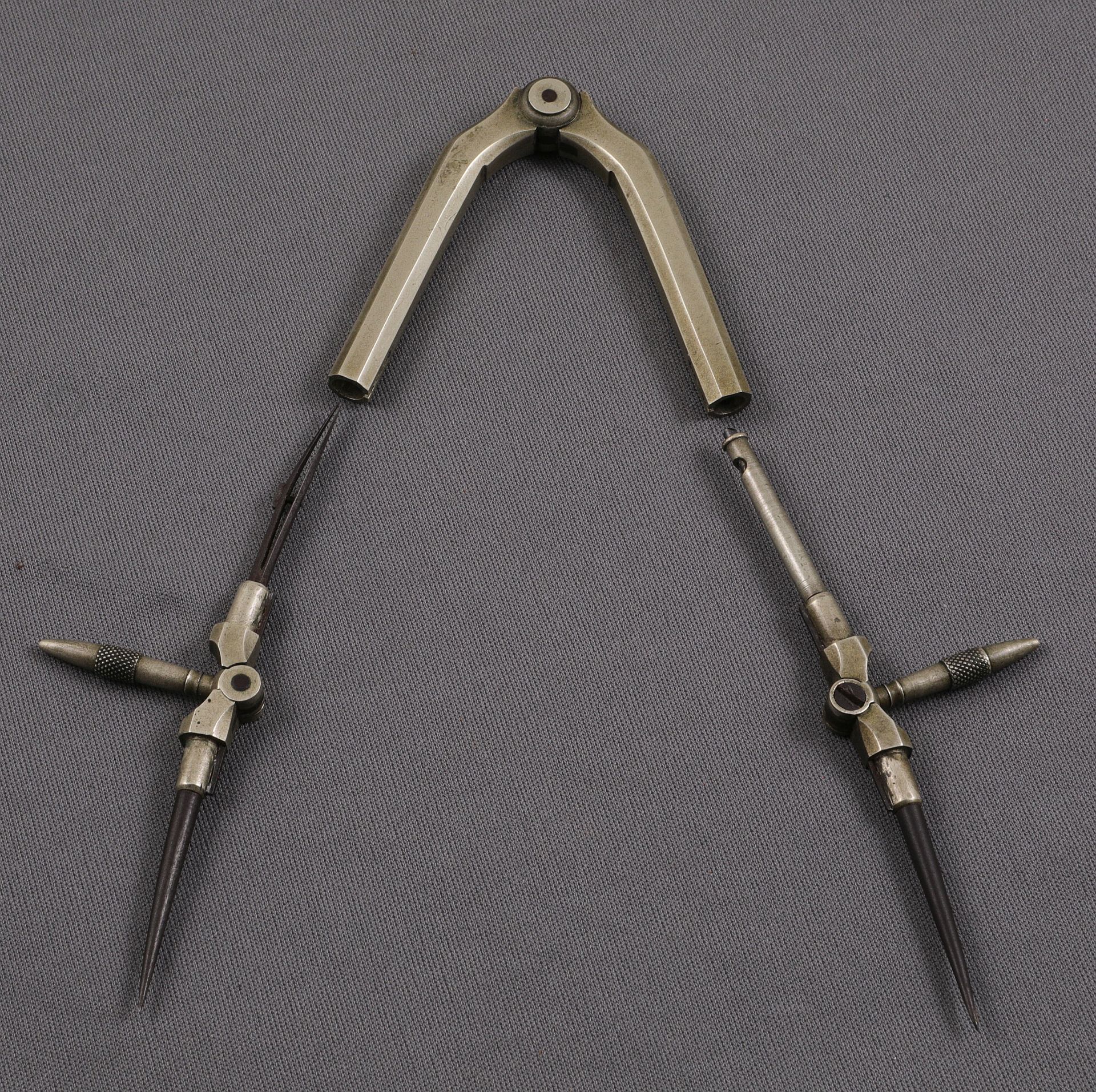
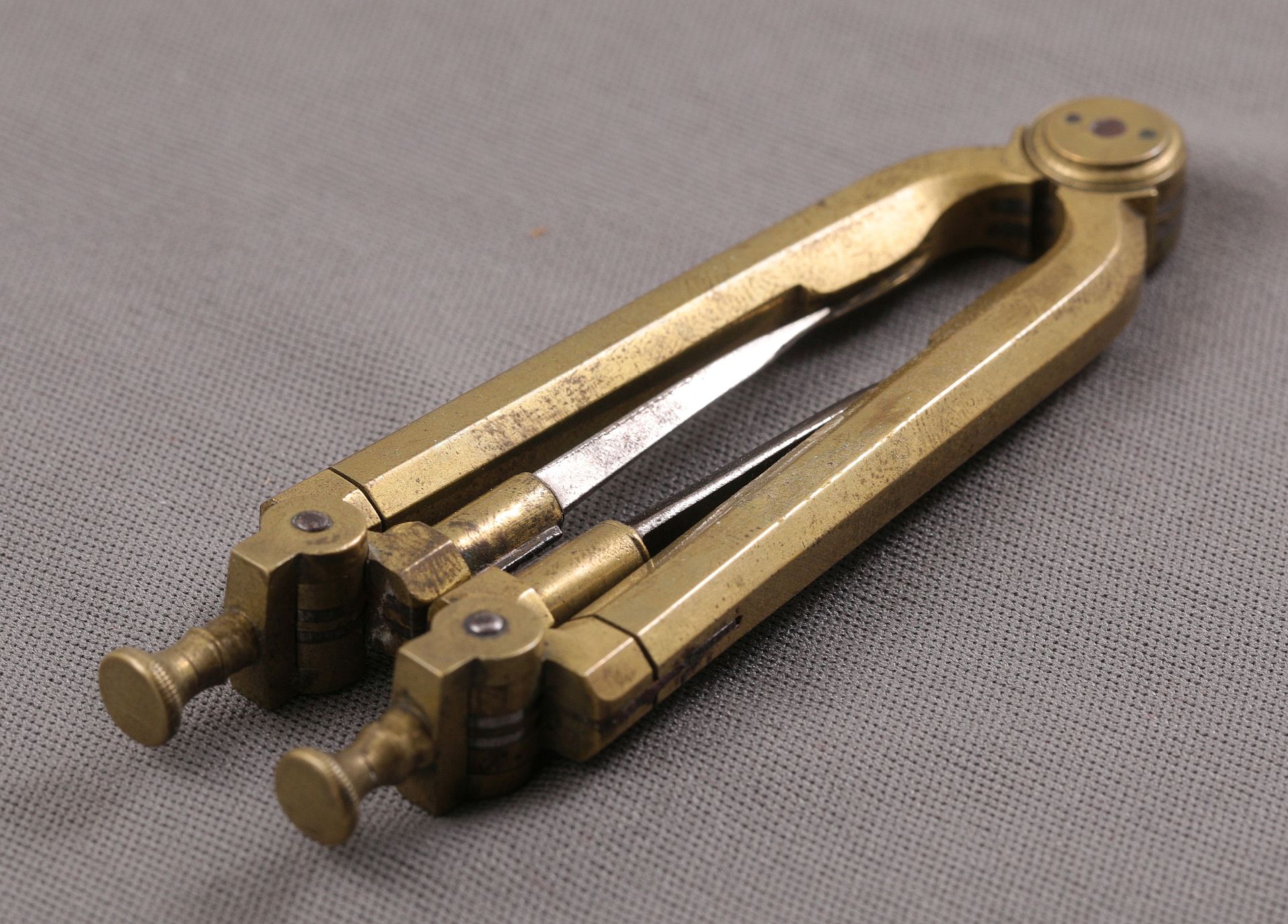
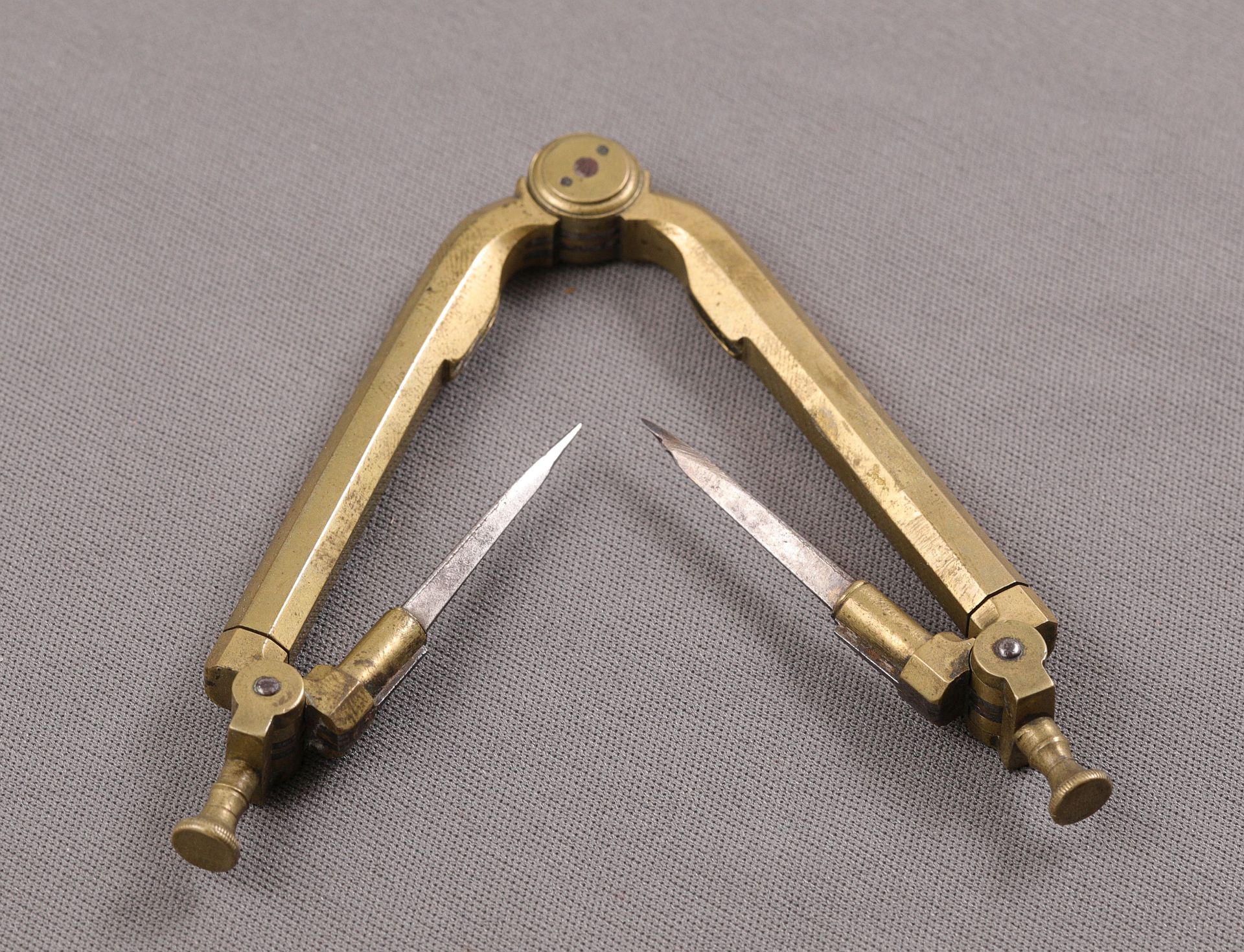
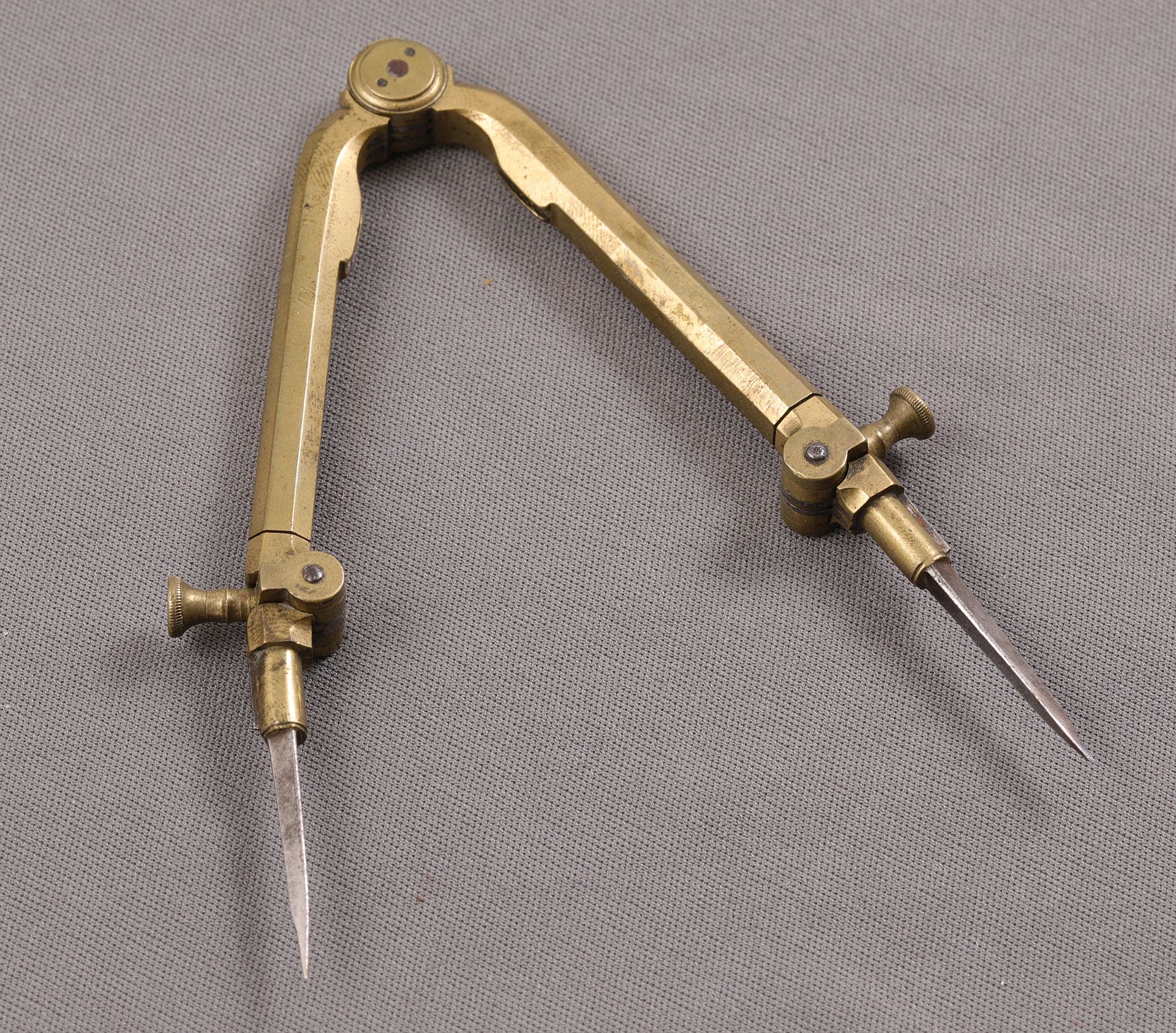
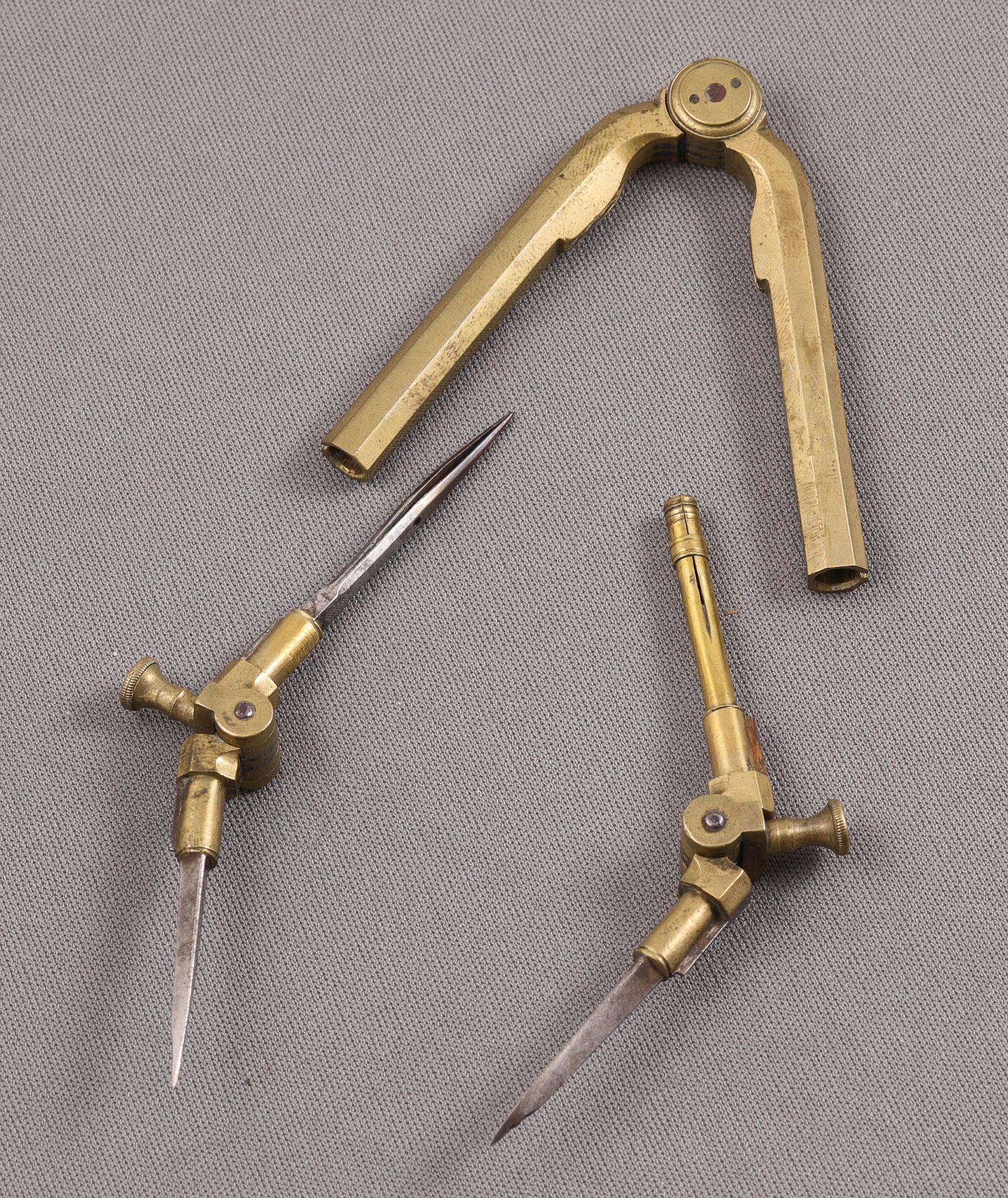
Napier's Compass with no maker's name, in case
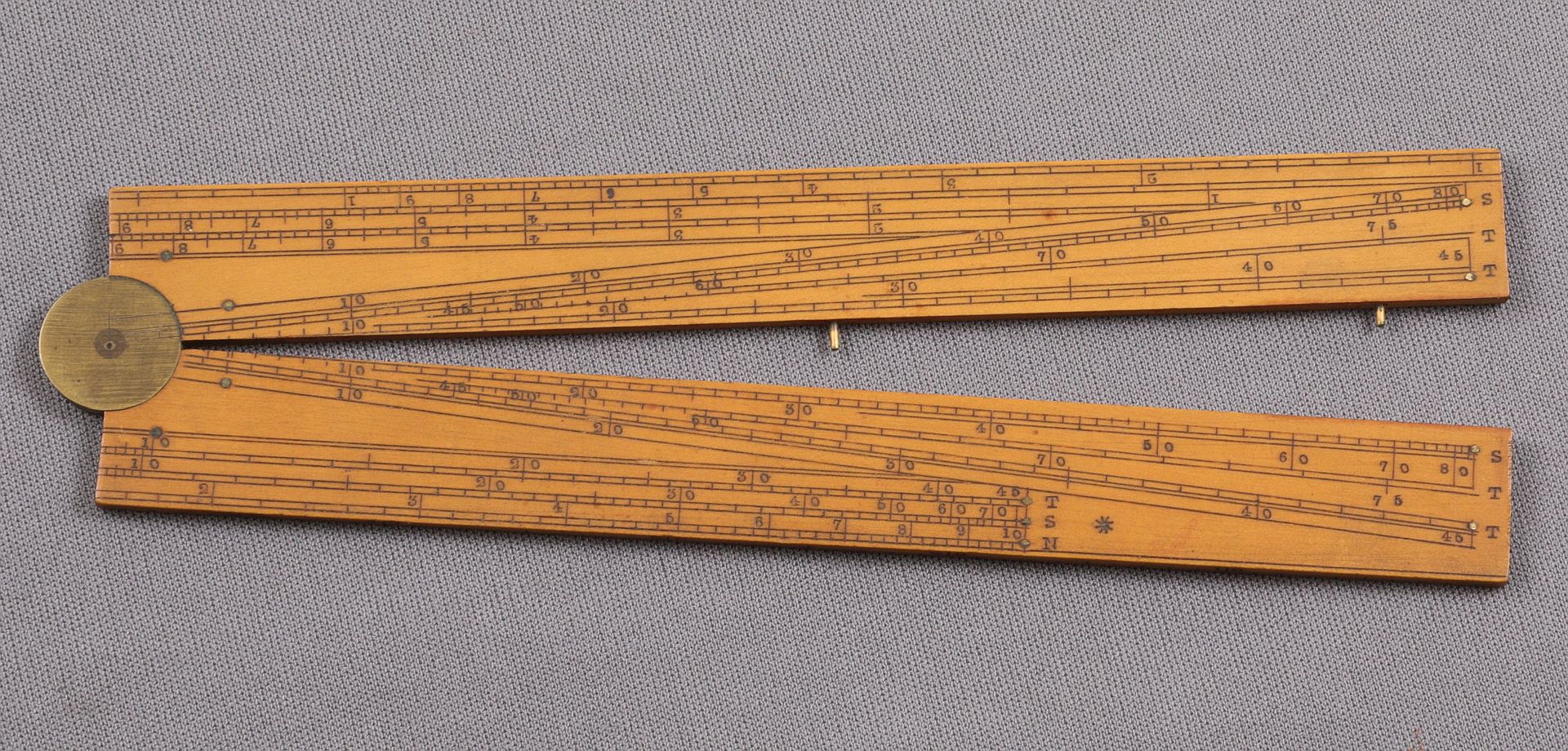
Englishman David Napier (1787–1873) is credited with inventing the folding compass in 1848. That's it, to be a Napier compass all that is required is for the arms to fold in, making it more compact to store. A later development was the Napier compass with two smaller compasses within the arms. You could use the small compasses separately, or leave them stored in the arms if you need a bigger compass. On this Napier compass, each of the small dividers has a pivot point and a drawing tool; one has a pencil lead holder (it appears to take standard 2mm drawing pencil lead) and the other a drafting pen. Either arm of either small compass can be inserted into the large compass arms, so when configured as a large compass, any combination of points is possible. This compass is in excellent condition. The case is also in good condition, but the hinge is quite loose.
|
|
| 25 |
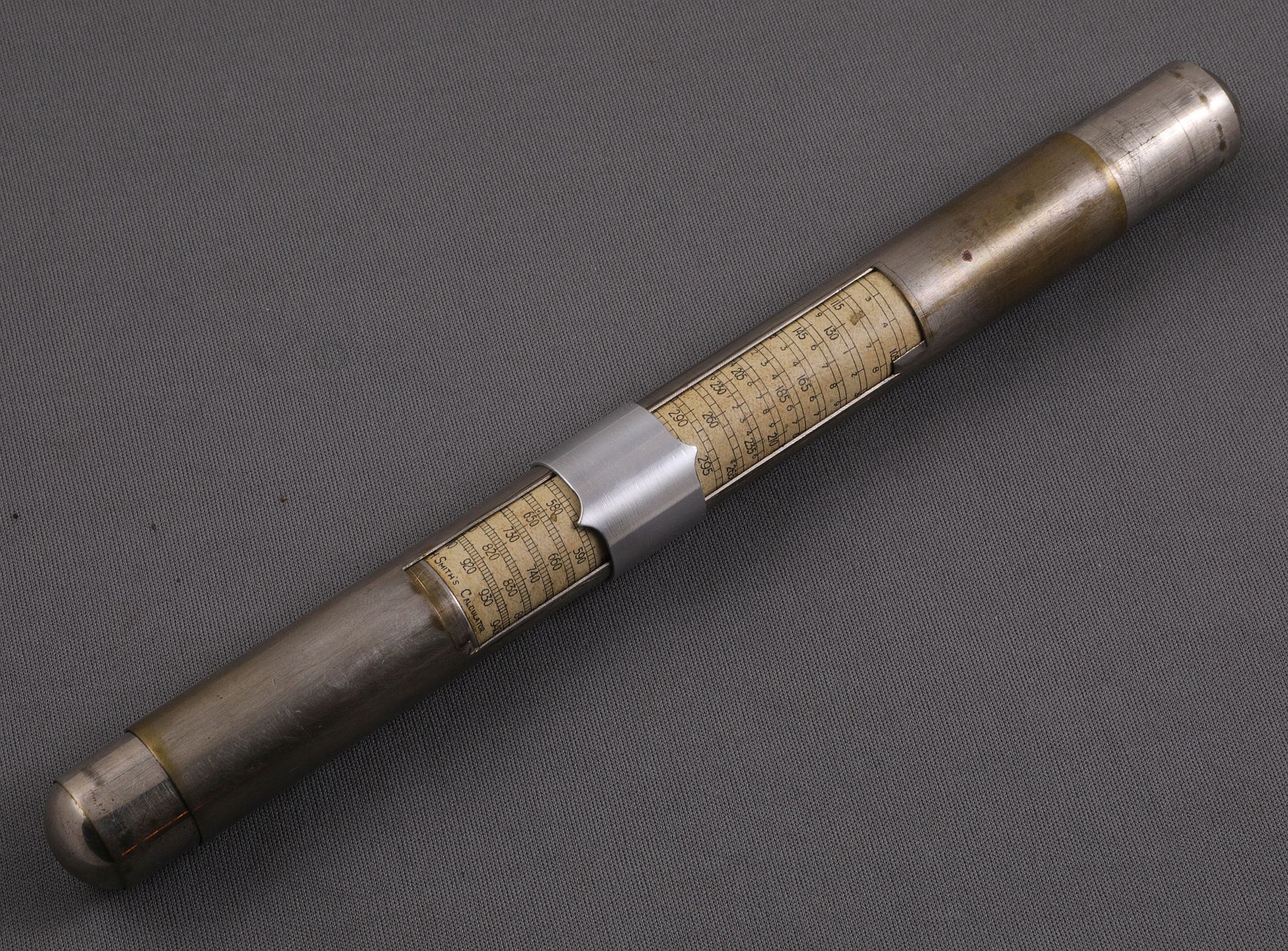
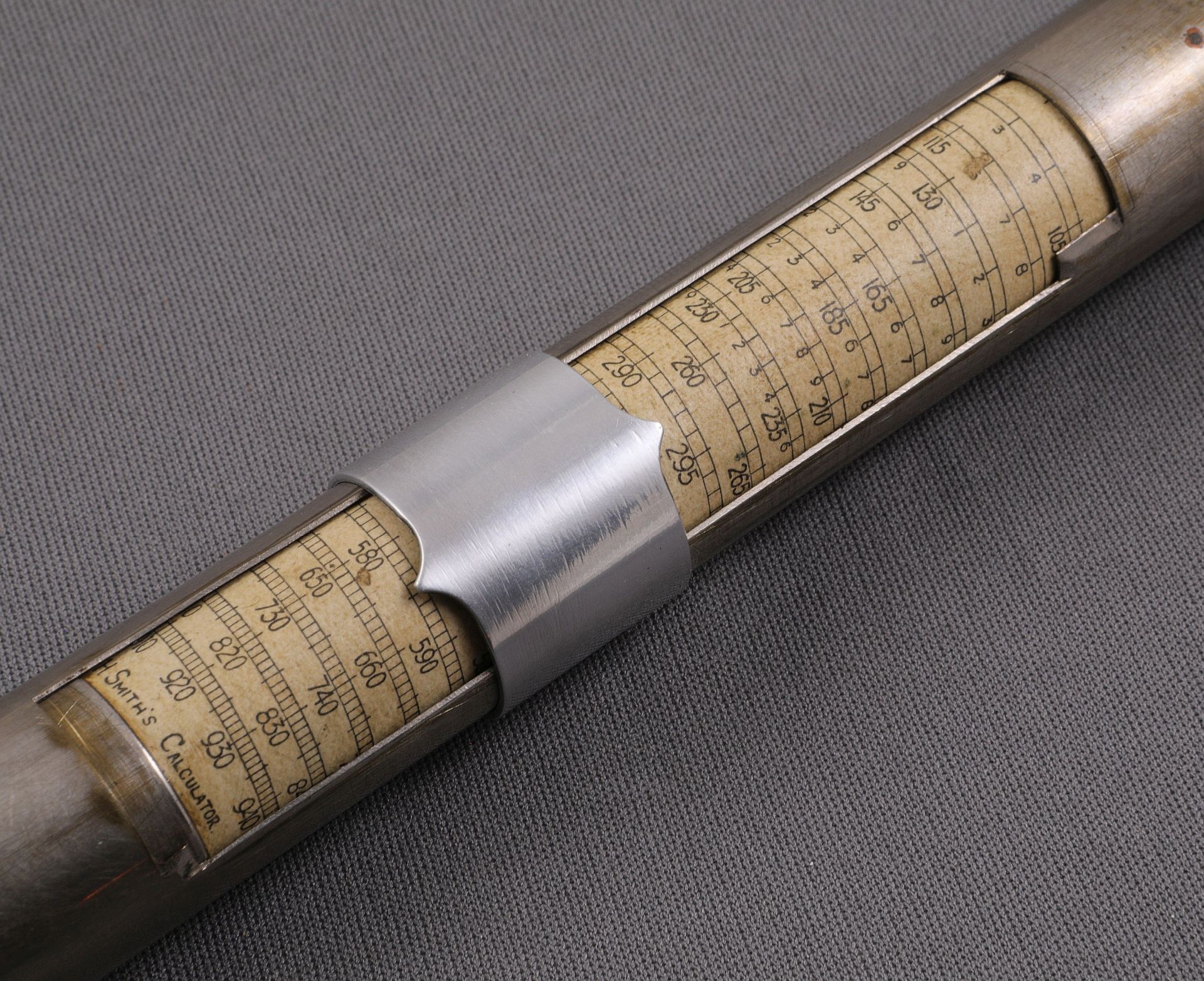
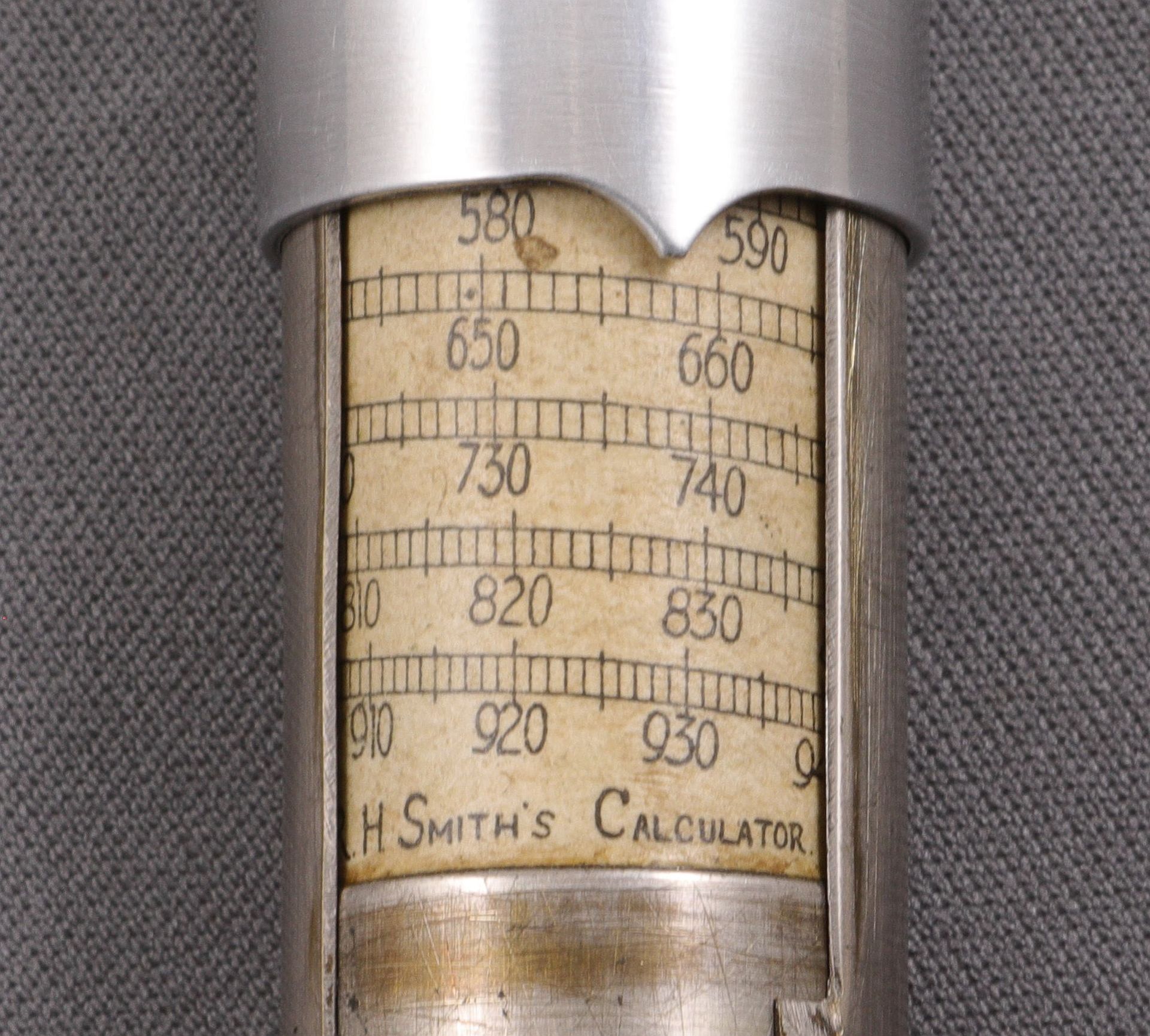
Prof. R. H. Smith's Calculator
This calculator probably looks familiar to you. Small-diameter spiral scale, movable pointers, it must be an Otis King, right? NO. The R. H. Smith Calculator was patented more than 20 years (1899 vs. 1921) before the Otis King, and is both longer and more slender. The innermost cylinder carries the spiral logarithmic scale. A slightly larger diameter outer sleeve slides over that, and provides four index points (pick any one!). A small "ring" slides over the outer sleeve, giving two more index points, and moves with the outer sleeve. In operation, it is essentially like a Gunter's rule and pair of dividers: one logarithmic scale, two index points that can be set a fixed distance apart and moved together. Most helical and spiral slide rules work like this. This Smith calculator is in good condition. The outer cylinder is a very tight fit over the inner cylinder, making smooth operation difficult. The nickel plating is also in good condition, though it is getting quite thin in some areas, and is gone altogether in a couple high-wear areas, revealing the brass underneath. The paper scale is also good, having only two areas where the paper has torn, the second of which is so small you will be hard pressed to find it. There is no case or instructions.
|
|
| 26 |
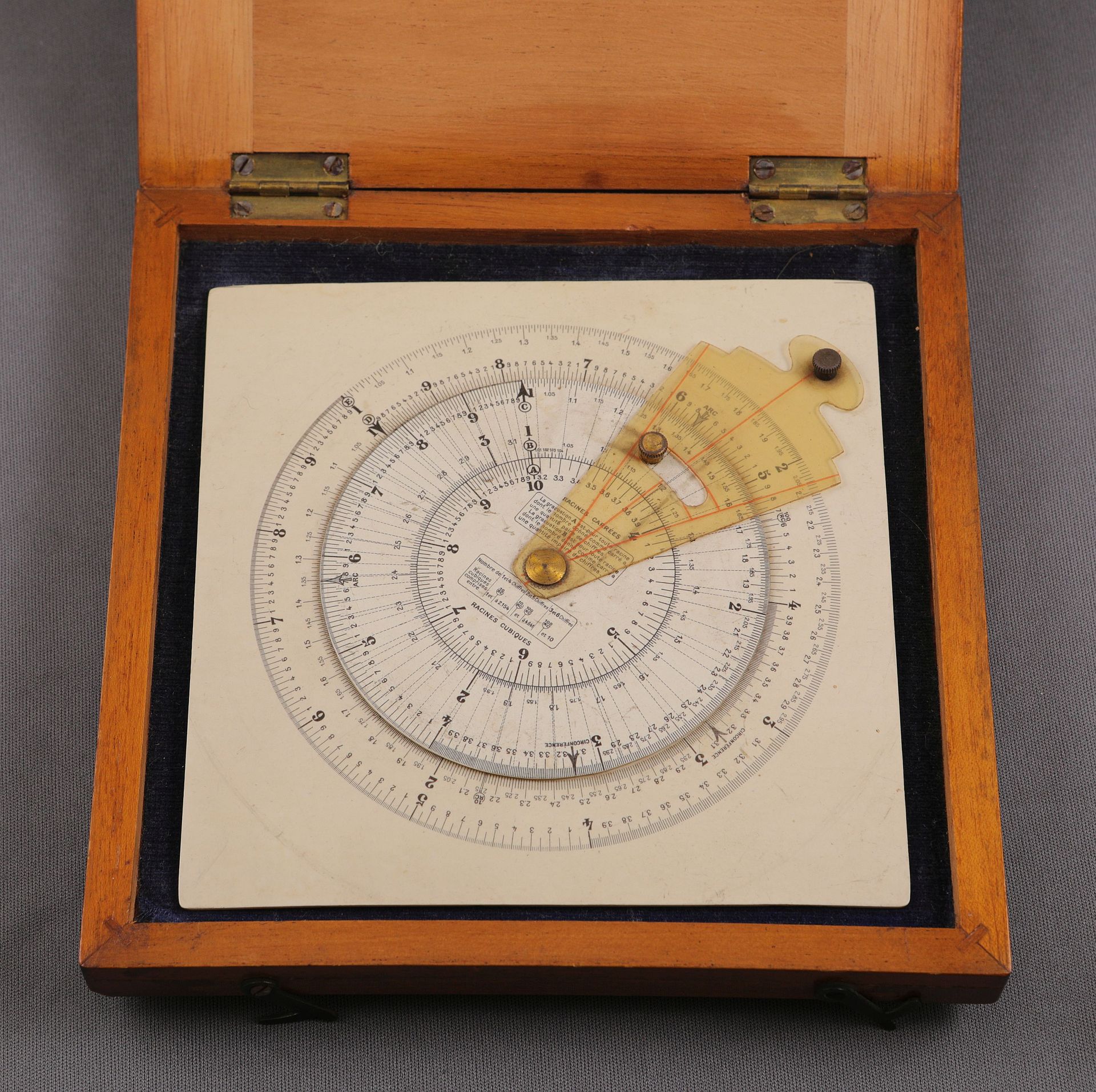
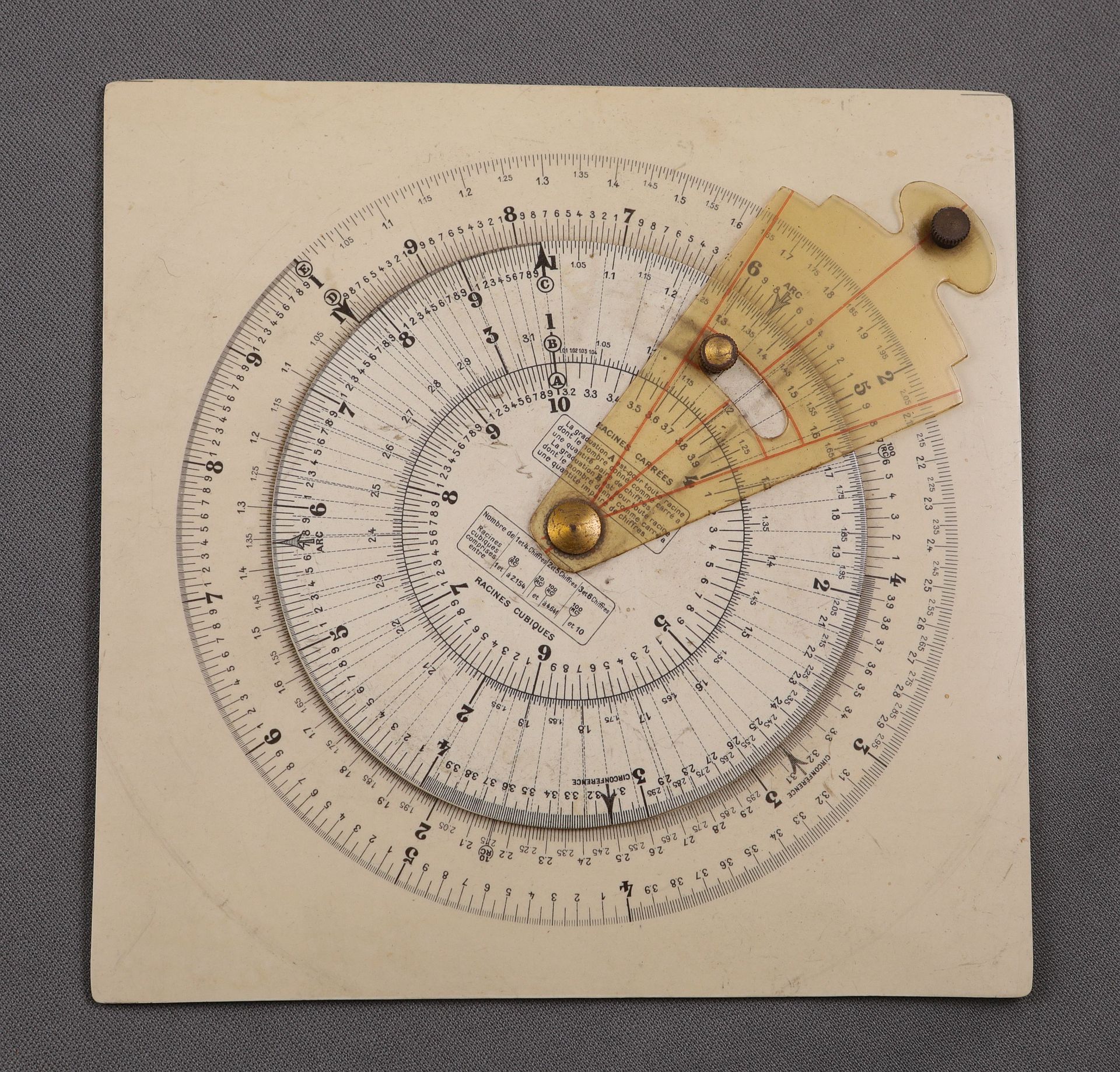
Arnault-Paineau calculator,
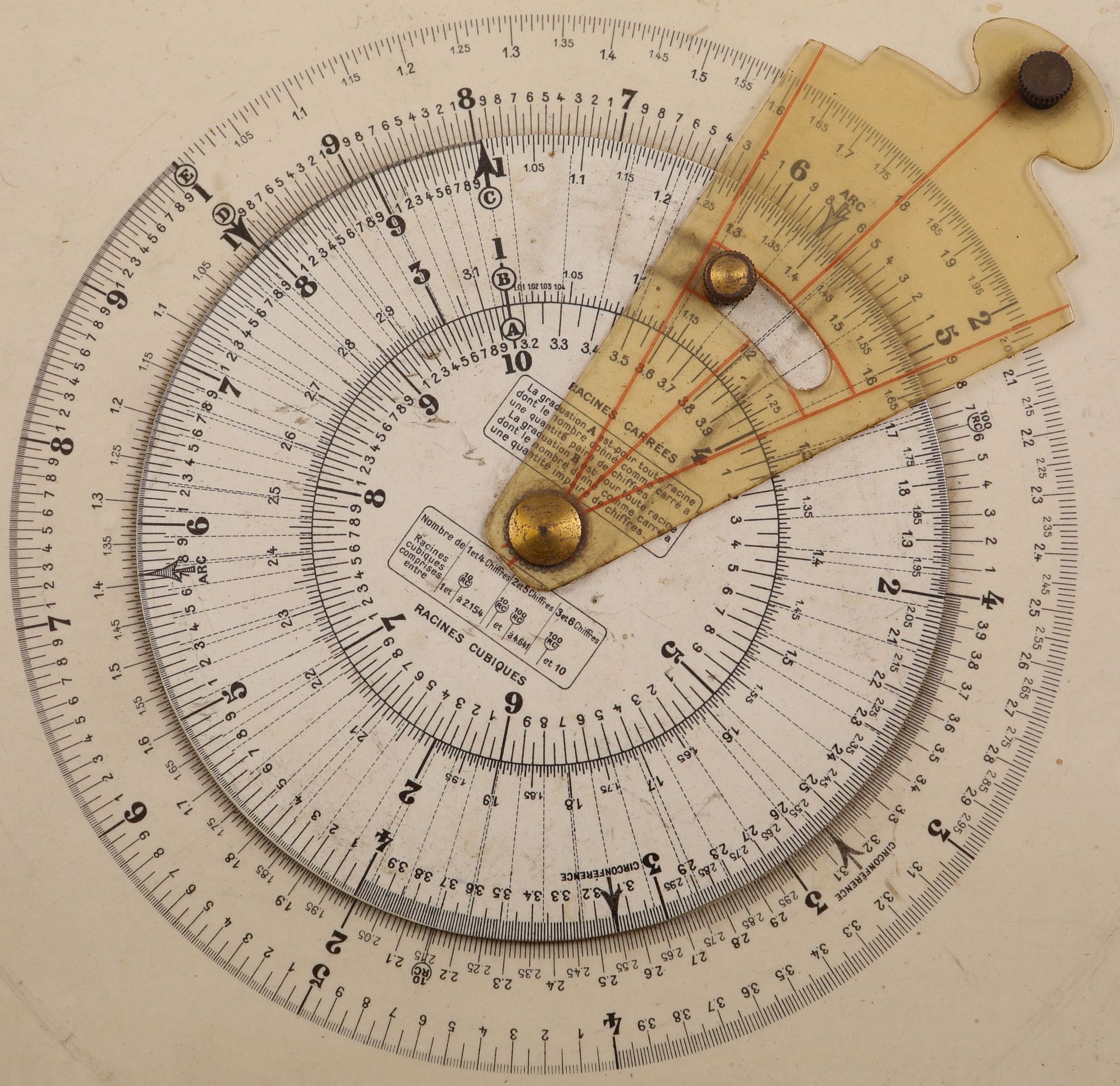
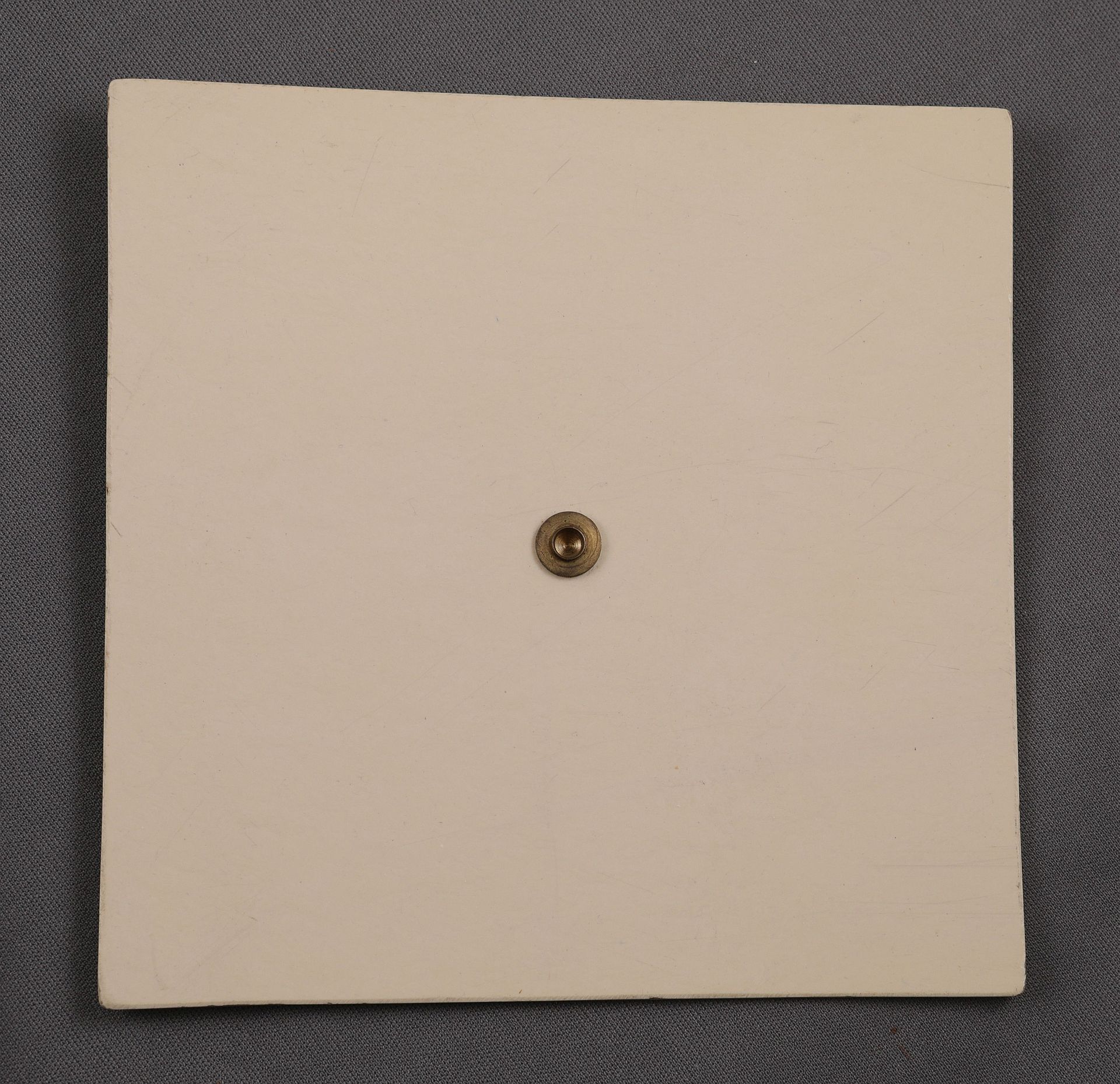
all celluloid circular slide rule, in wood box
This is a very small example of the circular slide rule originally designed by Jules Arnault and Louis Paineau in France, and patented in 1921. Larger sizes of nearly a foot in diameter and constructed of steel have been seen, as well as other models with sizes all the way down to the 5.5" square overall size, and 4.6" diameter scales of this one. This particular one is made entirely of celluloid, with a brass rivet in the center acting as a pivot, and two tiny brass knobs to move the scales and cursor. The scales are similar to the larger models, but as a concession to its size, the trig and L scales have been left off this one. This slide rule is undeniably a thing of beauty, existing at the junction of science and art.
|
|
| 27 |
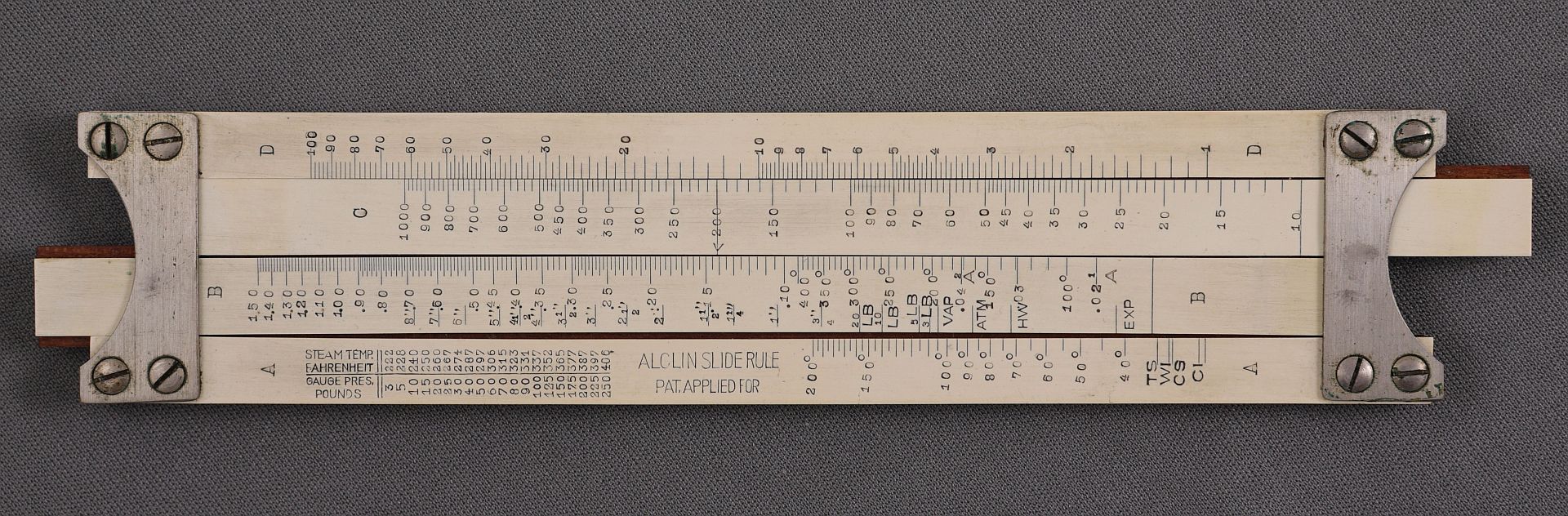
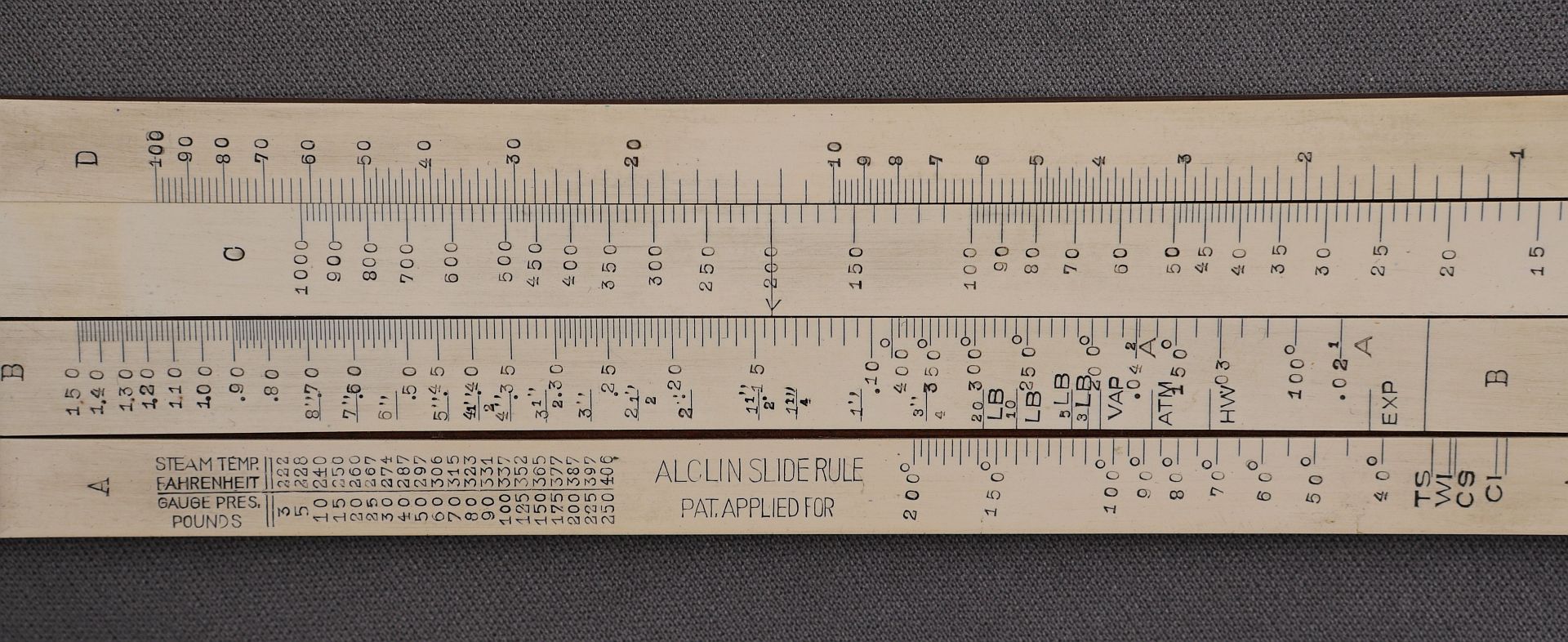
ALCUN Slide Rule
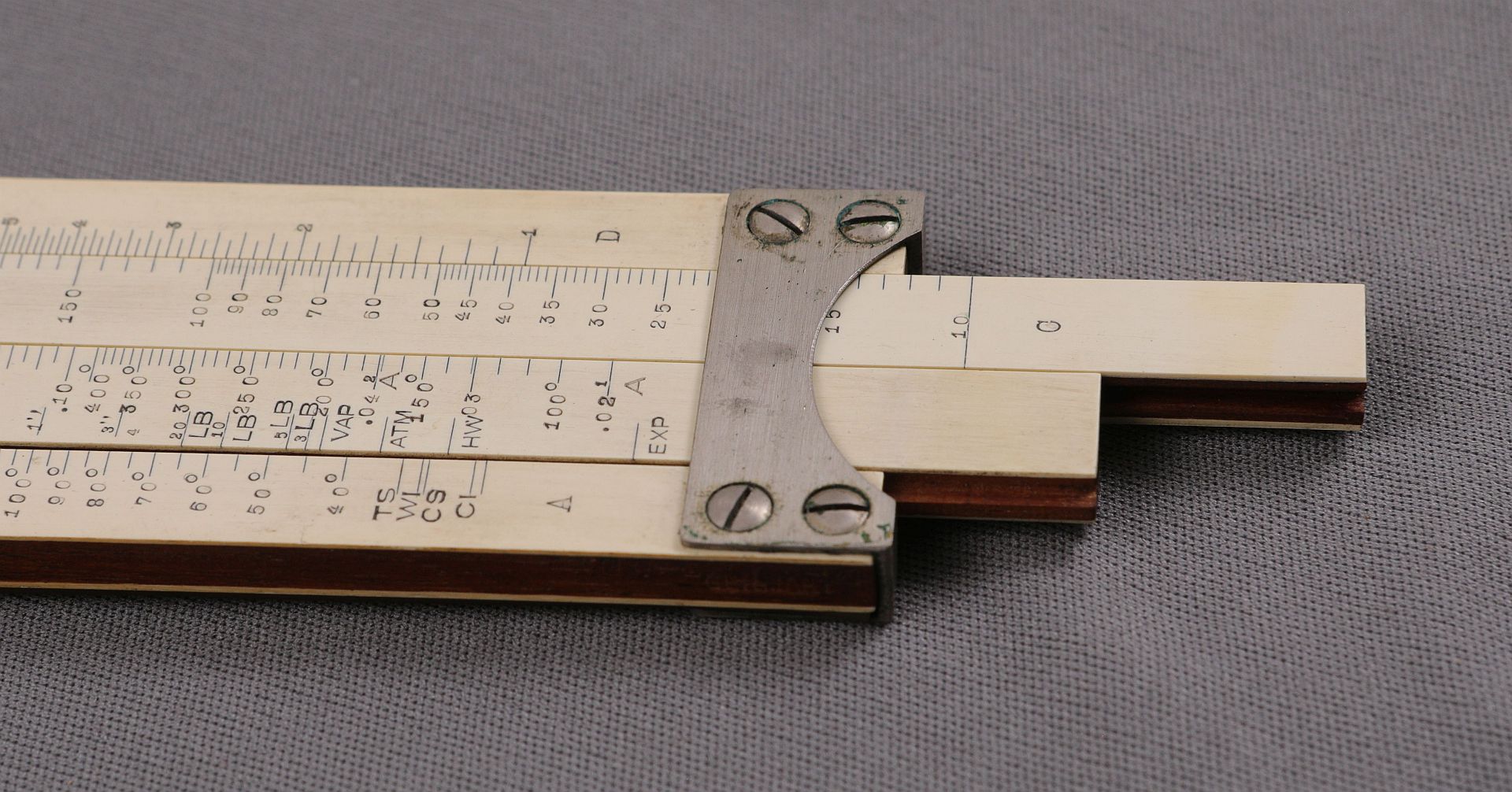
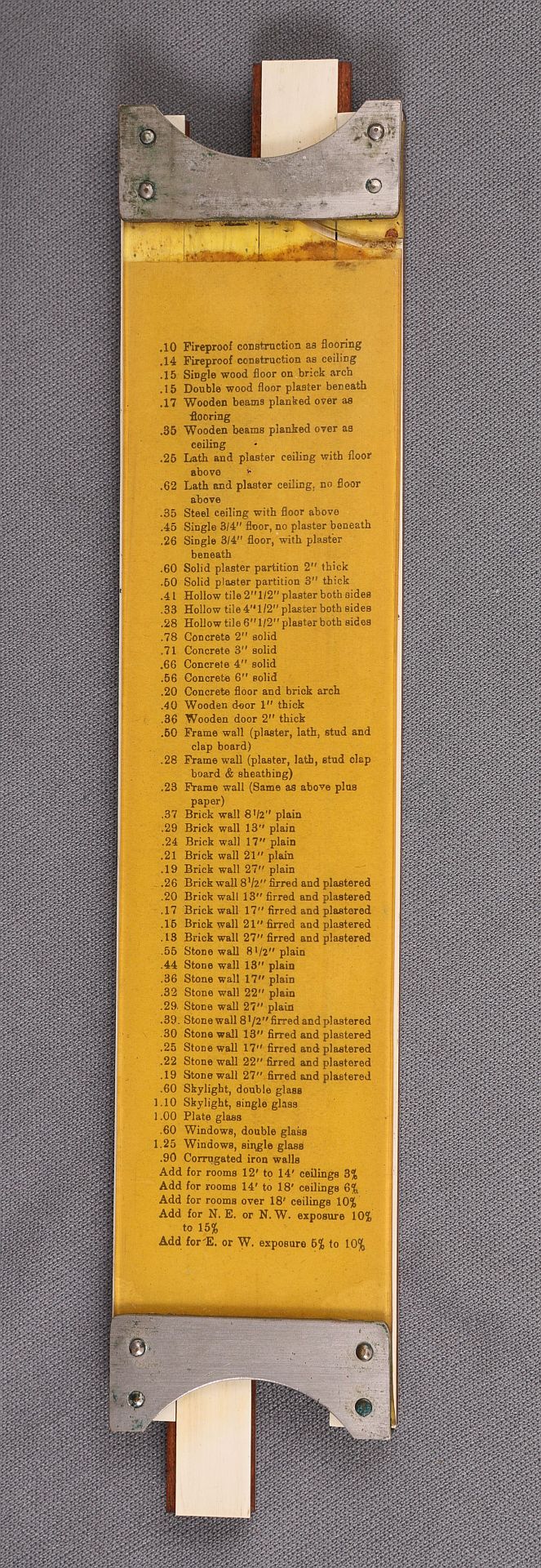
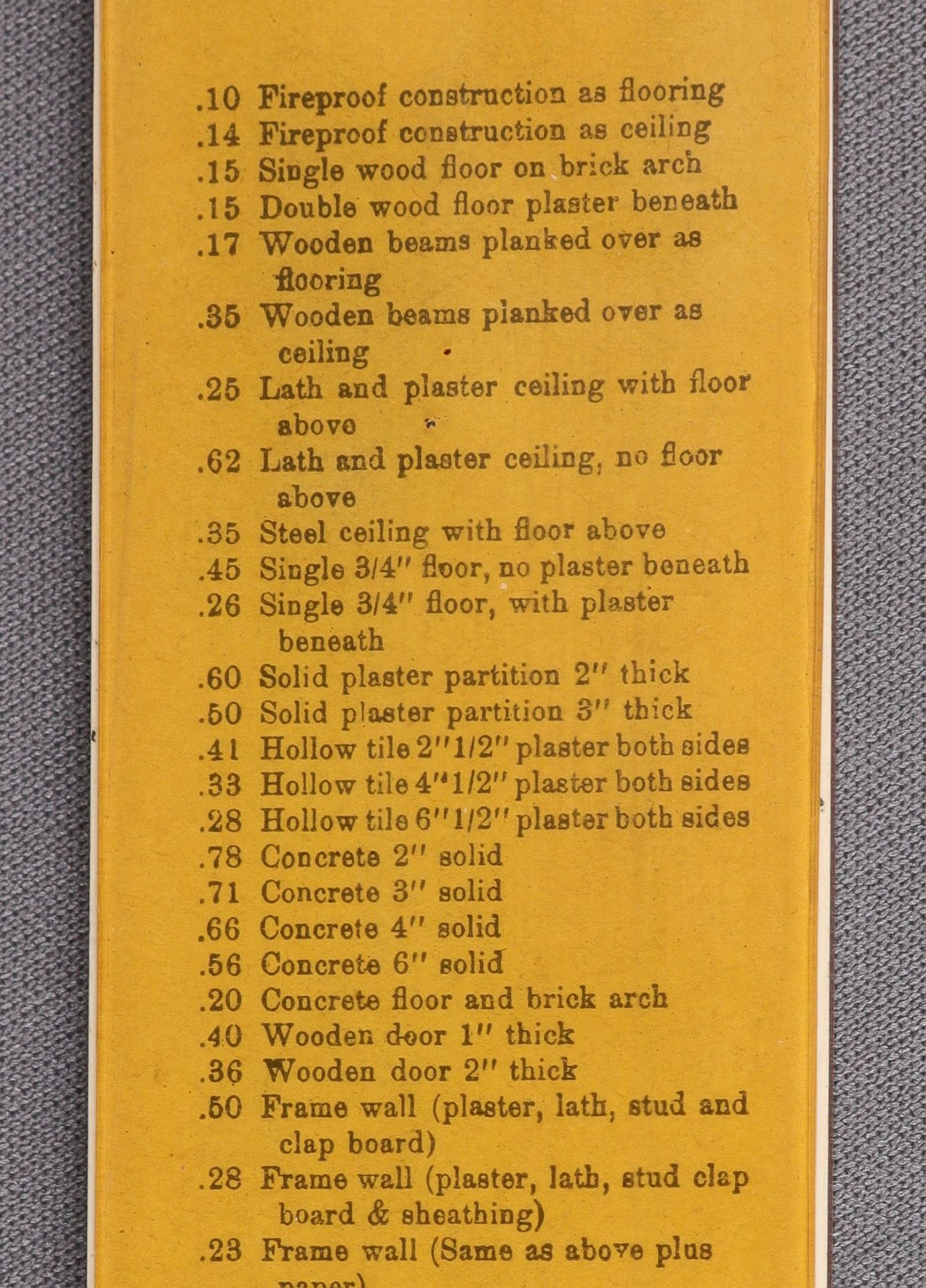
This slide rule is unlike any other I have seen. It appears to be for steam heating calculations. There are two slides and no cursor. There is a long list of building materials and components on the back, each associated with a number between 0.10 and 1.25. The list is neither alphabetically nor numerically sorted. These are possibly factors for calculating heat loss through walls, doors, windows, etc. On the front of the slide rule, the top two scales are equivalent to the familiar A and B scales. The rest of the markings on the lower slide and stator are unknown. There are markings that appear to be gauge points, but which are labeled with unknown identifiers: LB, VAP, ATM, HW, EXP, TS, WI, CS, and CI. There is also a table labeled "Steam Temp Fahrenheit" and "Gauge Pres. Pounds". Both slides are single-sided, not reversible. Construction is excellent and quite robust. Four screws hold the braces at each end. The table on the back appears to be printed on paper and covered with a thick piece of clear plastic which has yellowed with age. Most of the printing is very small, and I require a magnifying glass, in addition to my regular reading glasses, to read it. The slide rule is 6 ¾ inches long overall.
|
|
| 28 |
Boxwood sector, exc. cond., no maker's name
This sector, which is 12 inches long when open, looks like it was originally part of a set of drawing instruments, probably in a shagreen case with a hinged lid. The scales are very standard for sectors, but alas there is no maker's name. The condition is excellent, with no marks, scratches, or gouges in the wood.
|
|
| 29 |
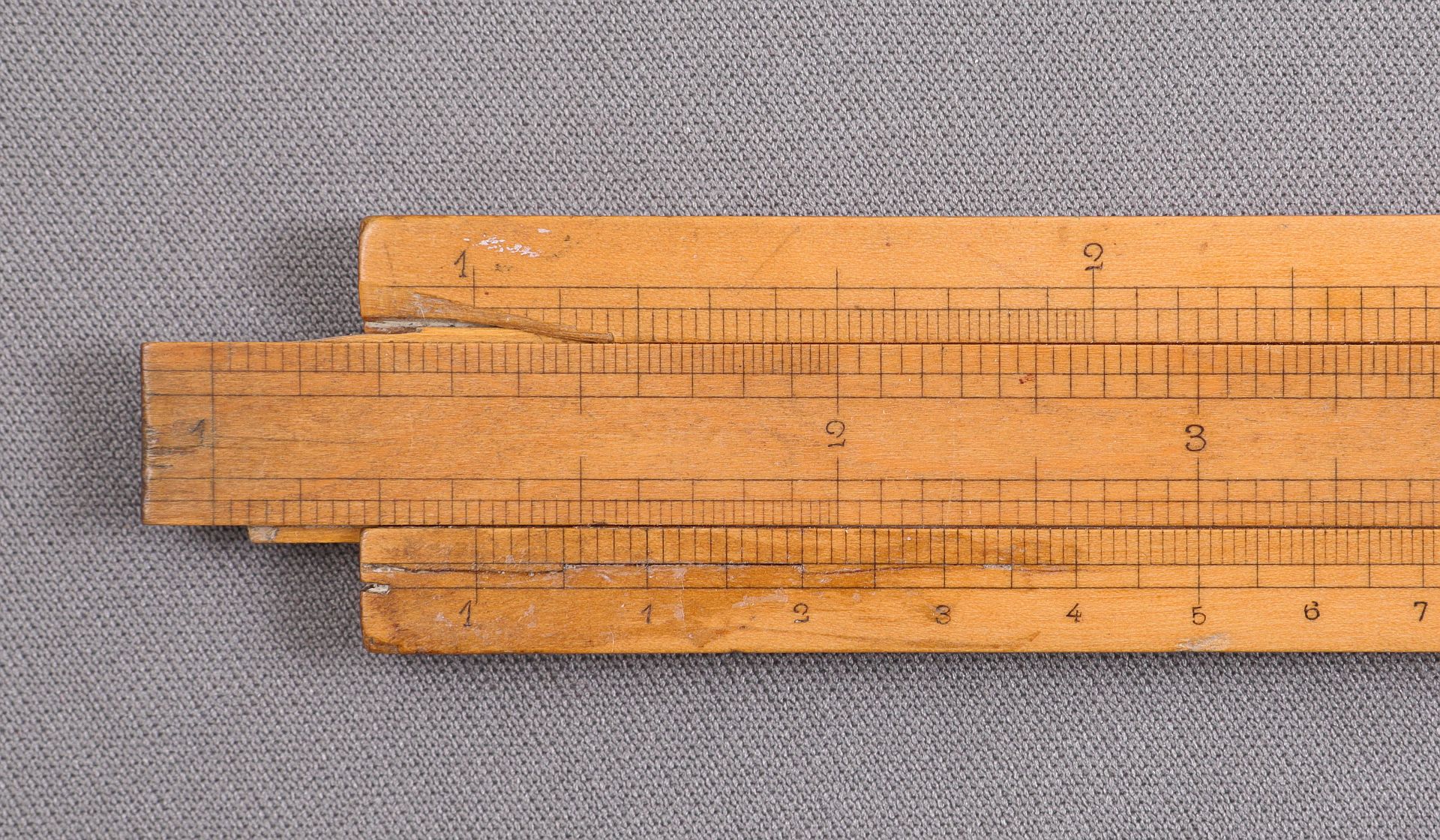
Tavernier-Gravet boxwood SOHO slide rule,
Rue de Babylone address
The SOHO slide rule was designed in the late 1700s by James Watt, of steam engine fame. This particular SOHO slide slide rule was made by Tavernier-Gravet of Paris, France. The address on the rule, Rue de Babylone indicates that this one was made between 1867 and 1881. The SOHO slide rule is generally credited as being the first slide rule designed to be a general purpose calculating rule for engineers, rather than a trade-specific slide rule. The scales on a SOHO slide rule are, from top to bottom and using modern scale names, A, B, B, D. The first three scales are identical 2-cycle logarithmic scales, and the last is a single-cycle logarithmic scale. You use the top pair of scales for multiplication and division, and the bottom pair for squares and square roots. SOHO slide rules have no cursor, and none is required because you are always using adjacent scales. Either a brass button or fingernail notch on the right end of the slide is a common feature of T-G SOHO rules, and is presumably there to give your fingers some purchase to move the slide. The fingernail notch on this one has been torn out through hard use. The SOHO slide rule was a major contributor to the design of the Mannheim slide rule, which came along roughly 70 years later. This SOHO slide rule shows significant wear and on the back a little ink staining. There is a small piece (≈2 cm) long missing from the upper stator at the left end. There are cracks at both ends that appear to have been glued shut. Both the upper and lower edges are vertical, not beveled. The upper edge is blank, and the lower edge has a 25 cm ruler. There appears to be glue residue on the back, but the paper label it would have held on is long gone.
|
|
| 30 |
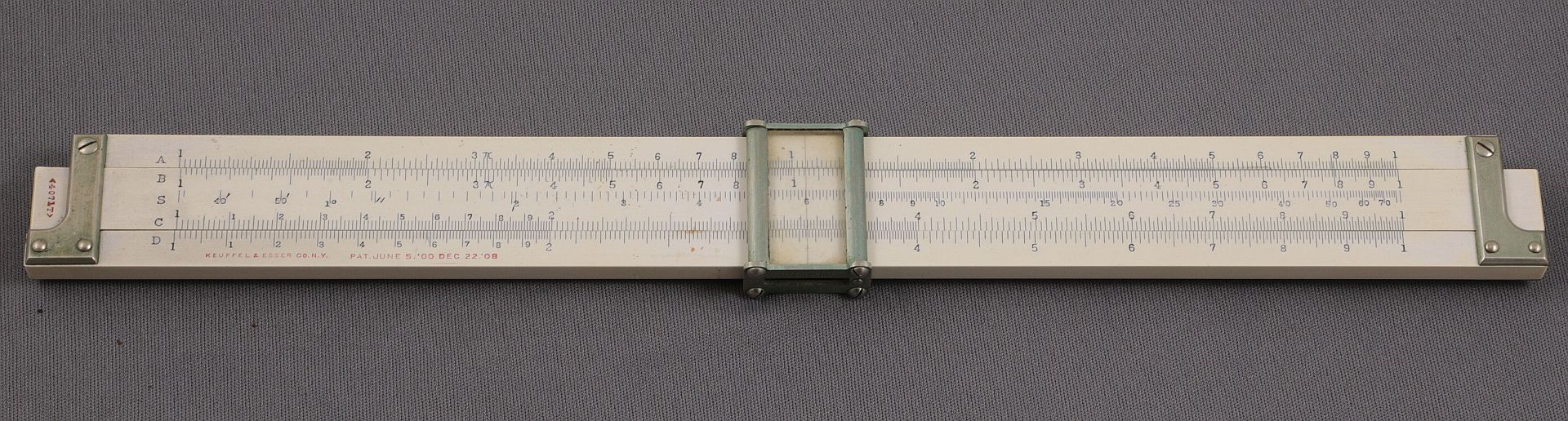
K&E 4071T slide rule with column cursor,
excellent condition
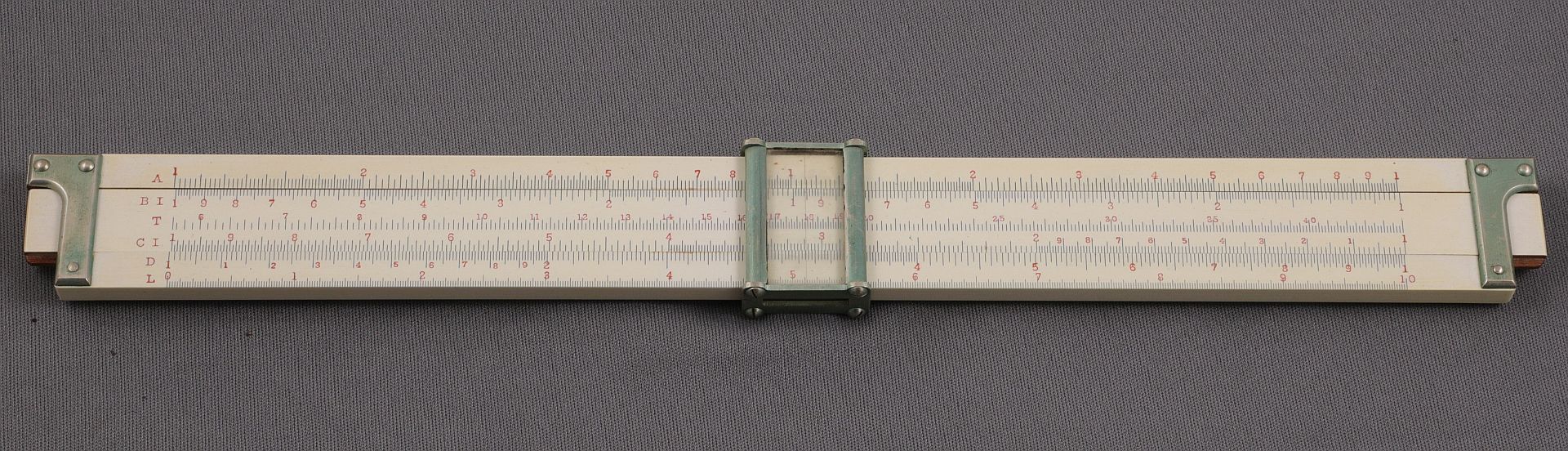
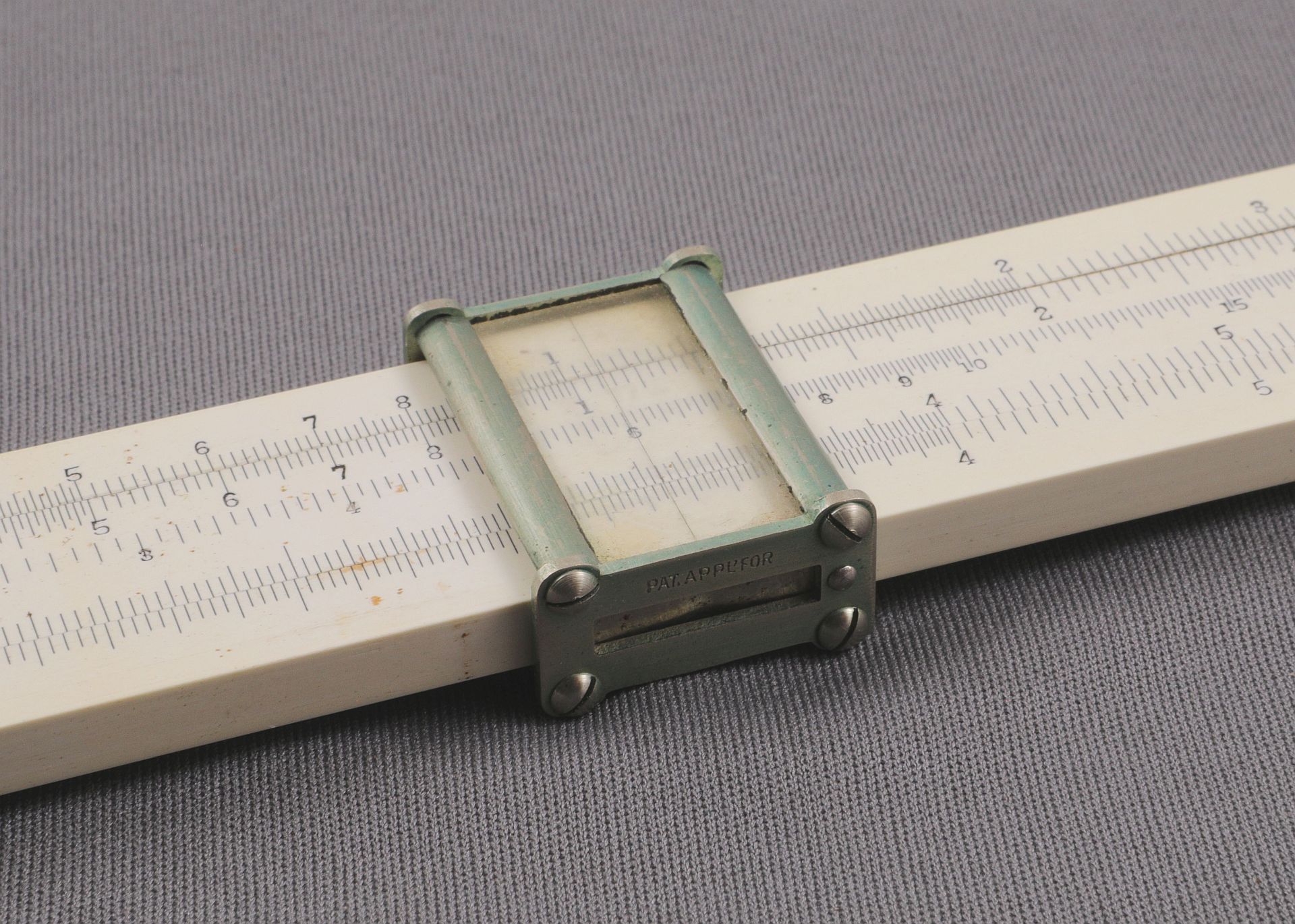
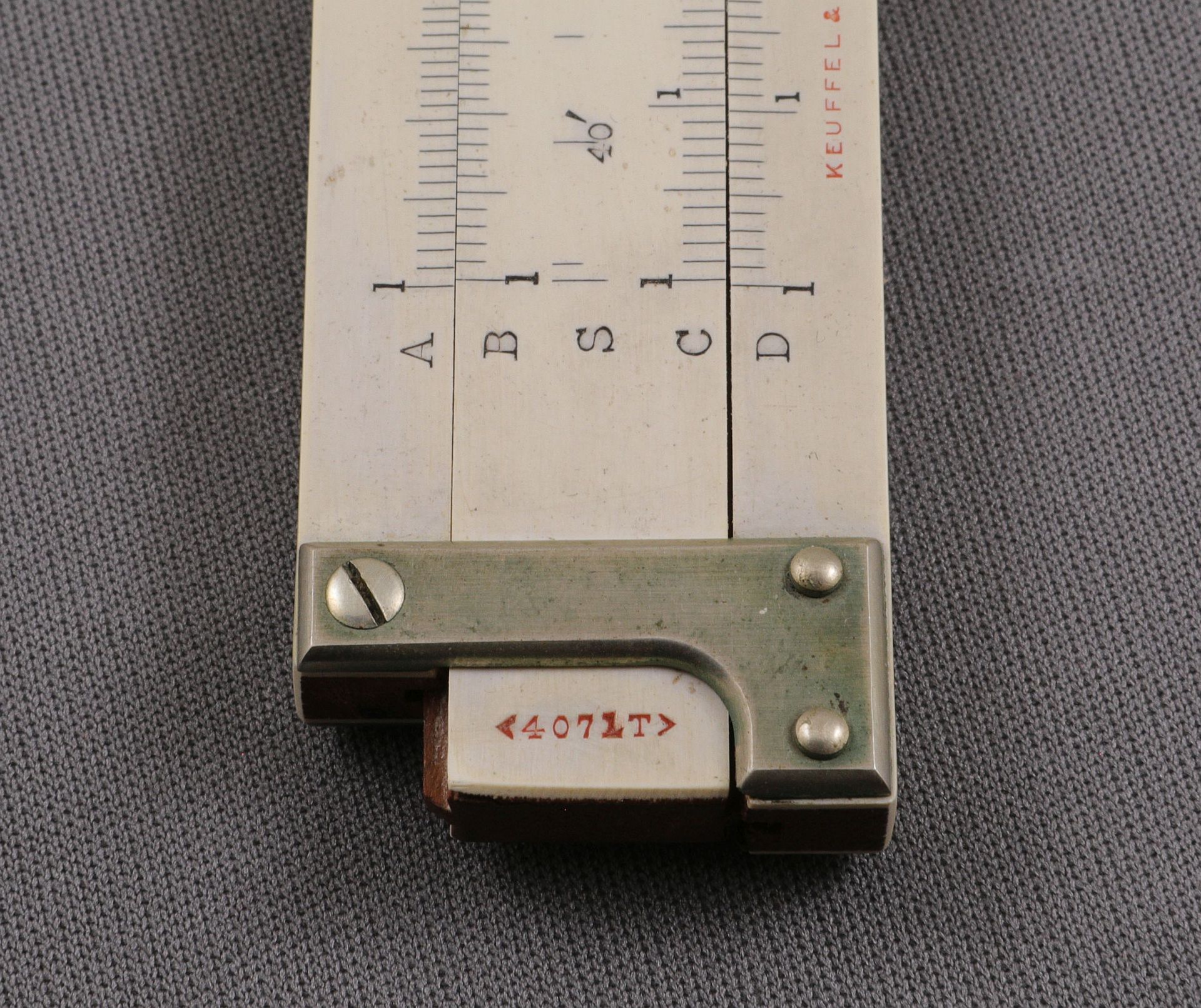
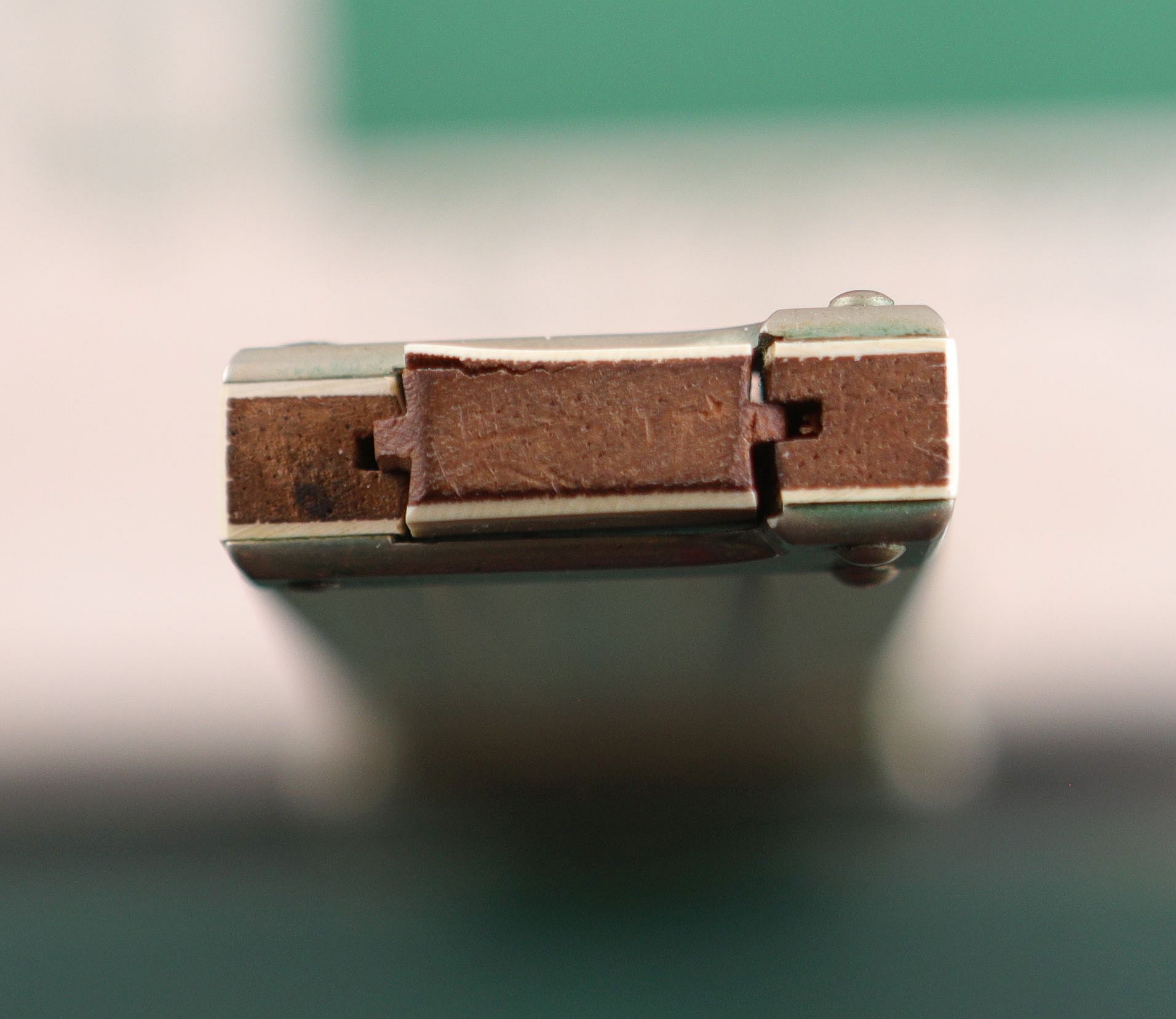
Keuffel & Esser described the 4071T in their catalog as Duplex Slide Rule, 10 in., like No. 4071 but with trig. scales. True enough, this duplex slide rule has S and T scales. The column (or pillar) cursor dates it to 1913-1915. This slide rule is in outstanding condition except for the celluloid face on the slide is starting to peel up at one corner, which causes it to hang up on the end braces. There are no cuts, gouges, or scrapes anywhere else on the rule. The cursor looks brand new. There is no case.
|
|
| 31 |
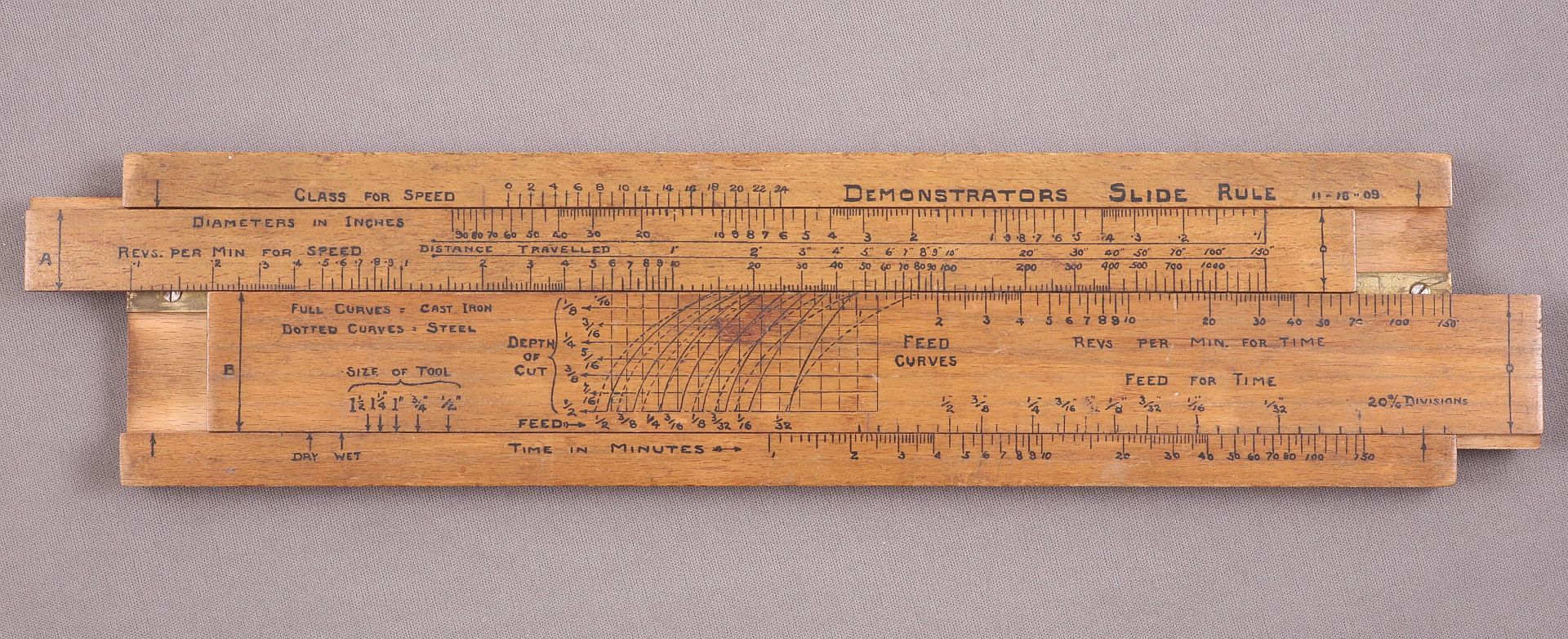
Demonstrators Slide Rule - for machine shop "feeds and speeds",
dated 11-16-09
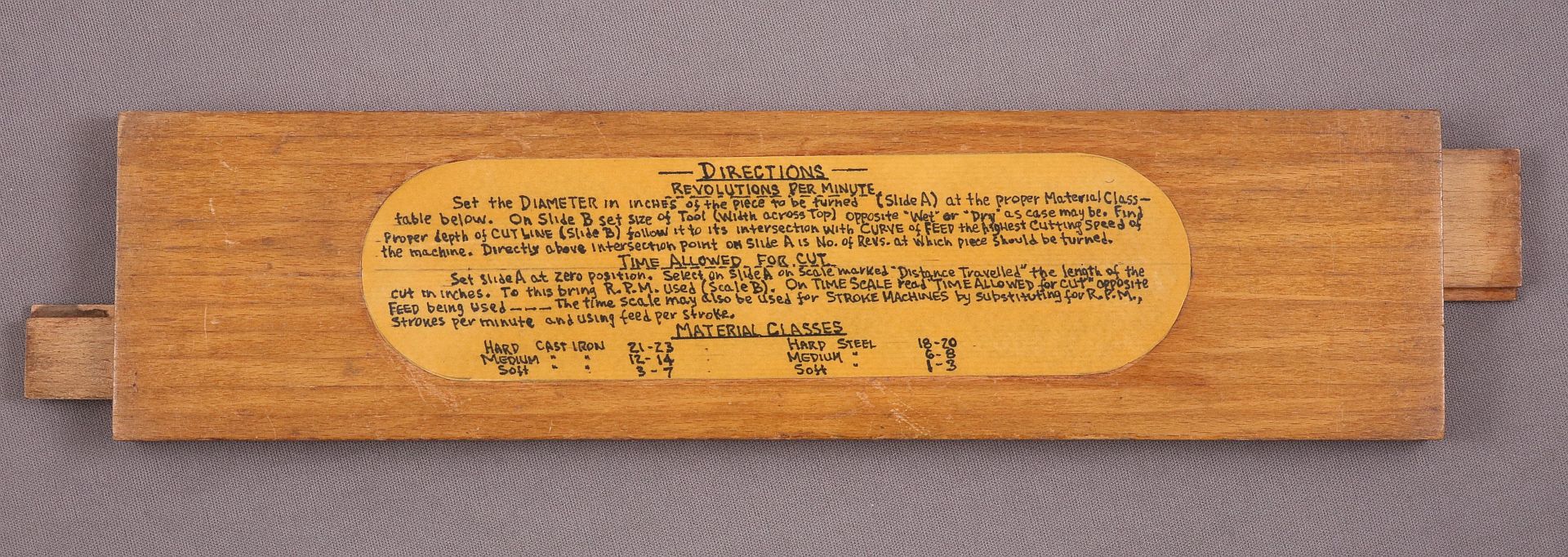
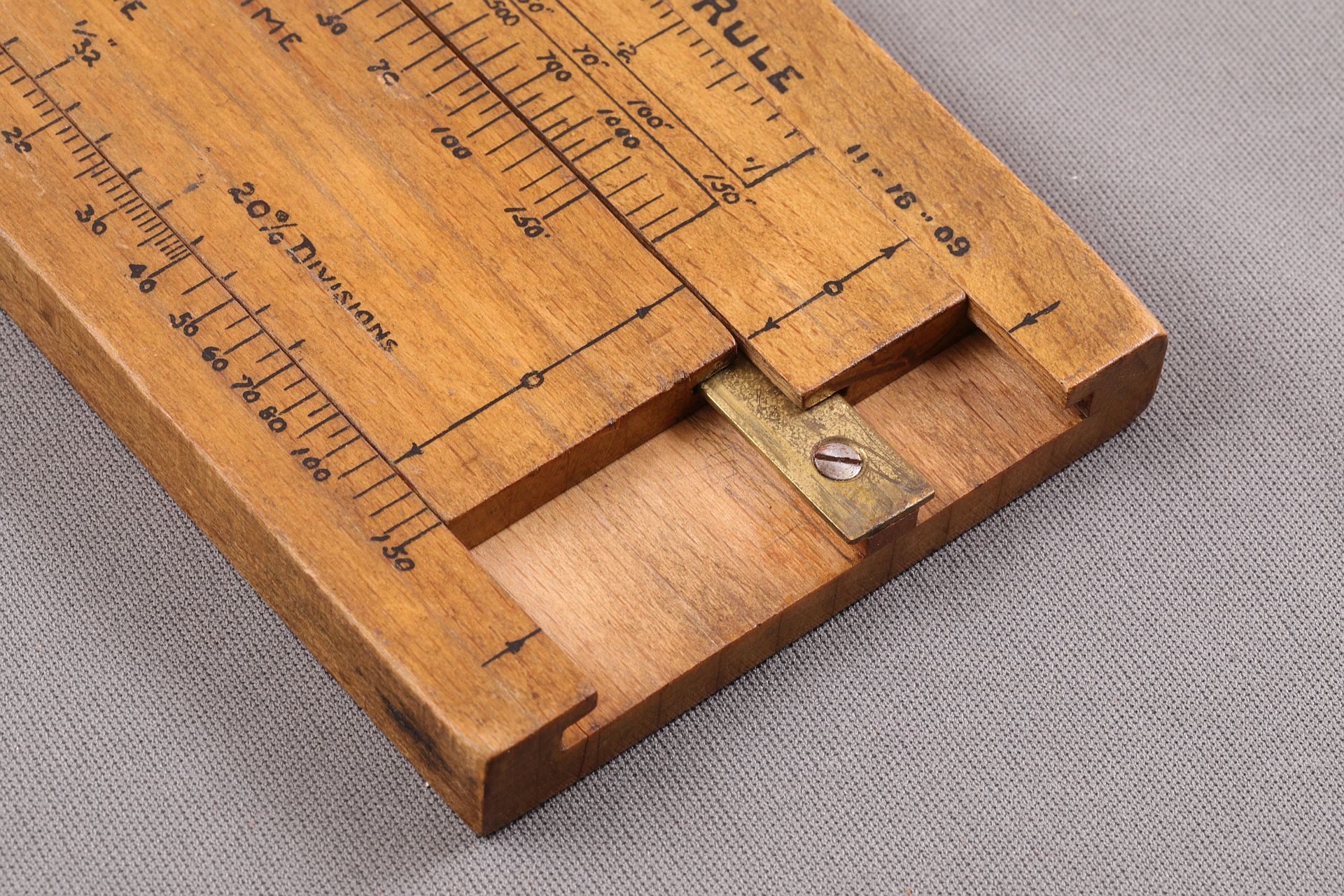
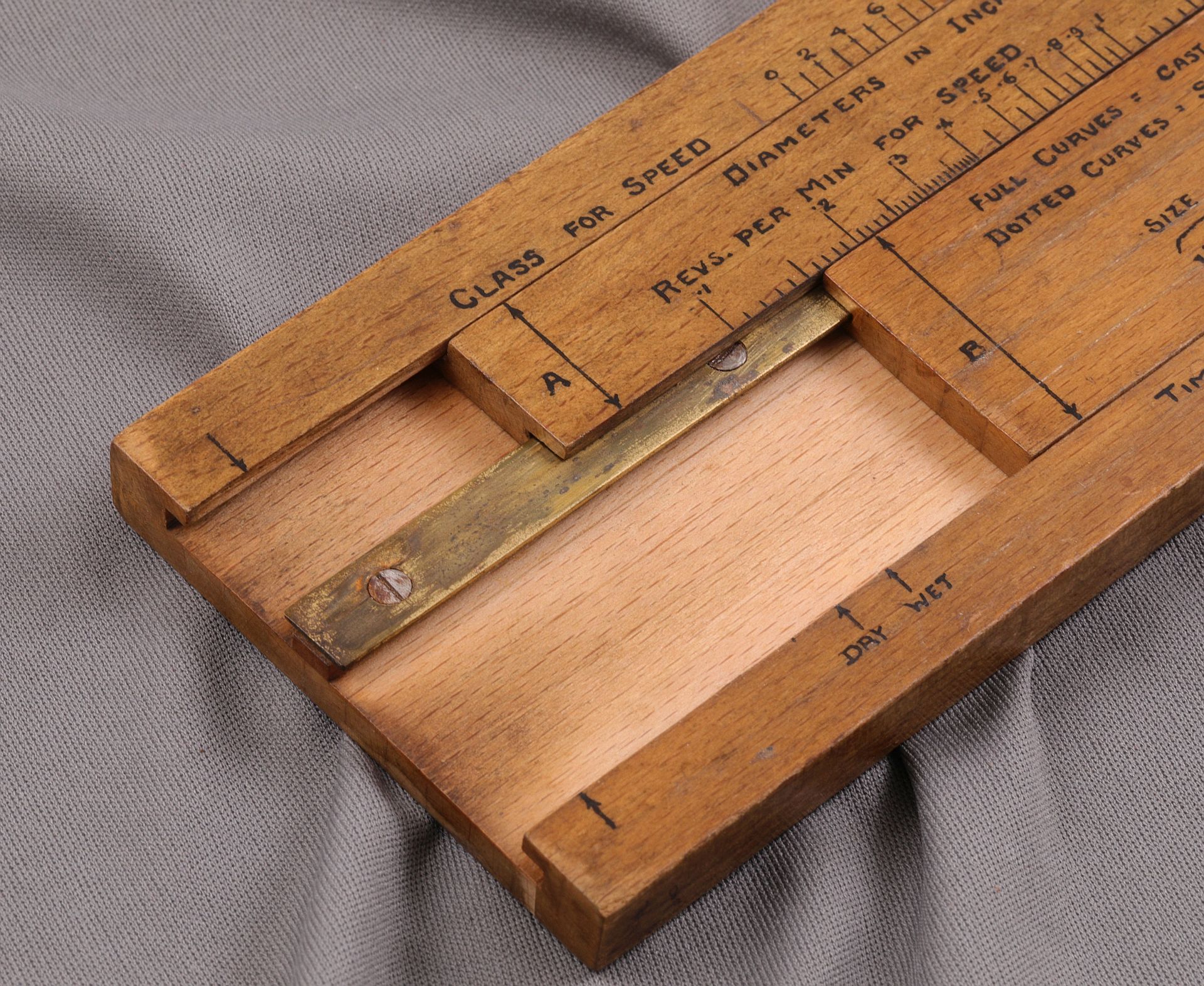
This slide rule is only 12 inches long, a common length, but it is ½ inch thick, and 3 inches wide, so it gives an impression of being very large and heavy. There are two slides, both single-sided. The slides, and the wells underneath them, are blank. The instructions are on the back. This rule solves the problem of how fast to run the lathe or mill for the size of the work piece, the diameter of the tool, and the hardness of the material. Why it is called the Demonstrators Slide Rule is a mystery.
|
|
| 32 |
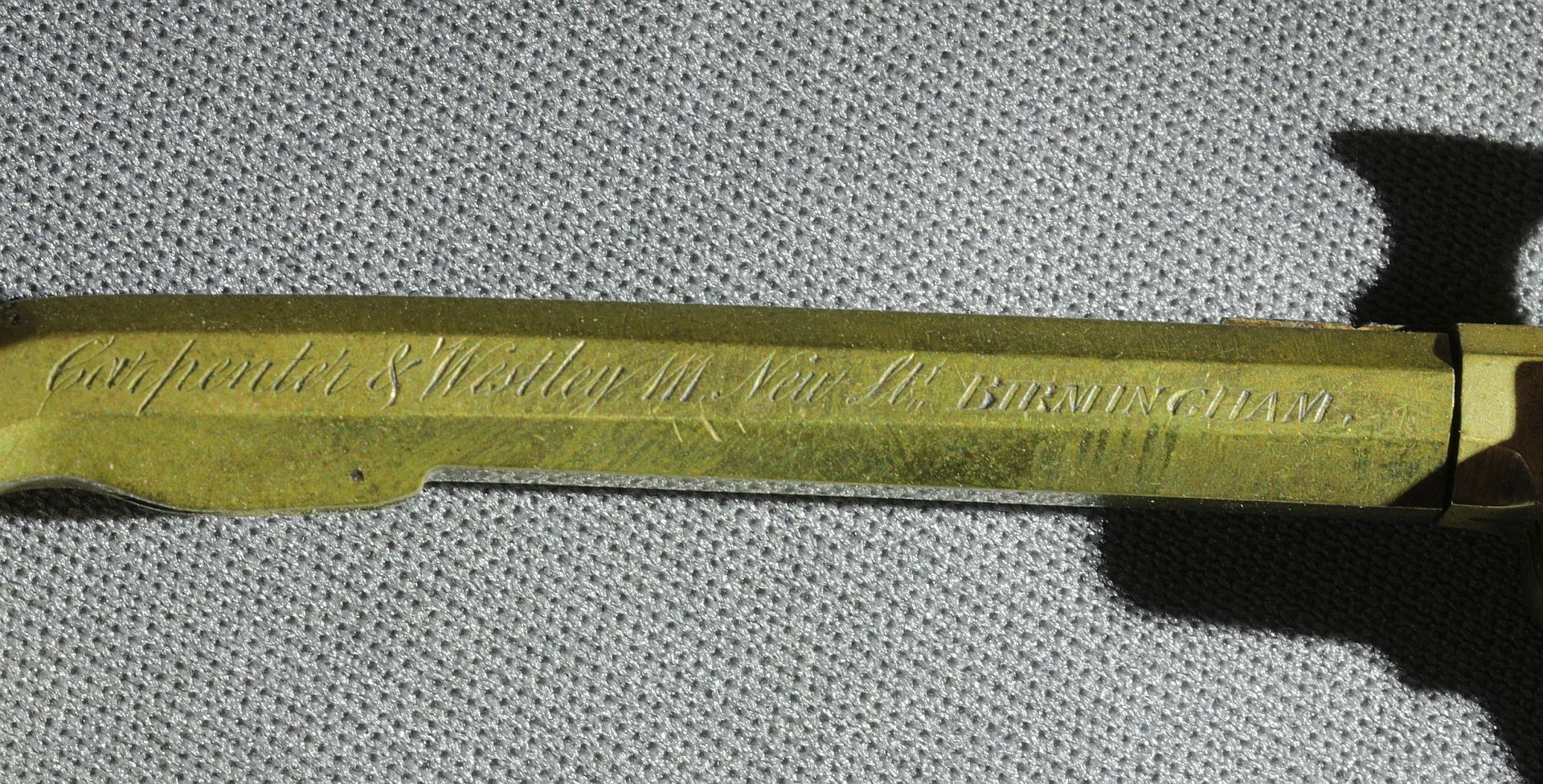
Napier's Compass by Carpenter & Westley, 111 New St., Birmingham
This Napier's Compass is, in function, identical to auction item 24 of this auction: divider points by default on both arms, switchable to pencil on one side and ink pen on the other. Most Napier's Compasses are not marked with a maker's name, but this one is: Carpenter & Westley 111 New St. Birmingham.
|
|
| 33 |
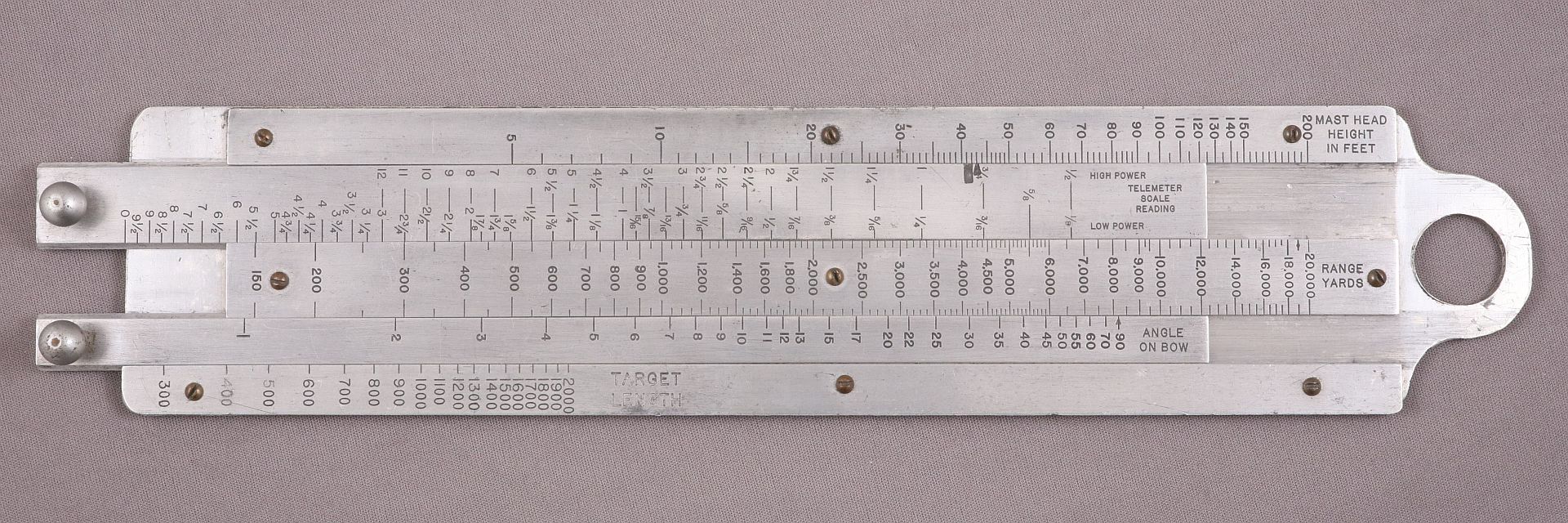
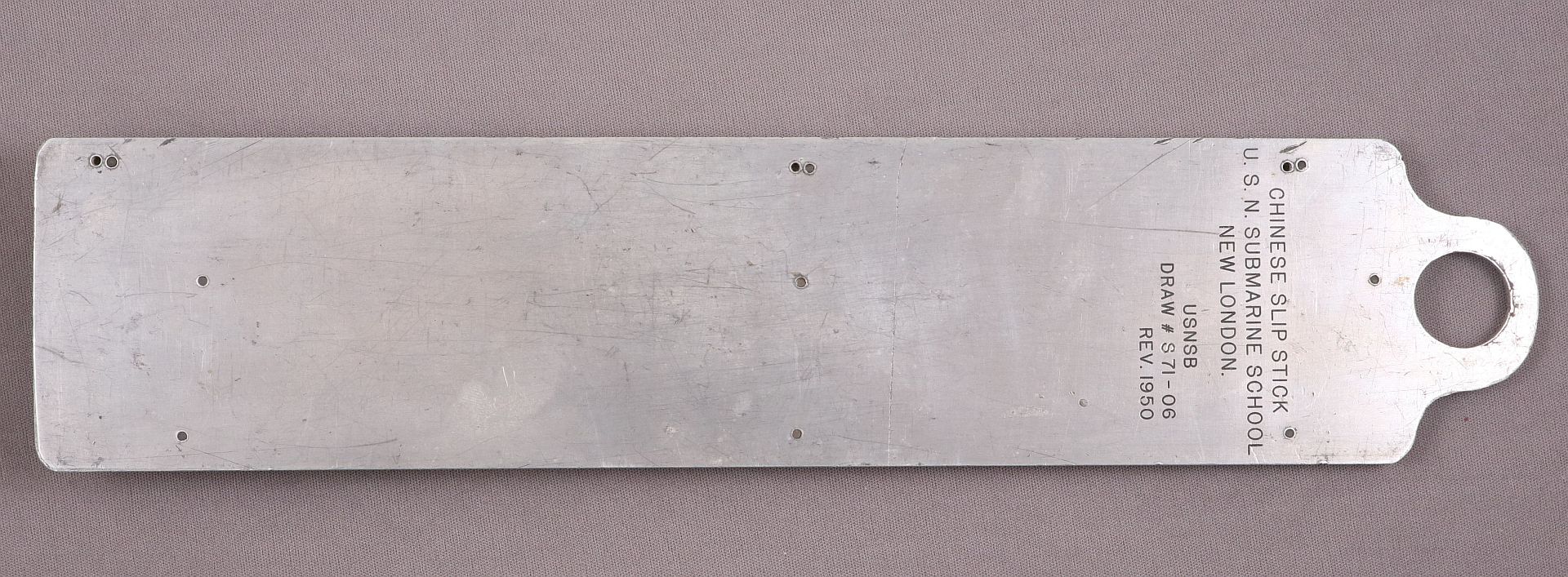
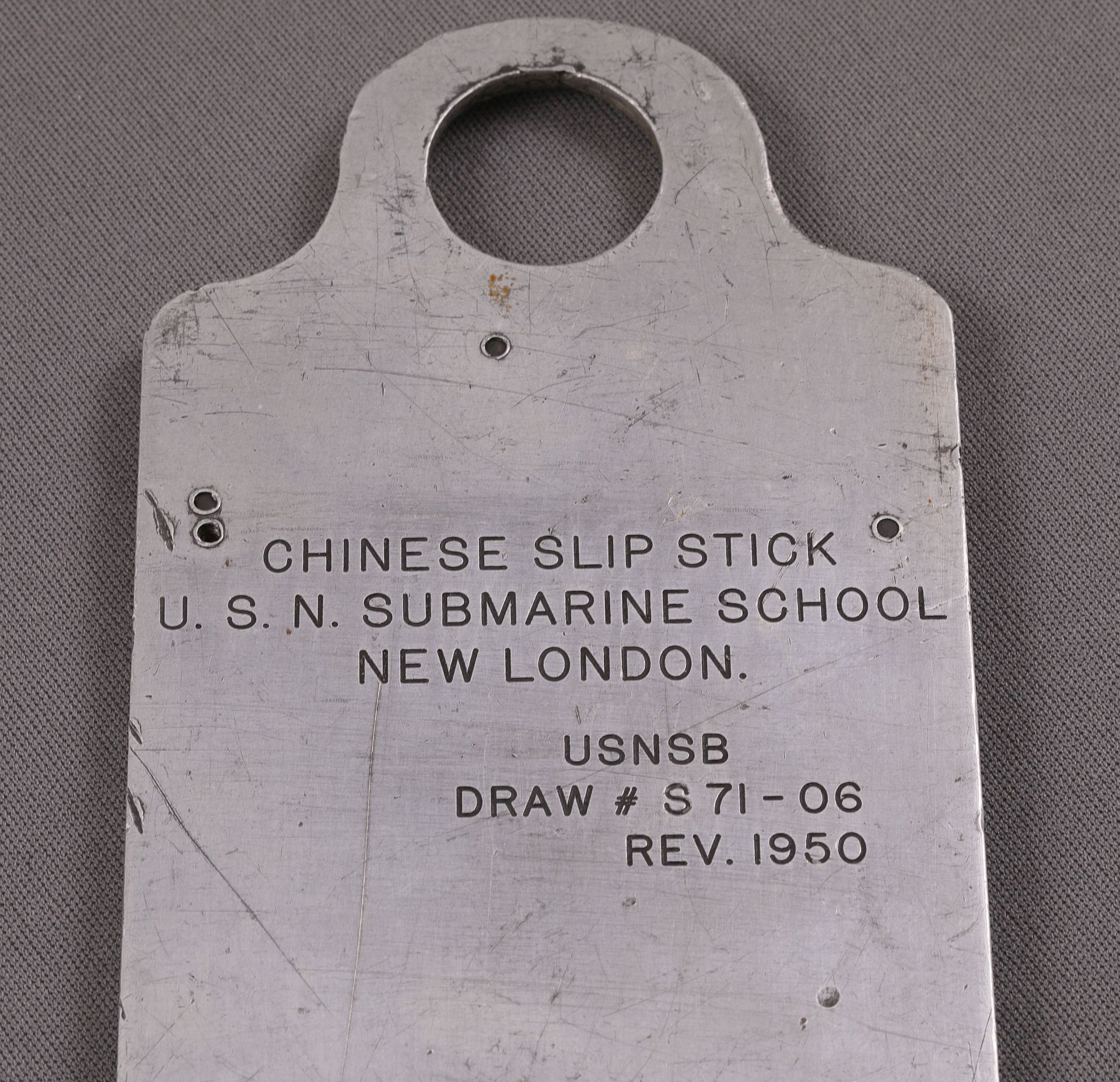
"Chinese Slip Stick U.S.N Submarine School"
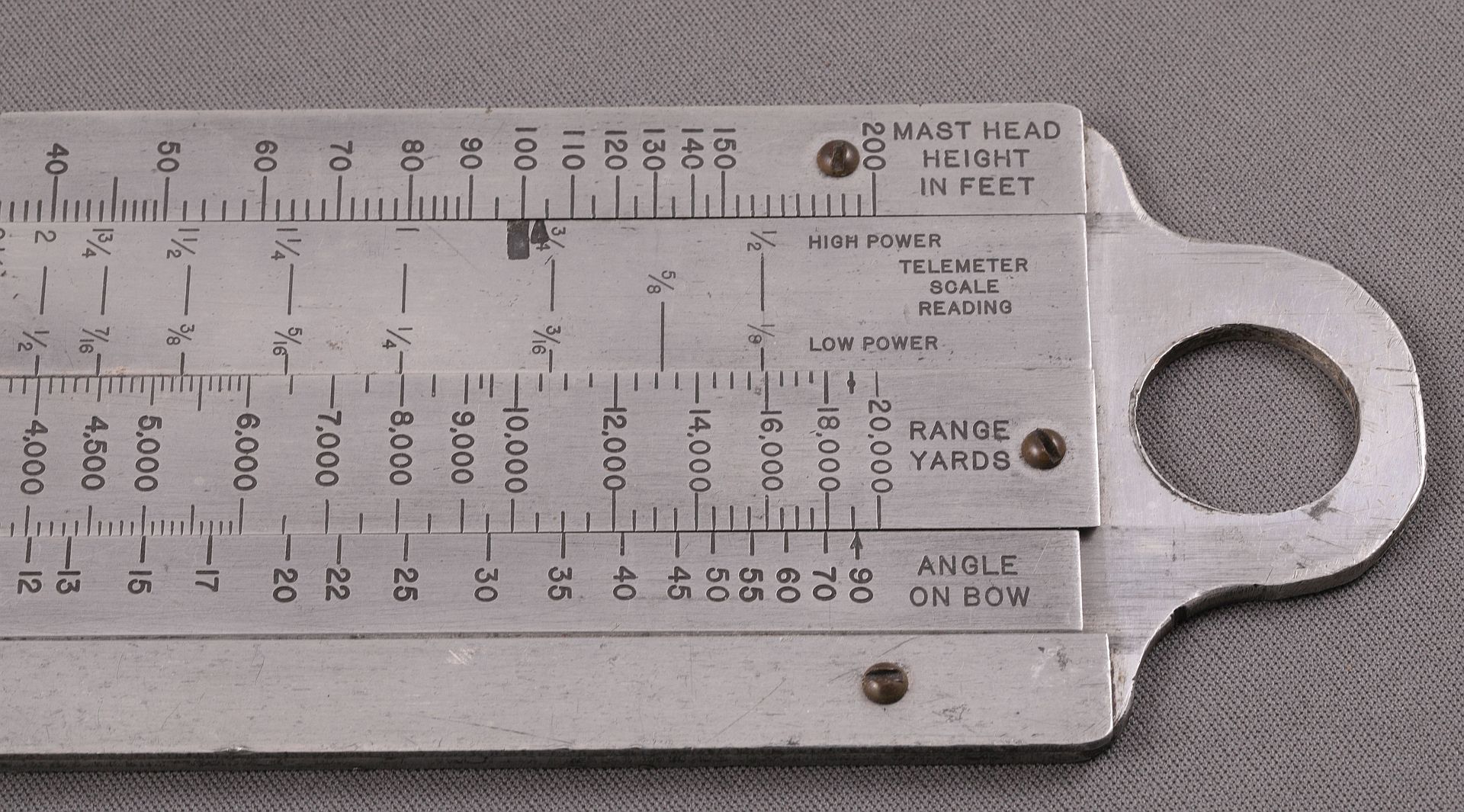
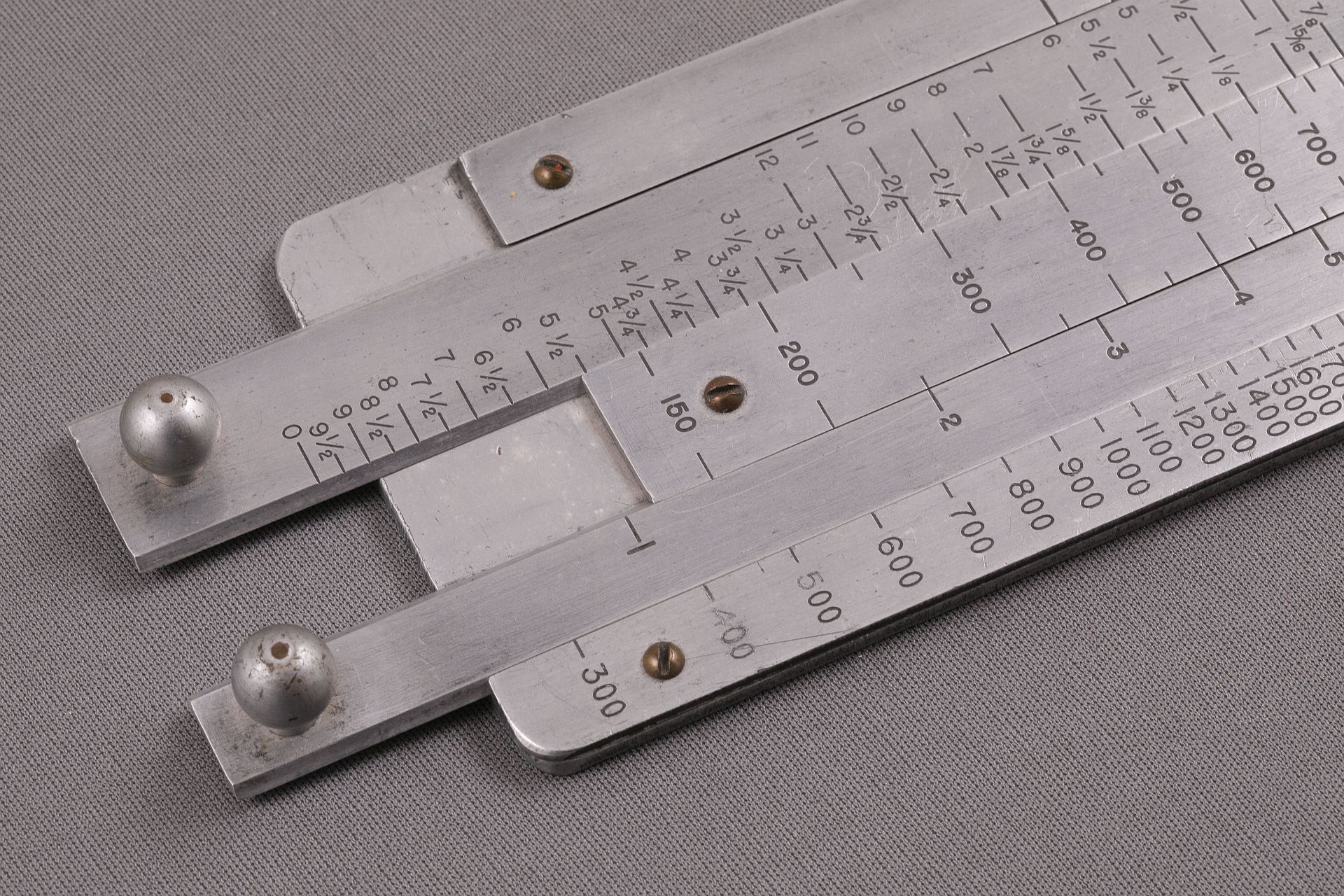
Aluminum slide rule
This slide rule is 14 inches long, 3 inches wide, has two slides, is made entirely of aluminum, and on the back is labeled "Chinese Slip Stick" for no obvious reason. The scales, "Range Yards", "Angle on Bow", "Target Length", suggest it was used for artillery or possibly torpedo calculations. There is a large (⅜ inch) aluminum knob on the end of each slide, making them very easy to grab and move. The large hole at the right end is undoubtably for hanging the slide rule on a wall, a nice consideration in the tight confines of a submarine.
|
|
| 34 |
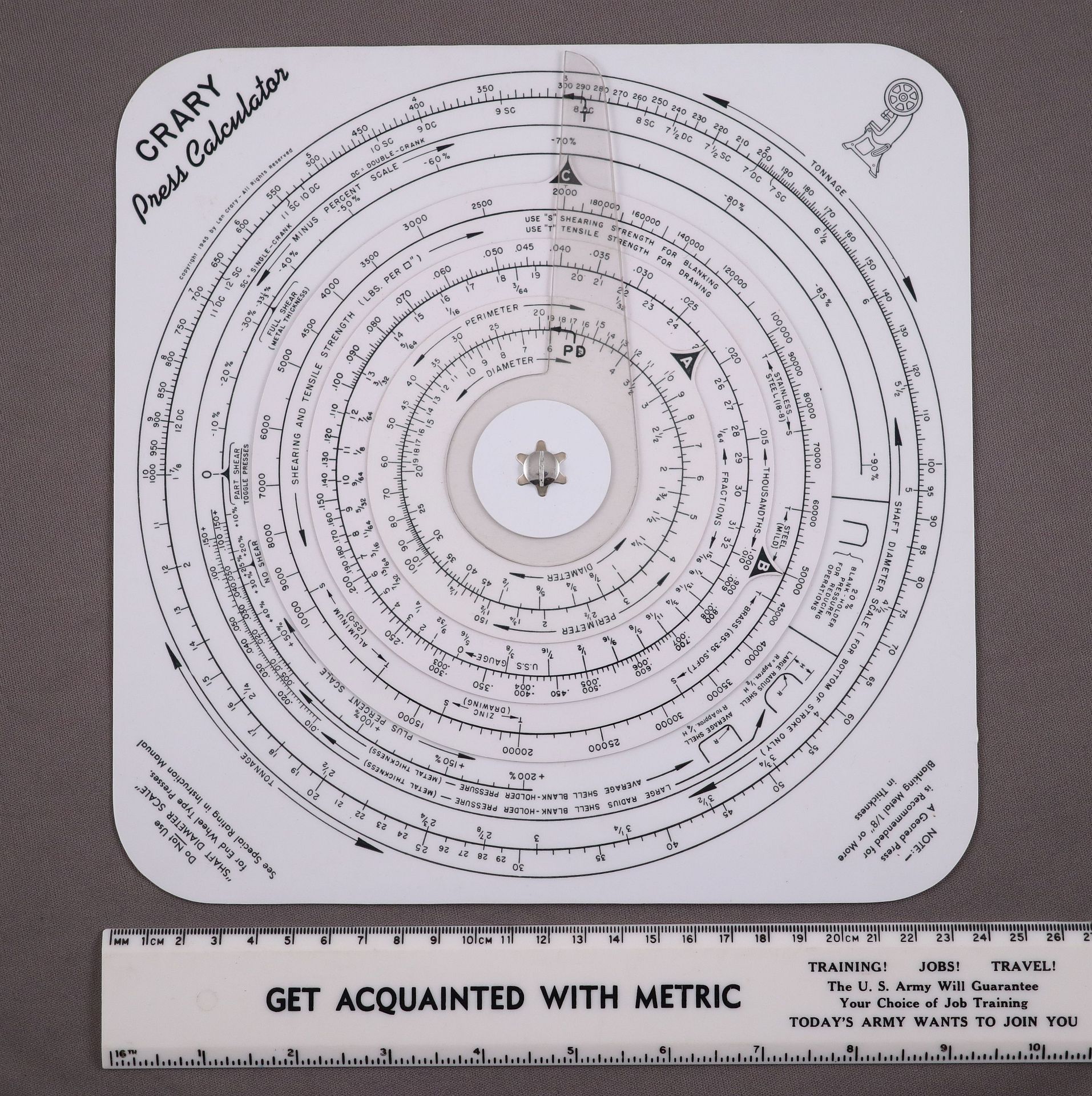
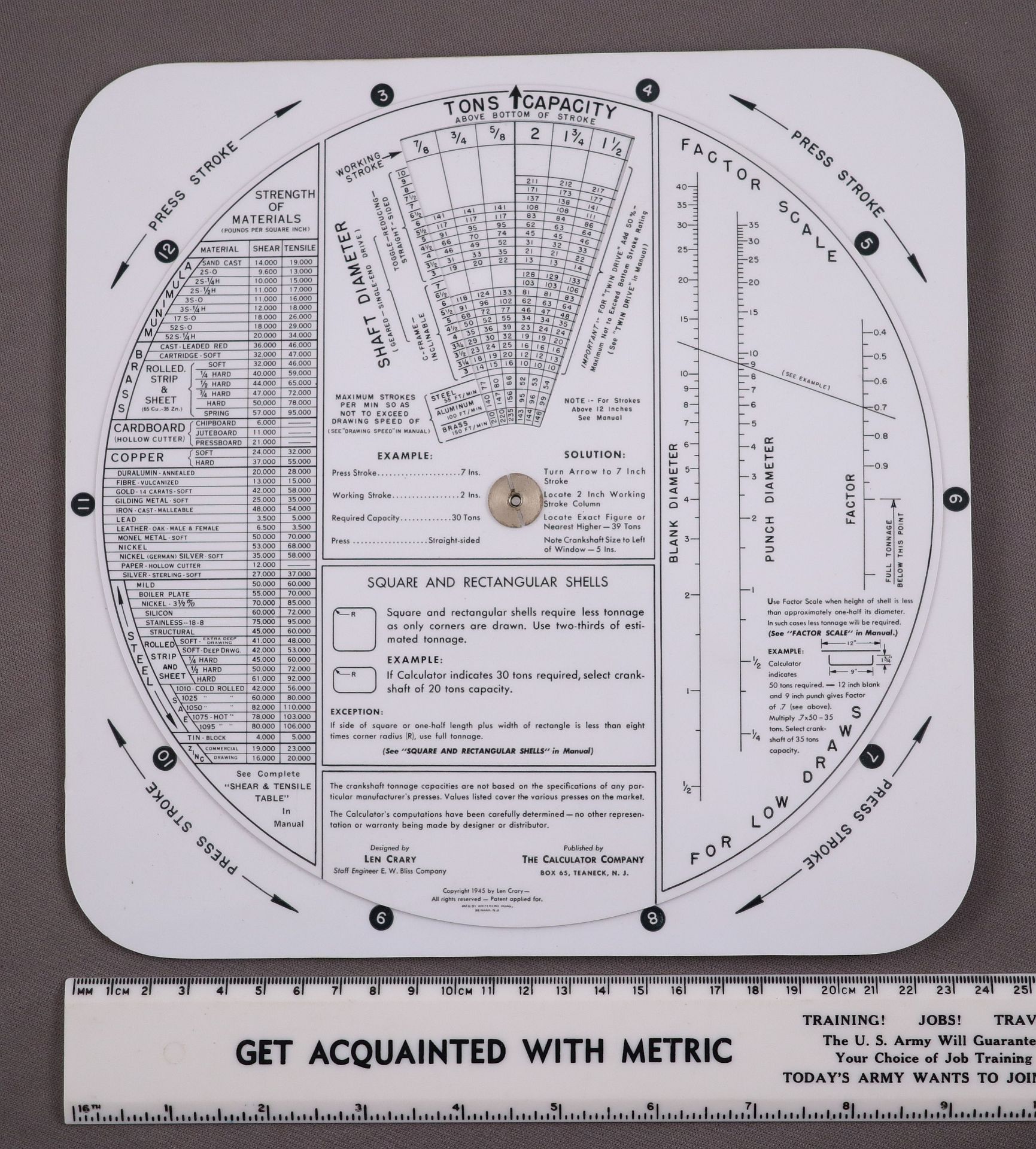
Crary Press Calculator, for machine shops,
with instructions and case
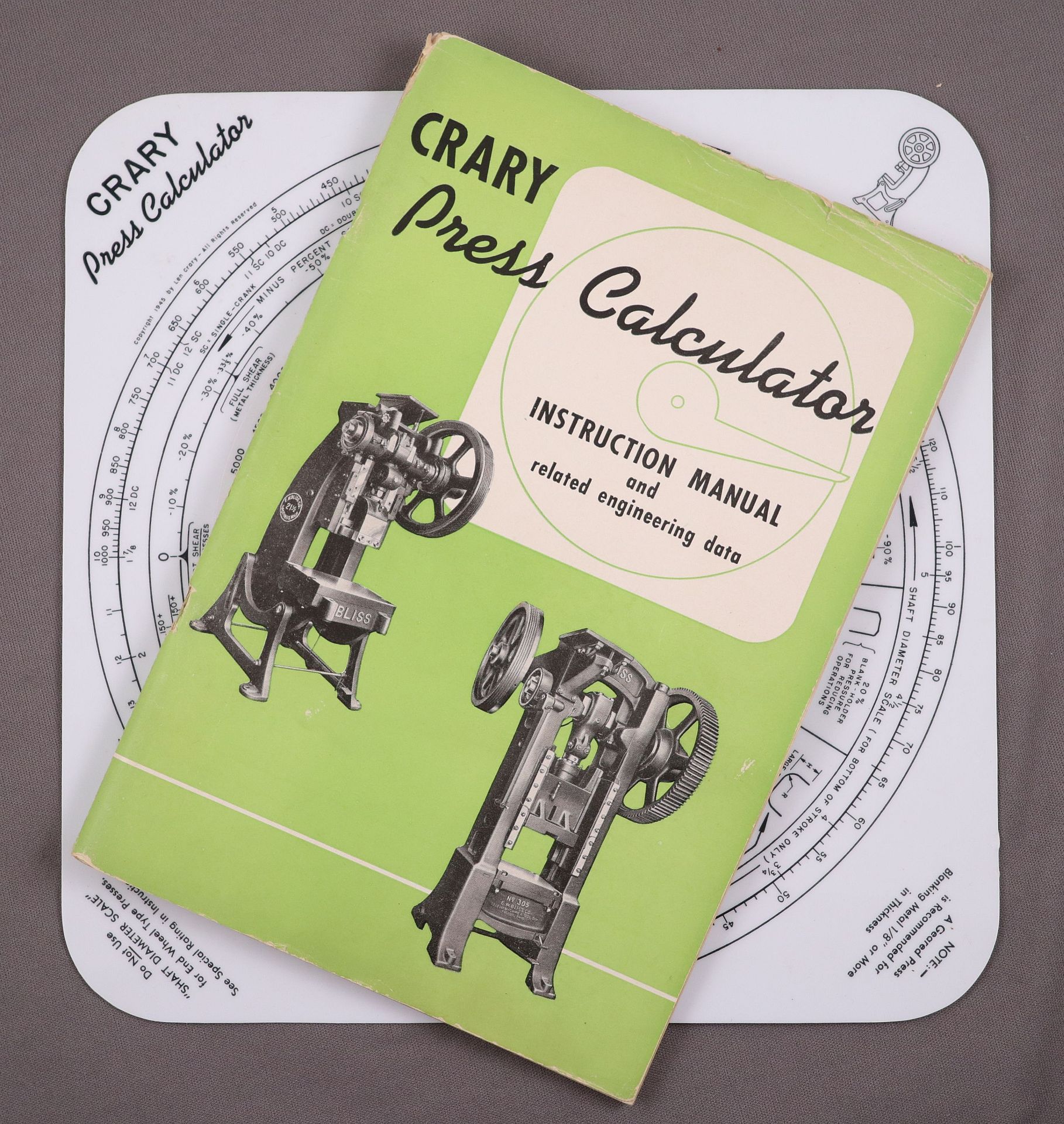
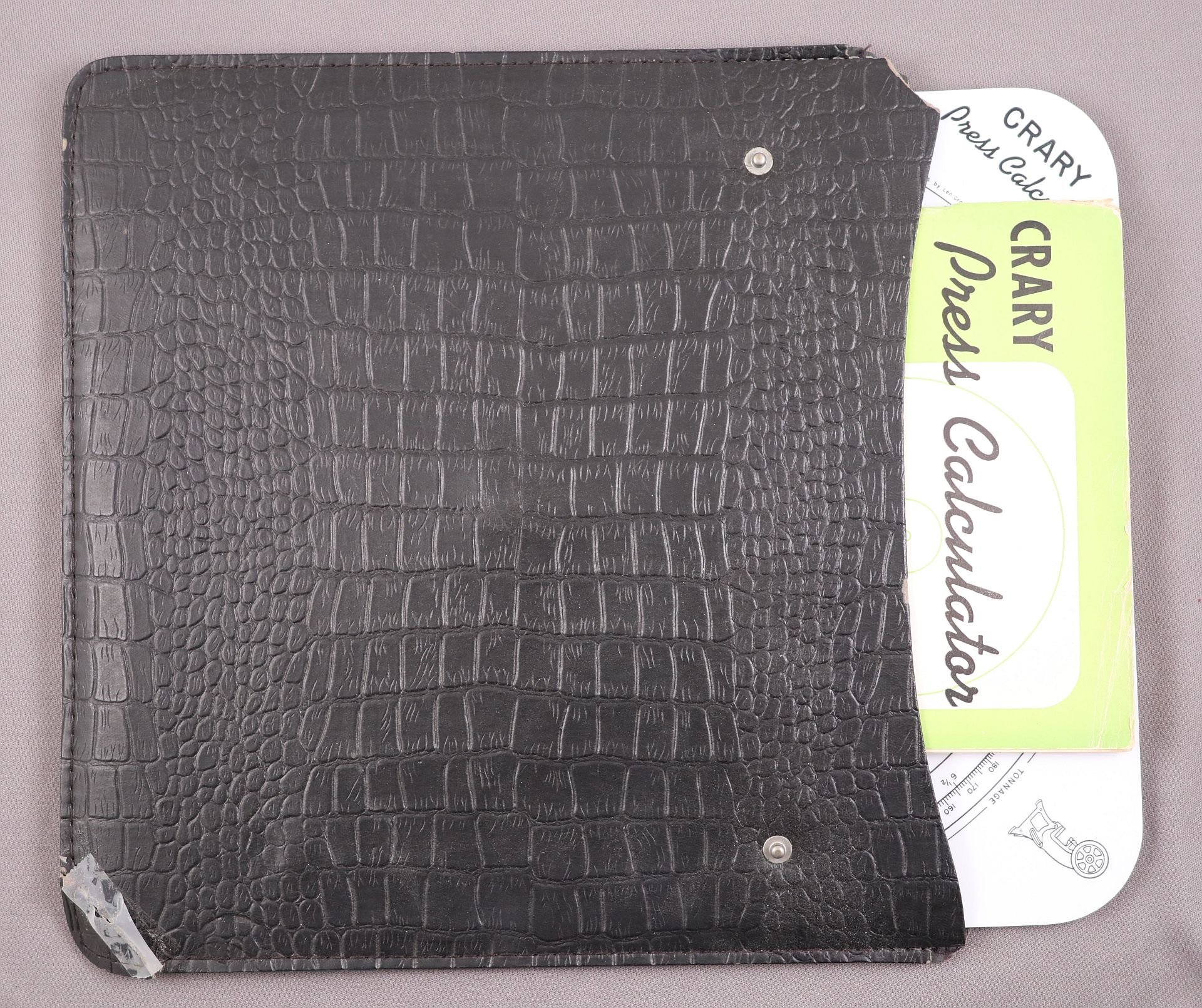
This is a large (9 ⅜ inches square), double-sided, very complicated slide rule for determining the size of press in a machine shop that is needed for a given job. There is a 70-page instruction manual included — so not just another simple slide chart! While the pressed fiberboard case is brittle and cracking, the calculator itself is perfect, as is the instruction manual, with the exception of minor tears on the front and back covers.
|
|
| 35 |
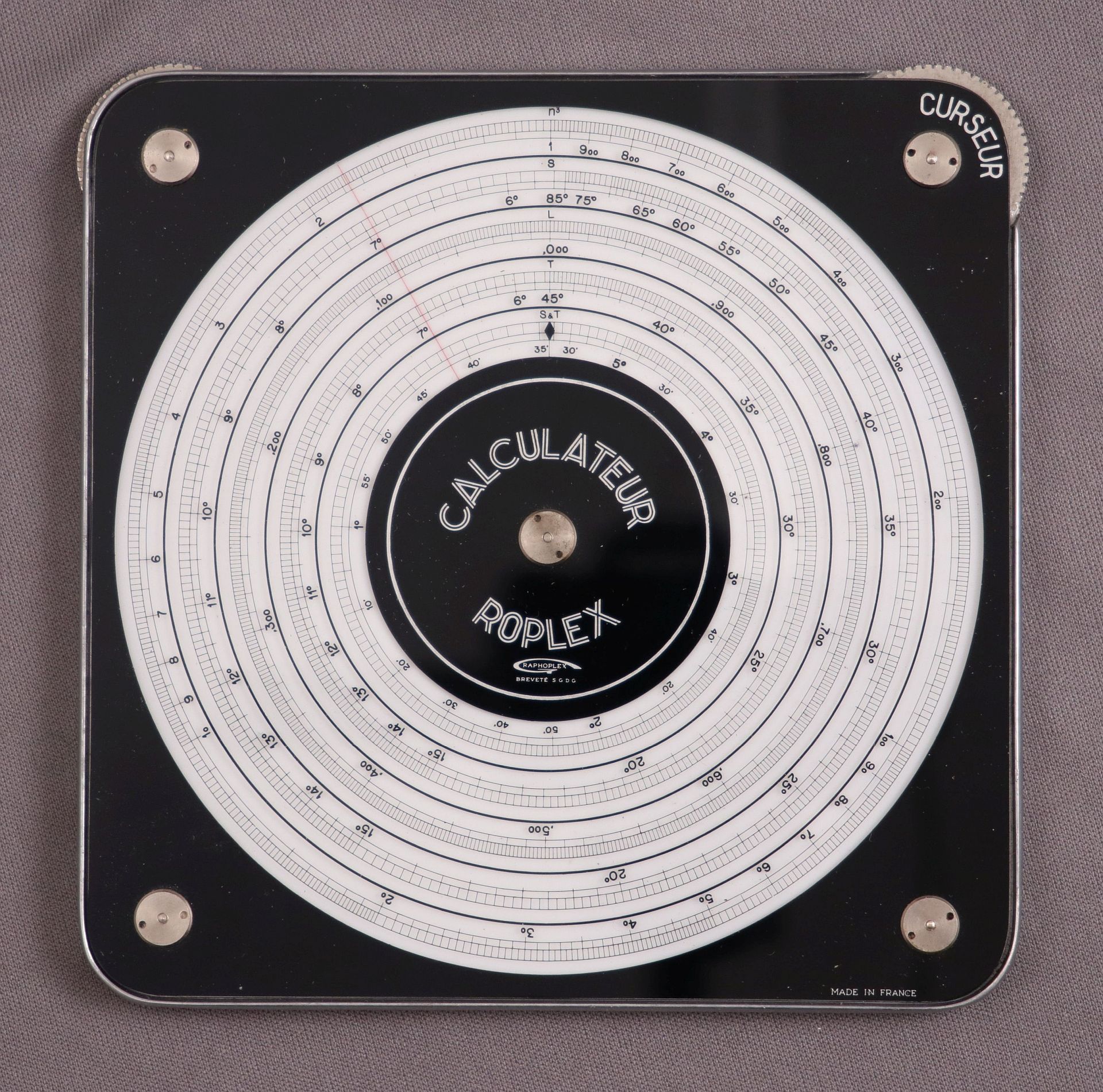
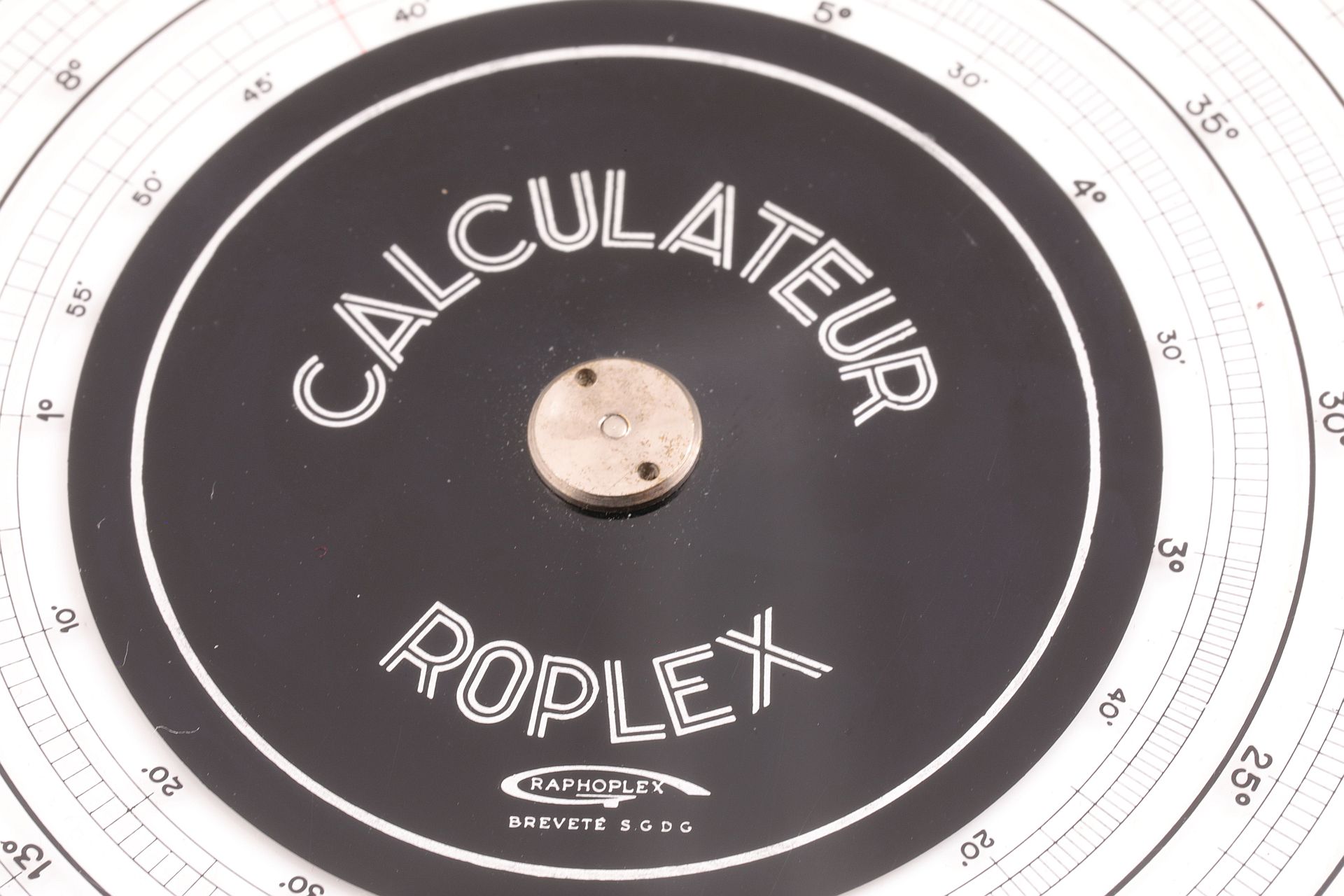
Graphoplex Calculateur Roplex
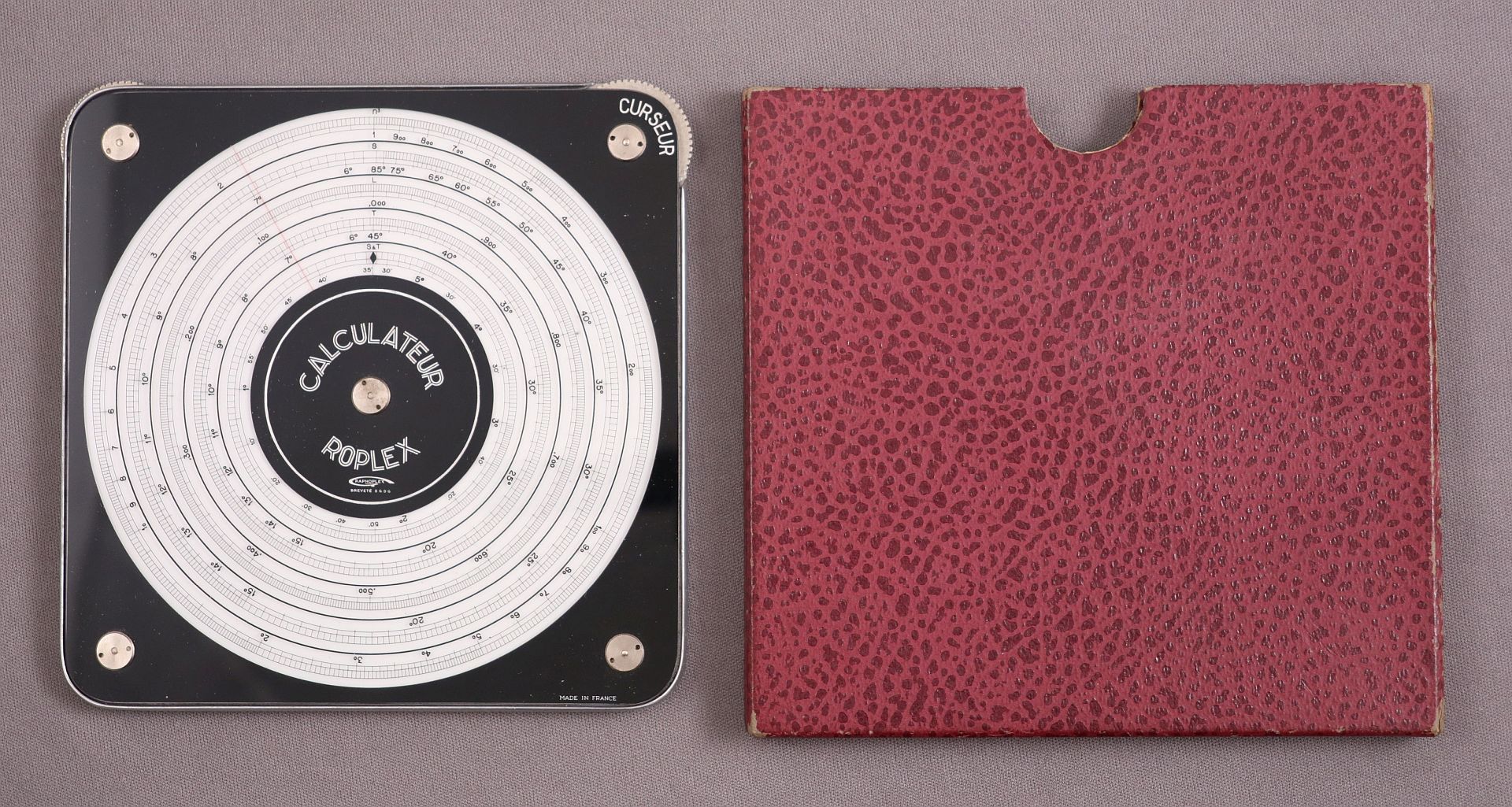
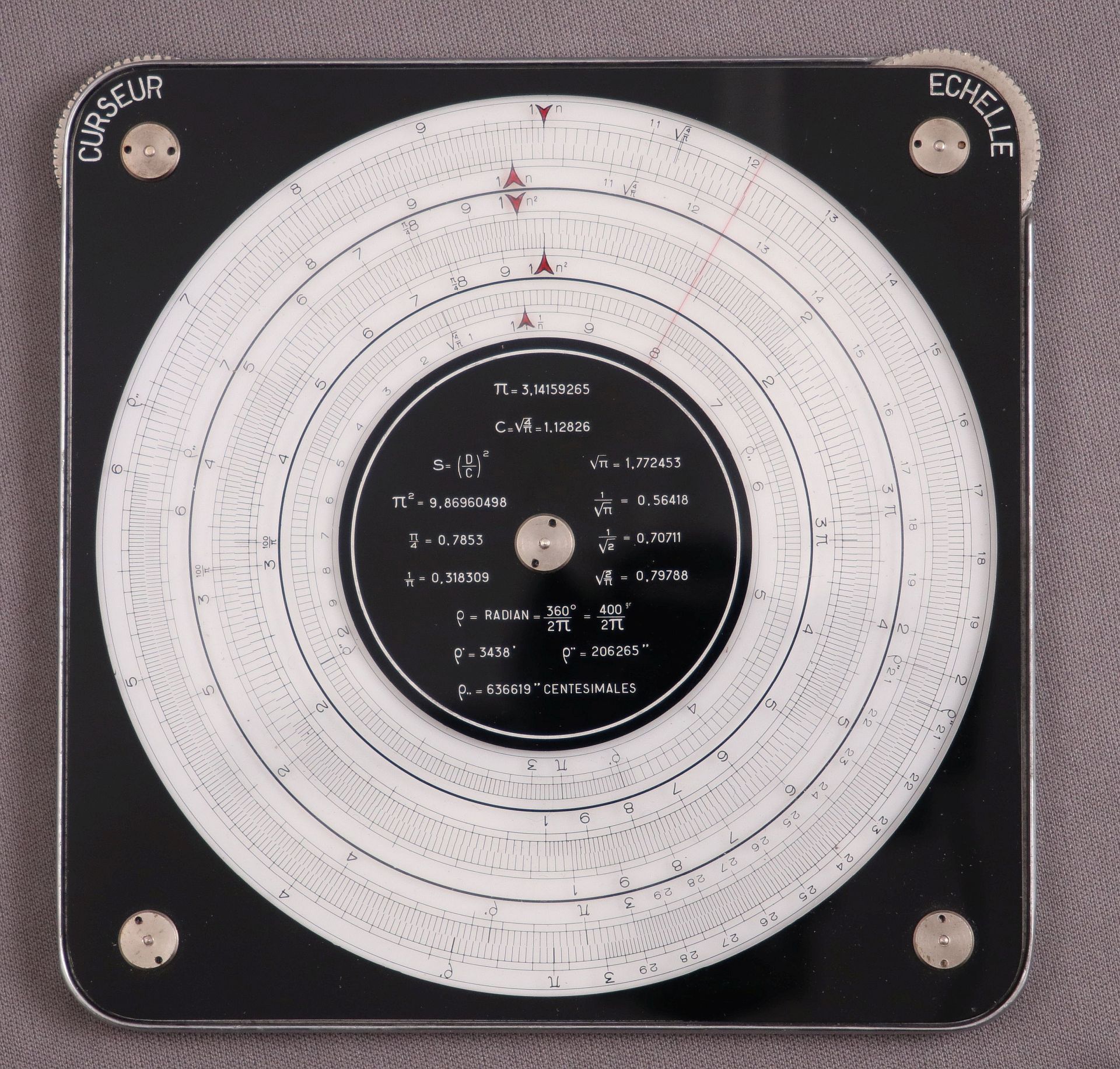
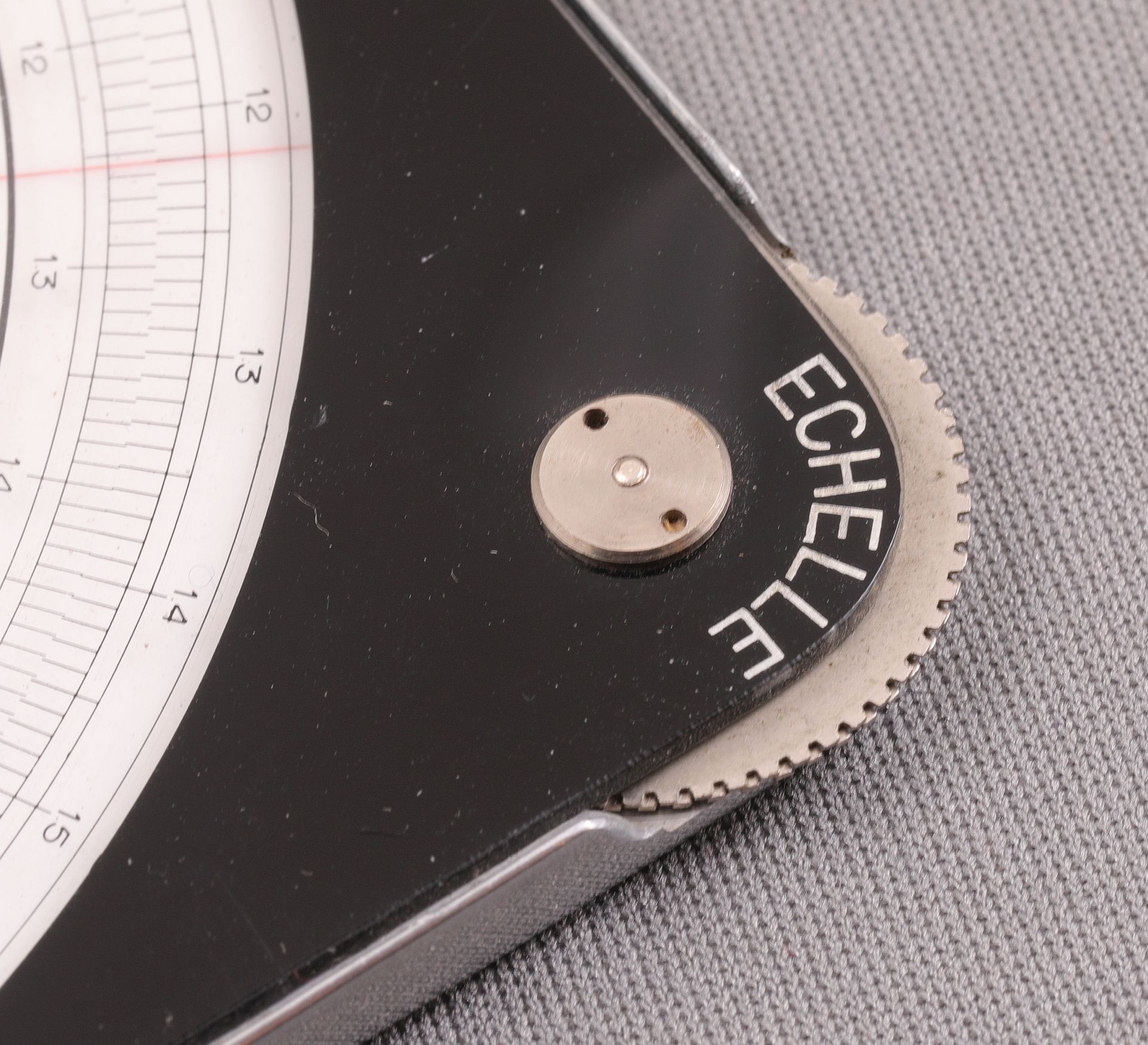
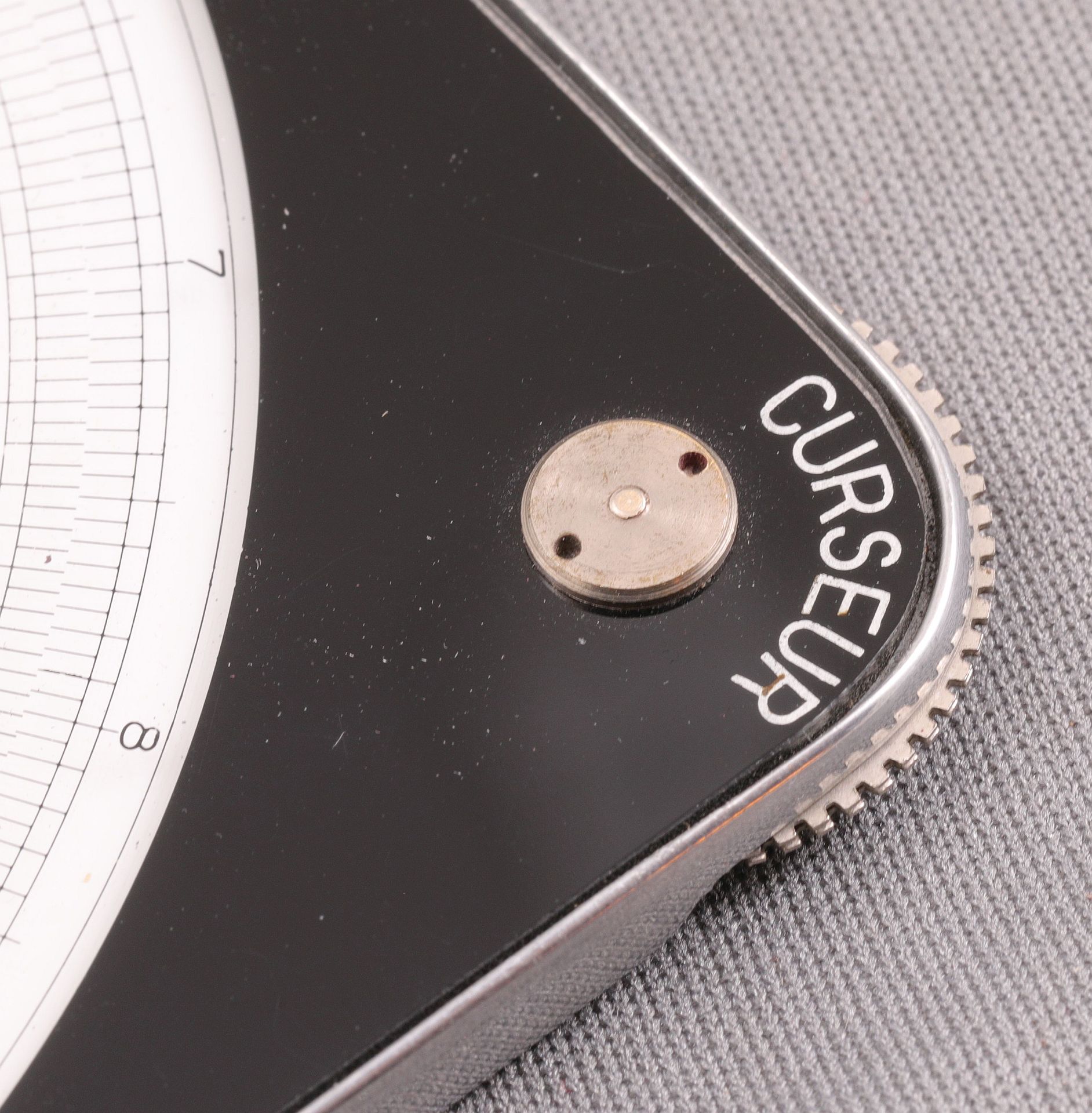
This circular slide rule in a square case is unique as far as I know. The scales on the front are, from outside to inside, D, C, B, A, and CI. On the rear, the scales are fixed and only the cursor moves. The scales are K, S, L, T, S&T. None of the scales are labeled. On the front the scales are moved by turning the notched wheel on the upper right corner labeled "ECHELLE", and the cursor is moved by turning the "CURSEUR" wheel on the upper left corner (these are the French words for scale and cursor). Only the C, B, and CI scales move on the front. The materials appear to be acrylic faces with an aluminum frame around the outside edge. There is a paperboard slipcase.
|
|
| 36 |
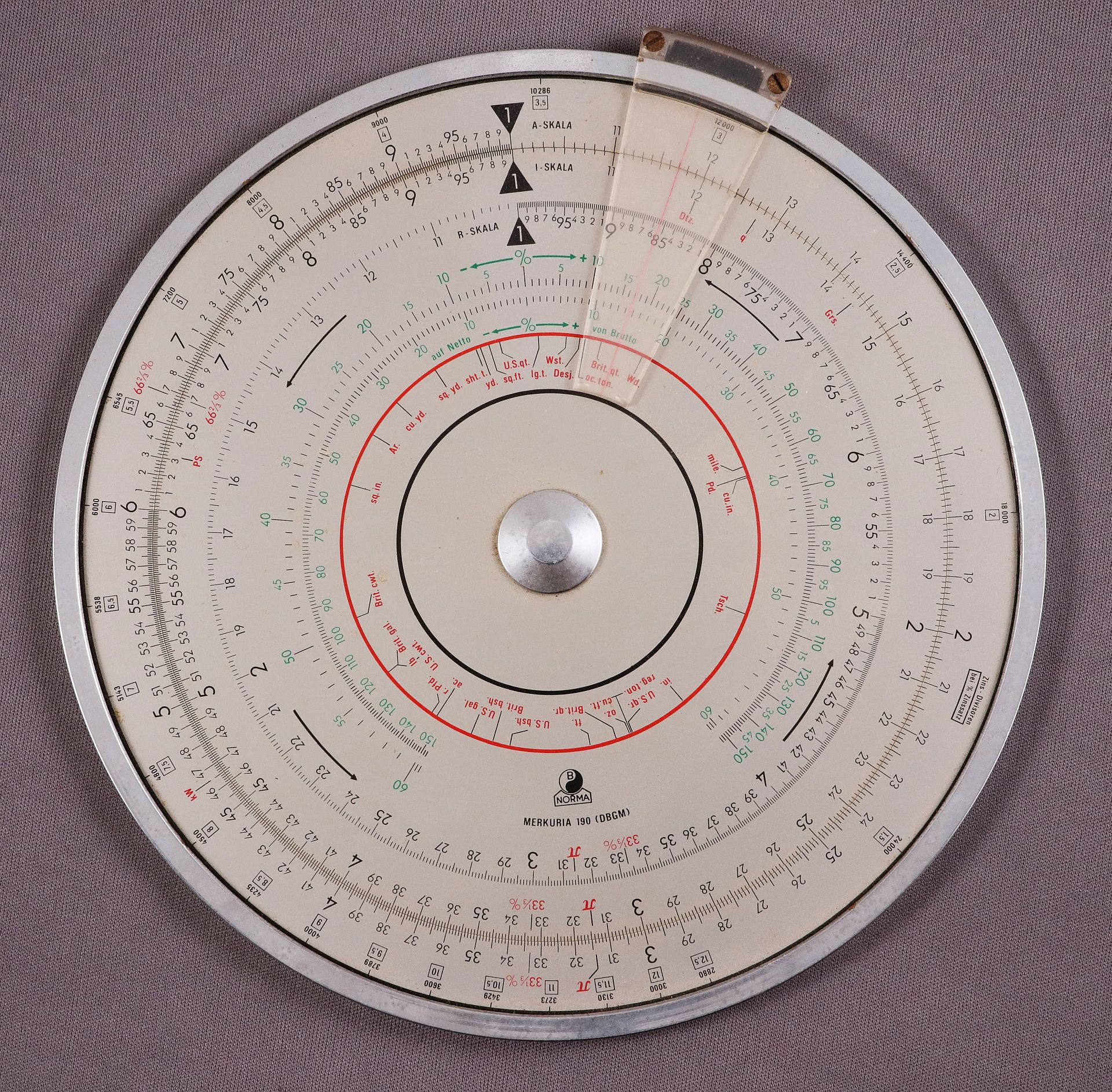
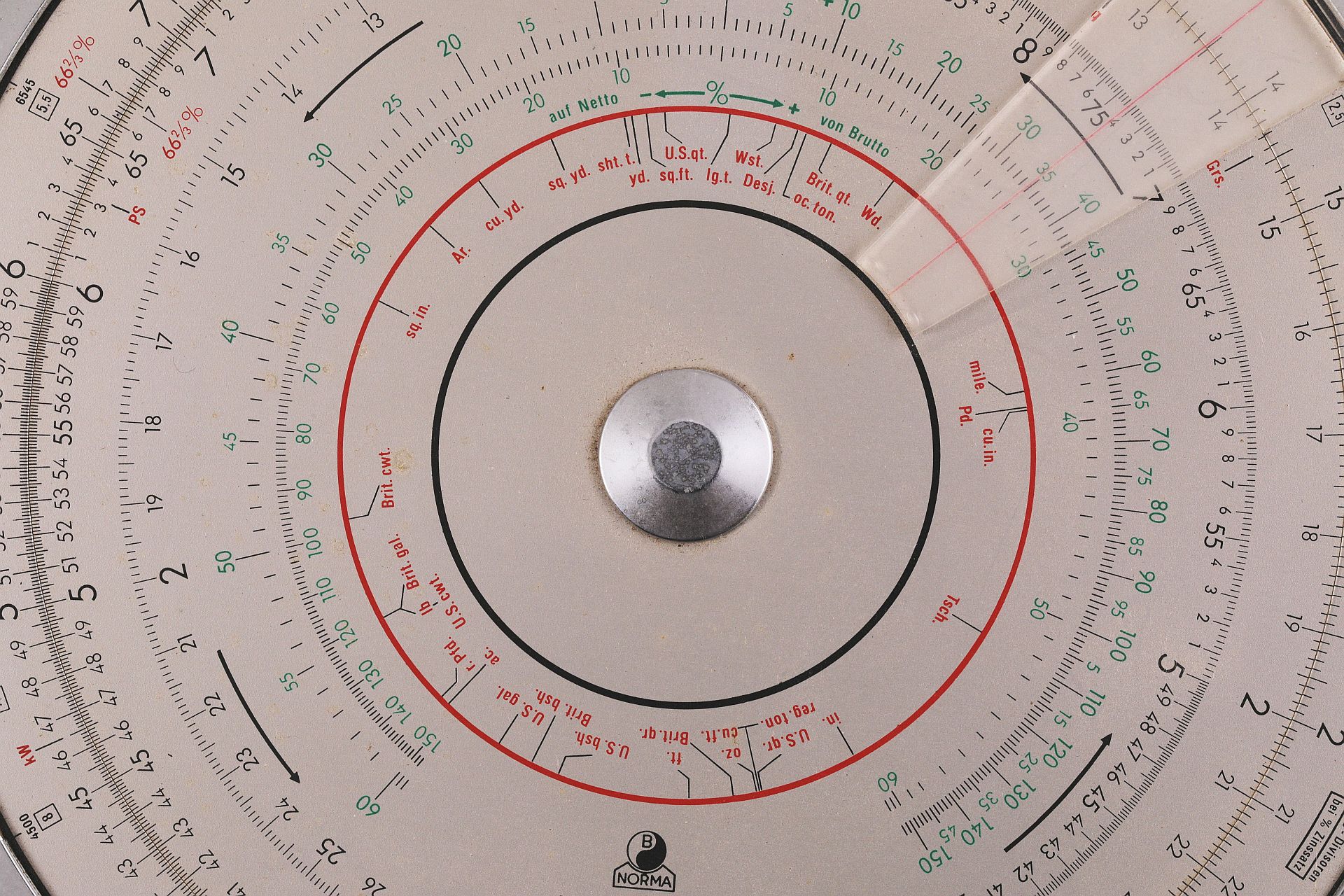
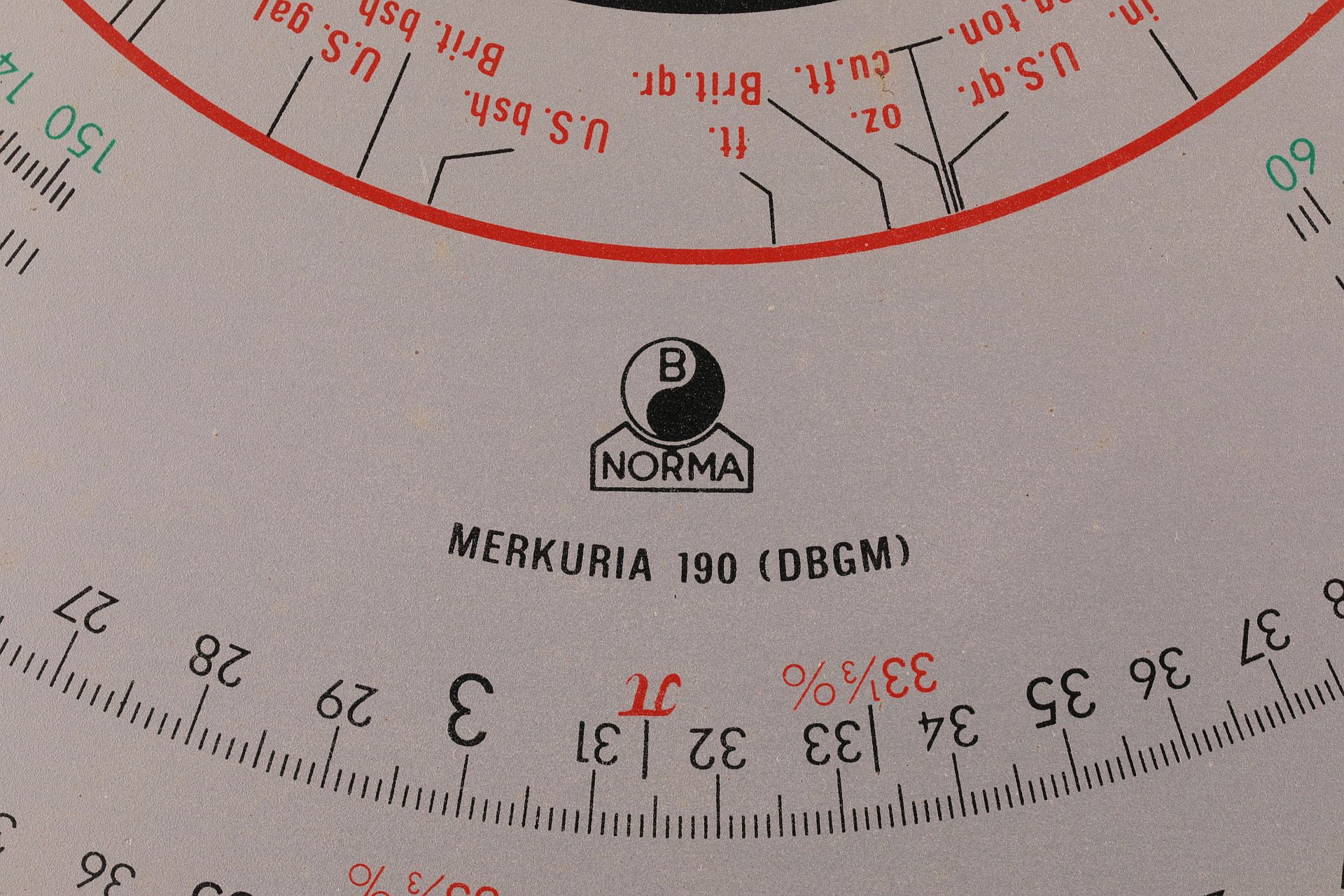
Norma Mercuria 190 circular slide rule
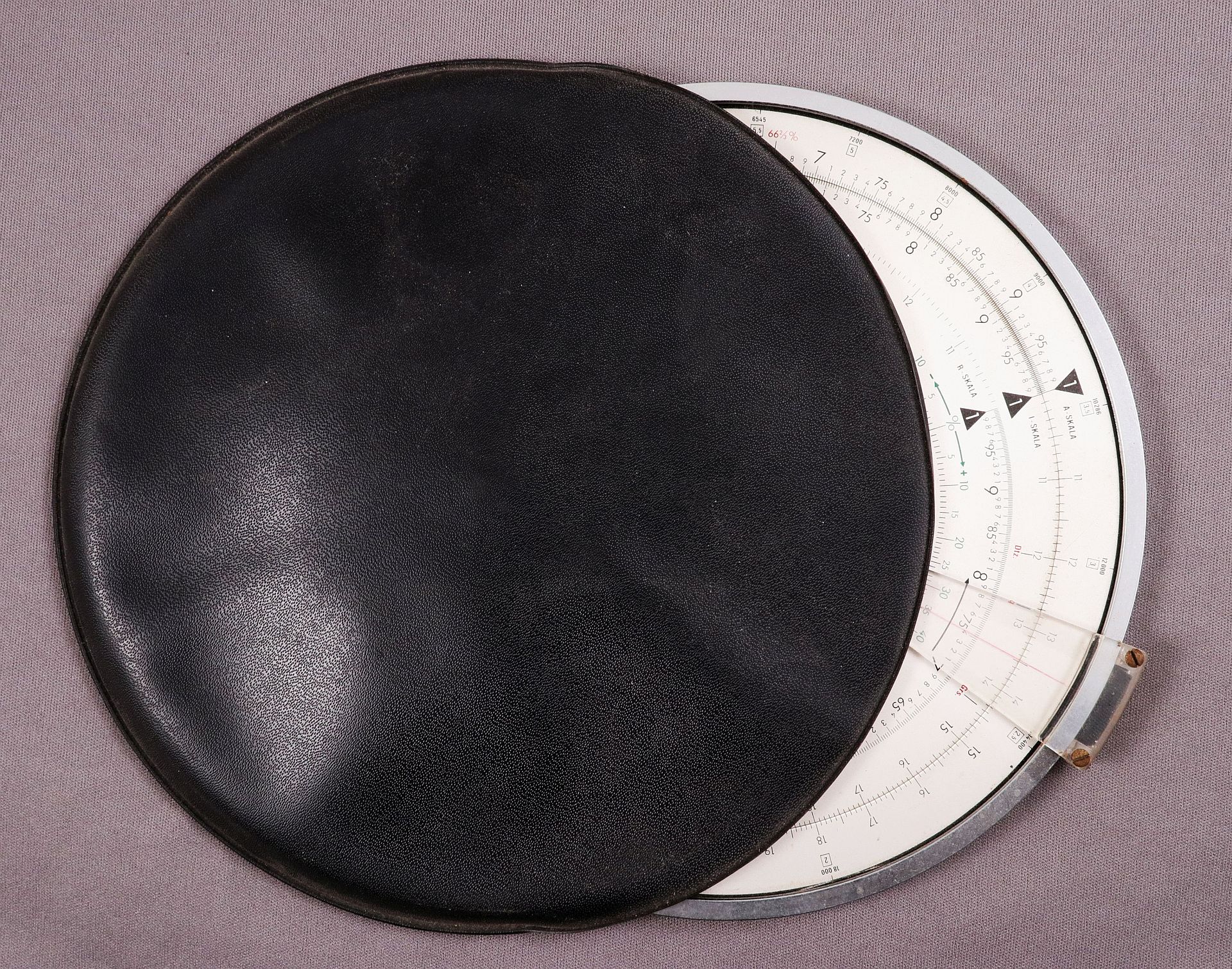
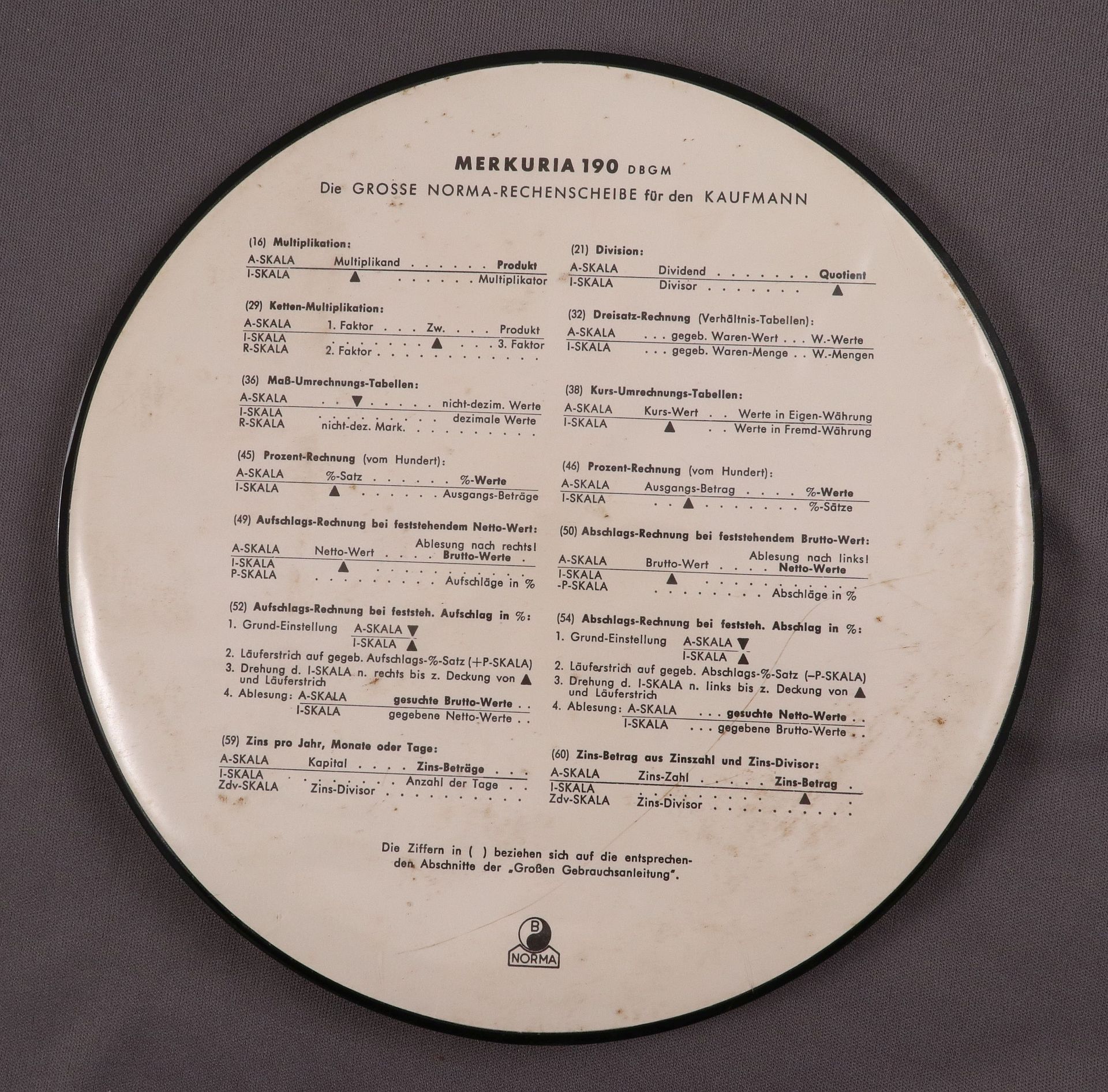
The Norma Merkuria 190 is a very sturdy, 7.5 inch diameter slide rule (the outer diameter is 190 mm, thus the name; the scale diameter is 153 mm, resulting in a scale length of 480 mm). The scales are simple: C, D, CI, and scales for percentages and numerous conversion constants and gauge points. It is very handy slide rule for commercial purposes, not just percentage and interest calculations, but also handling many physical sizes for freight items — it was the era before modern container shipment; traders had to take much more care of optimum and safe packing of goods for their transportation. The vinyl slipcase has an abbreviated list of example problems on the back, in German. The condition is excellent, though dirty.
|
|
| 37 |
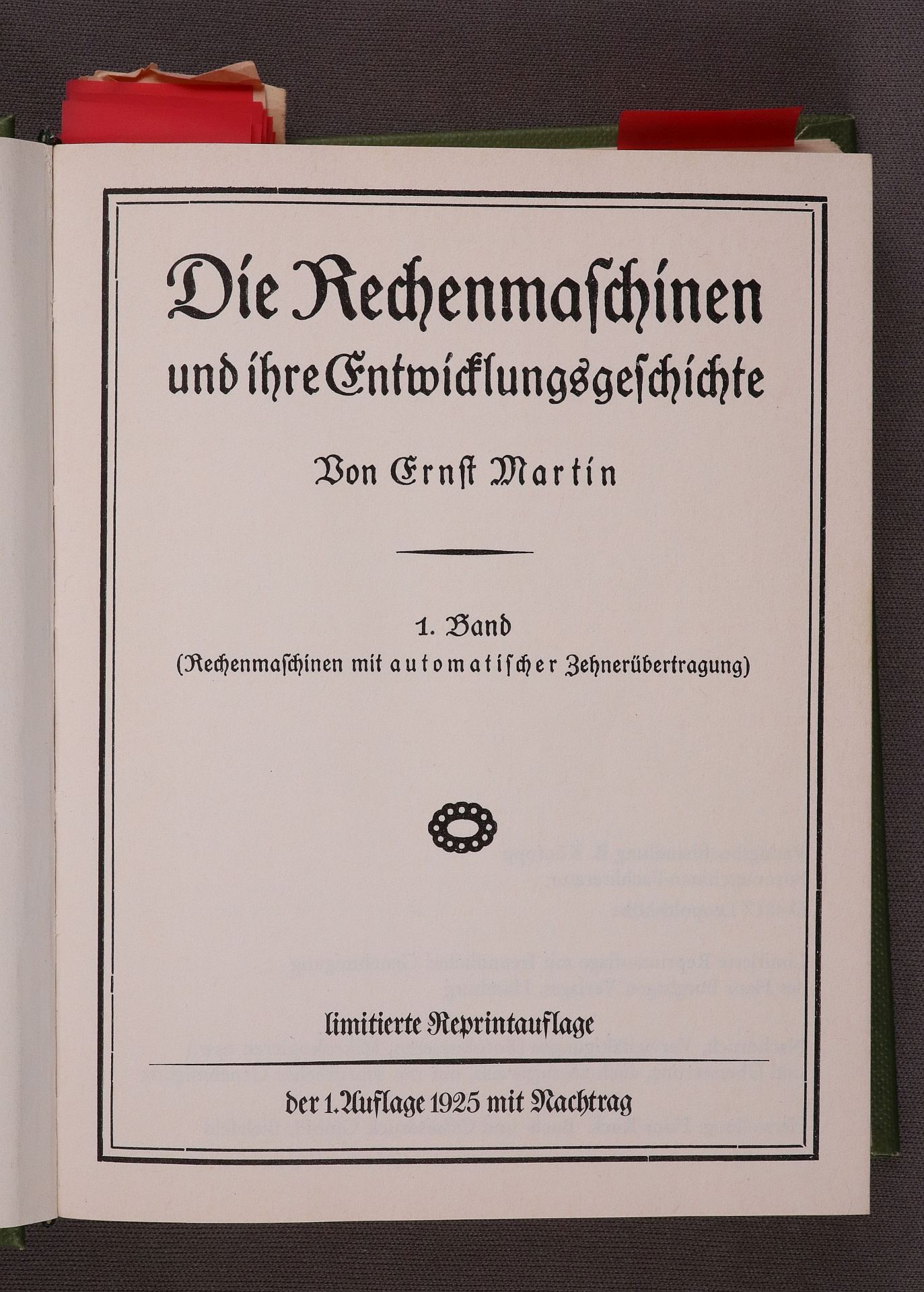
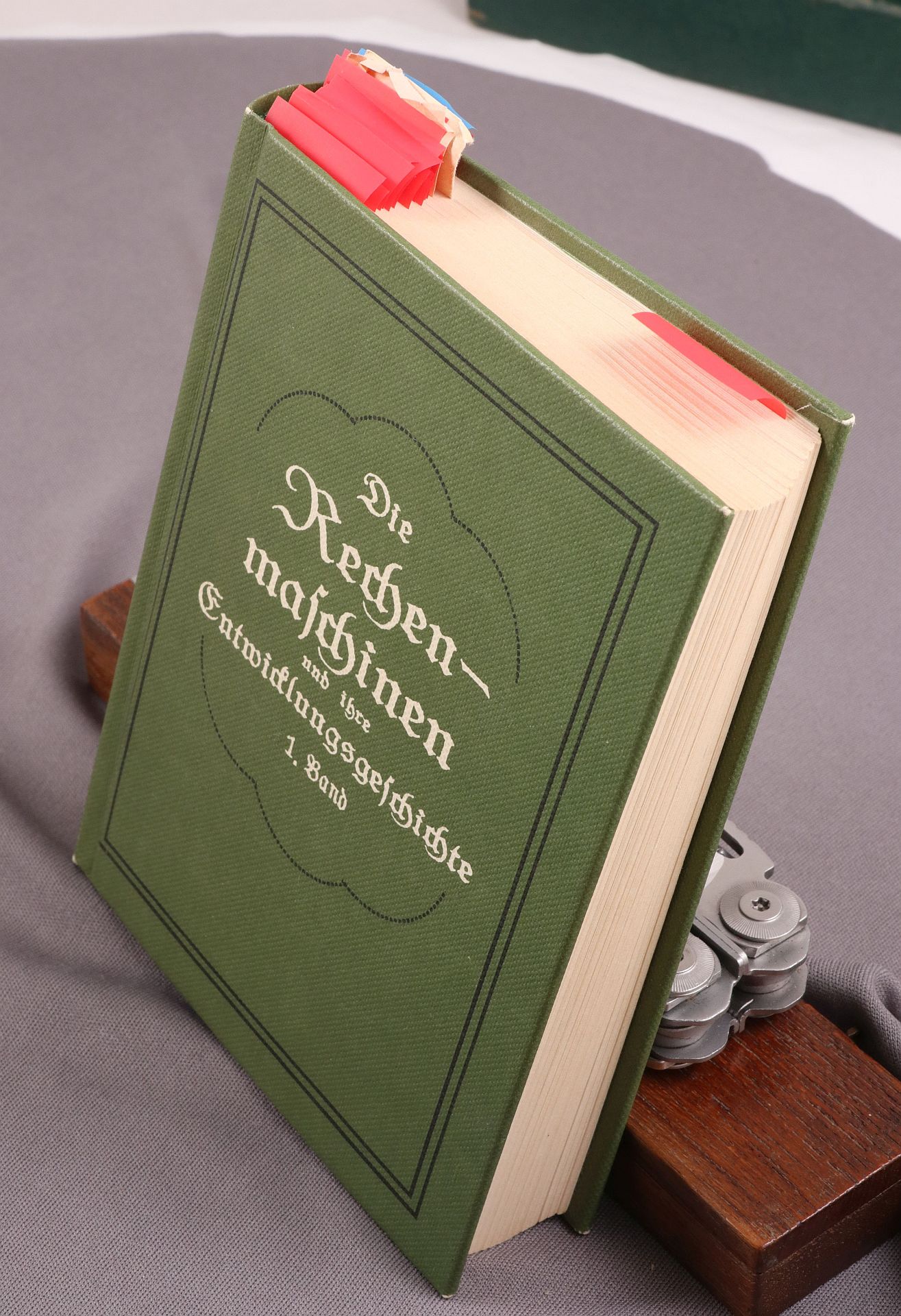
Book "Die Rechenmaschinen und ihre
Entwicklungsgeschichte" by Ernst Martin.
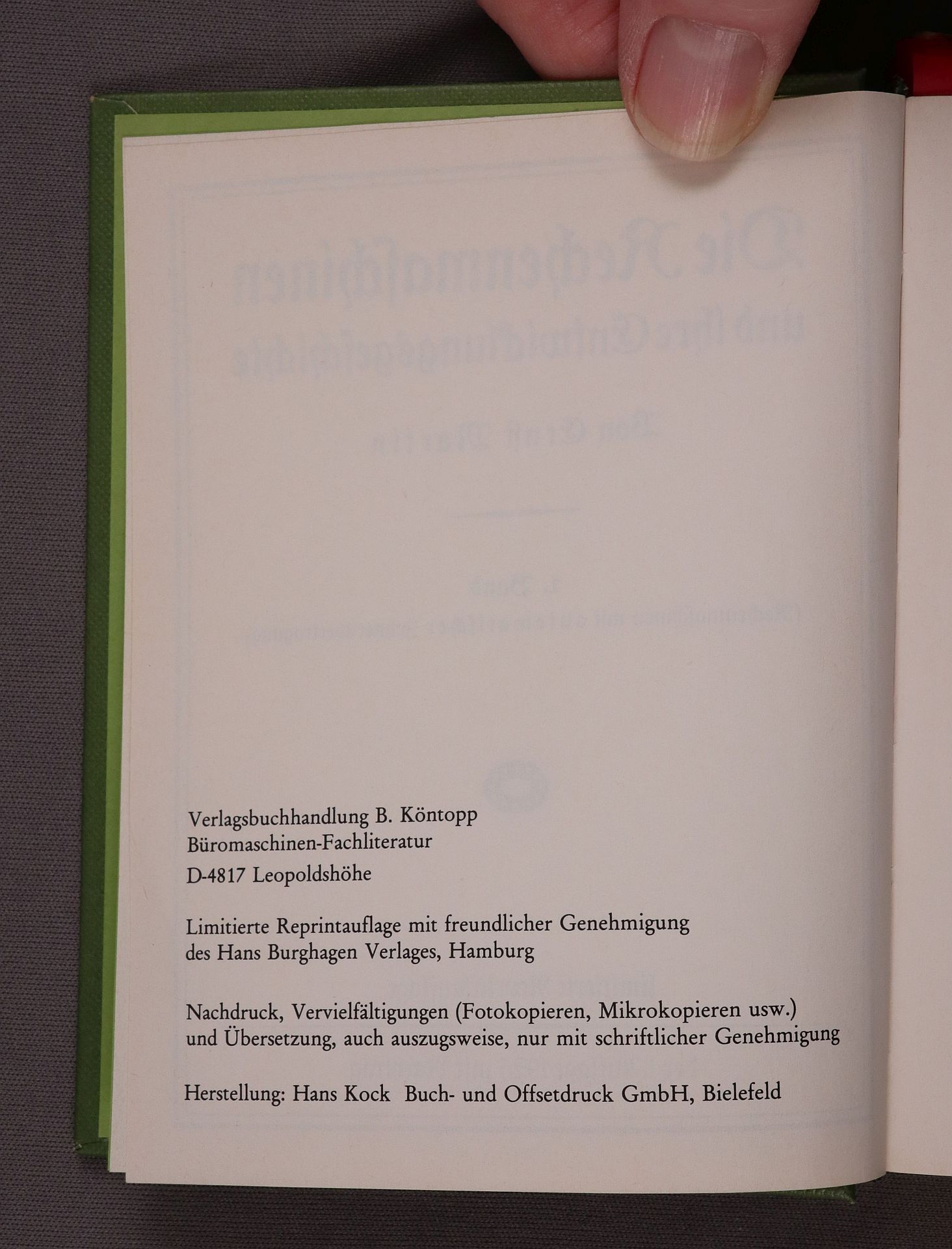
Reprint of 1985 of the augmented edition of 1936. In German. Universally regarded as the bible for collectors of mechanical calculators, Ernst Martin's book, Die Rechenmaschinen und ihre Entwicklungsgeschichte, (Calculators and their Evolution) is a comprehensive survey of all the calculating machines available in 1925, as well as all the machines he could find that had already come and gone. But this is only the start of the story. First published in 1925 with 390 pages, the book was augmented with additional pages (original ones unchanged) in 1936 to 477 pages total for newer / additional models. However, the year of issue was never changed, kept at 1925. This was probably due to save on copyright fees, in particular for the international market (remember: Germany 1936). Furthermore, it was not published by a large, experiencend and respected publisher, though technically the printer did an outstanding job with the many very detailled illustrations. Coverage, rich detail, and the illustrations made the book invaluable for research, and copies much searched. In 1985 a limited reprint of the 1936 edition was produced (the author had died in 1949), and the book offered here is such a copy. It is almost indistinguishable from the original; only the title and copyright pages are different. The book consists of perfect photo reproductions of the original pages. It is in German, and uses the fraktur font, making casual reading a chore. But as said: invaluable for research. The condition of this copy is overall excellent, noting a few detached pages near the back of the book, and numerous stick note bookmarks denoting a previous owner's favorite pages. Kidwell and Williams translated the book (only the original part of 1925, without the addendum of 1936) to English and MIT Press printed this translation in 1992 as part of the History of Computing series of books from the Charles Babbage Institute. [bibliographic research: Karl Kleine]
|
|
| 38 |
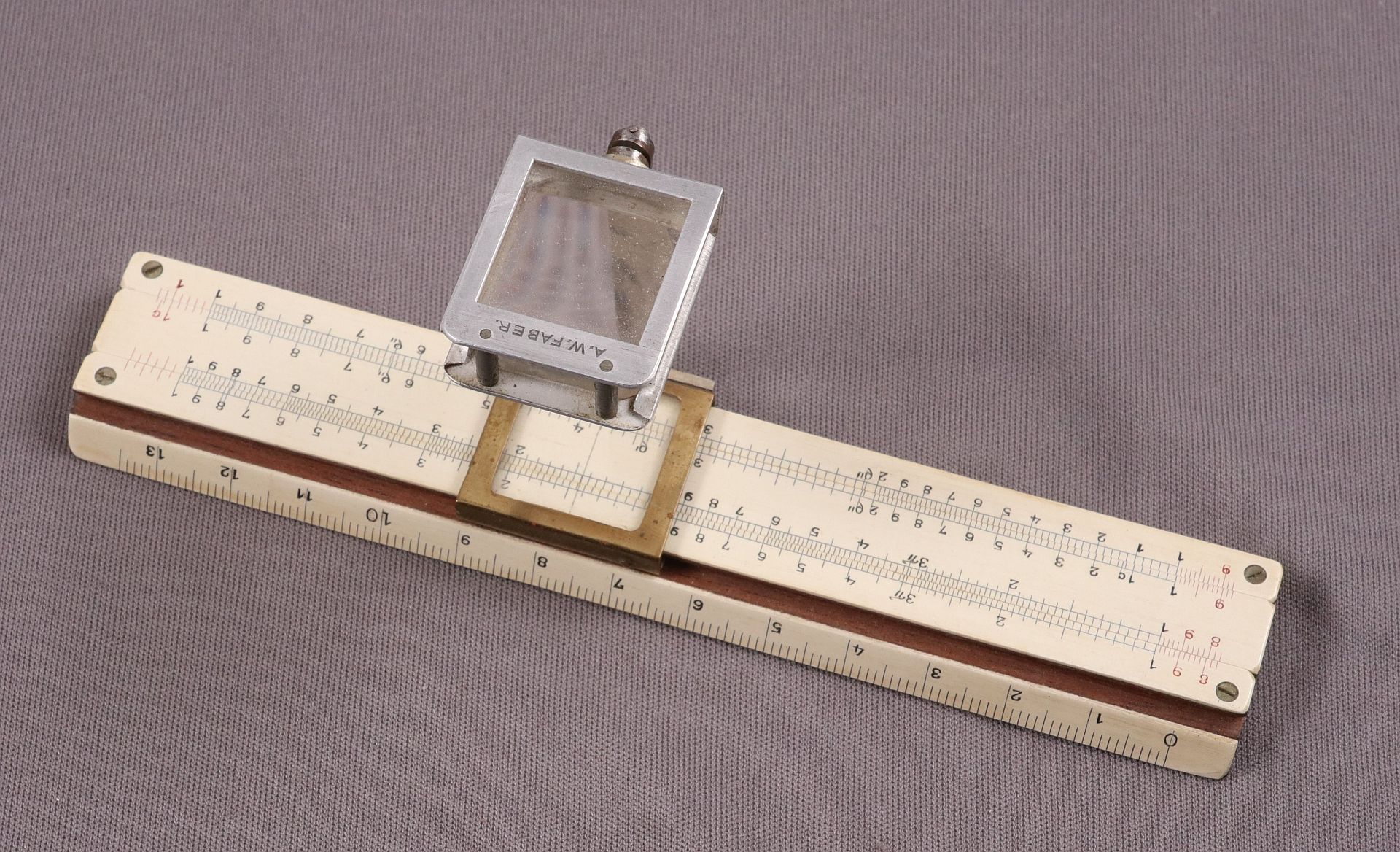
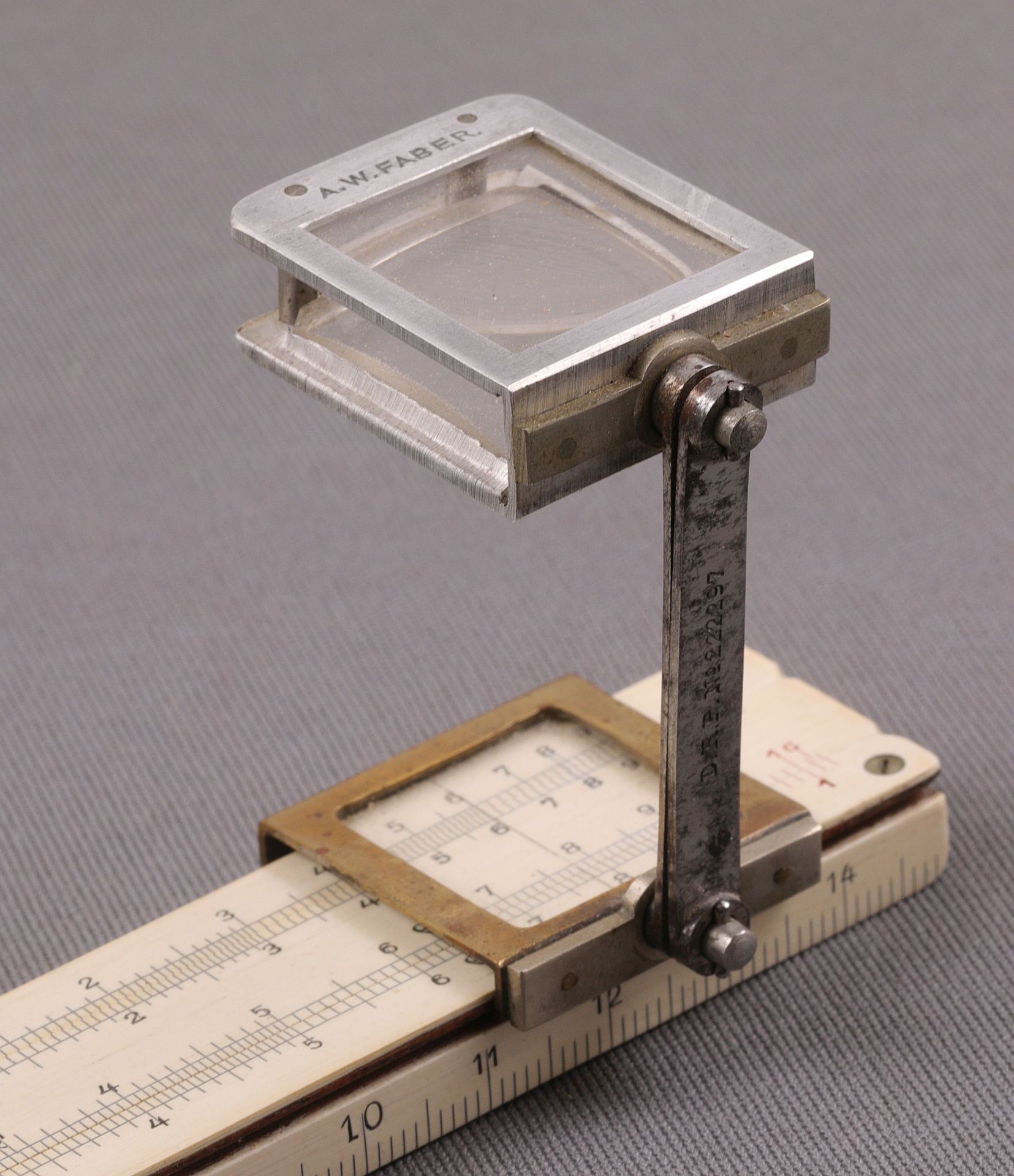
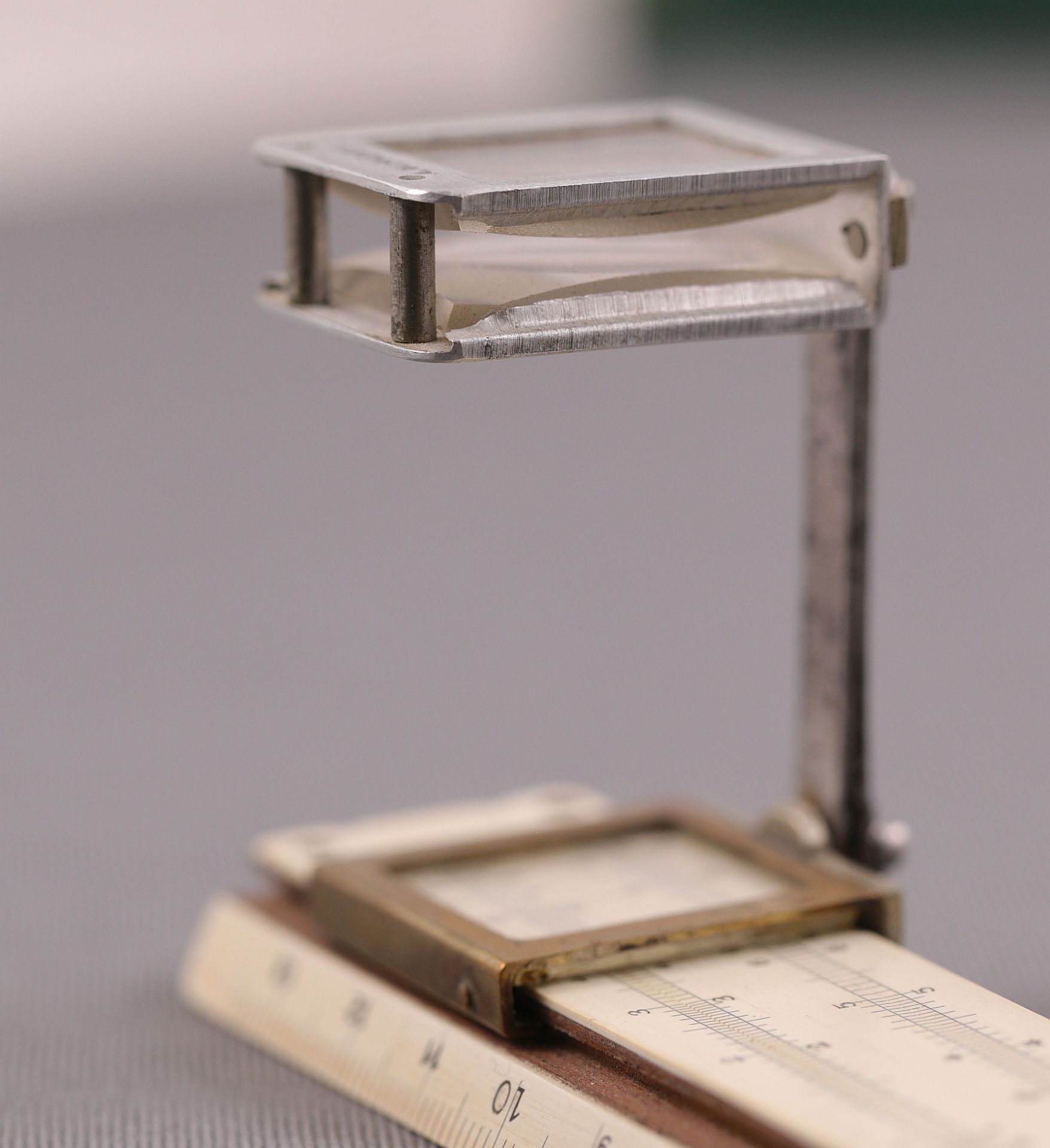
A. W. Faber 12.5 cm (5") Mannheim
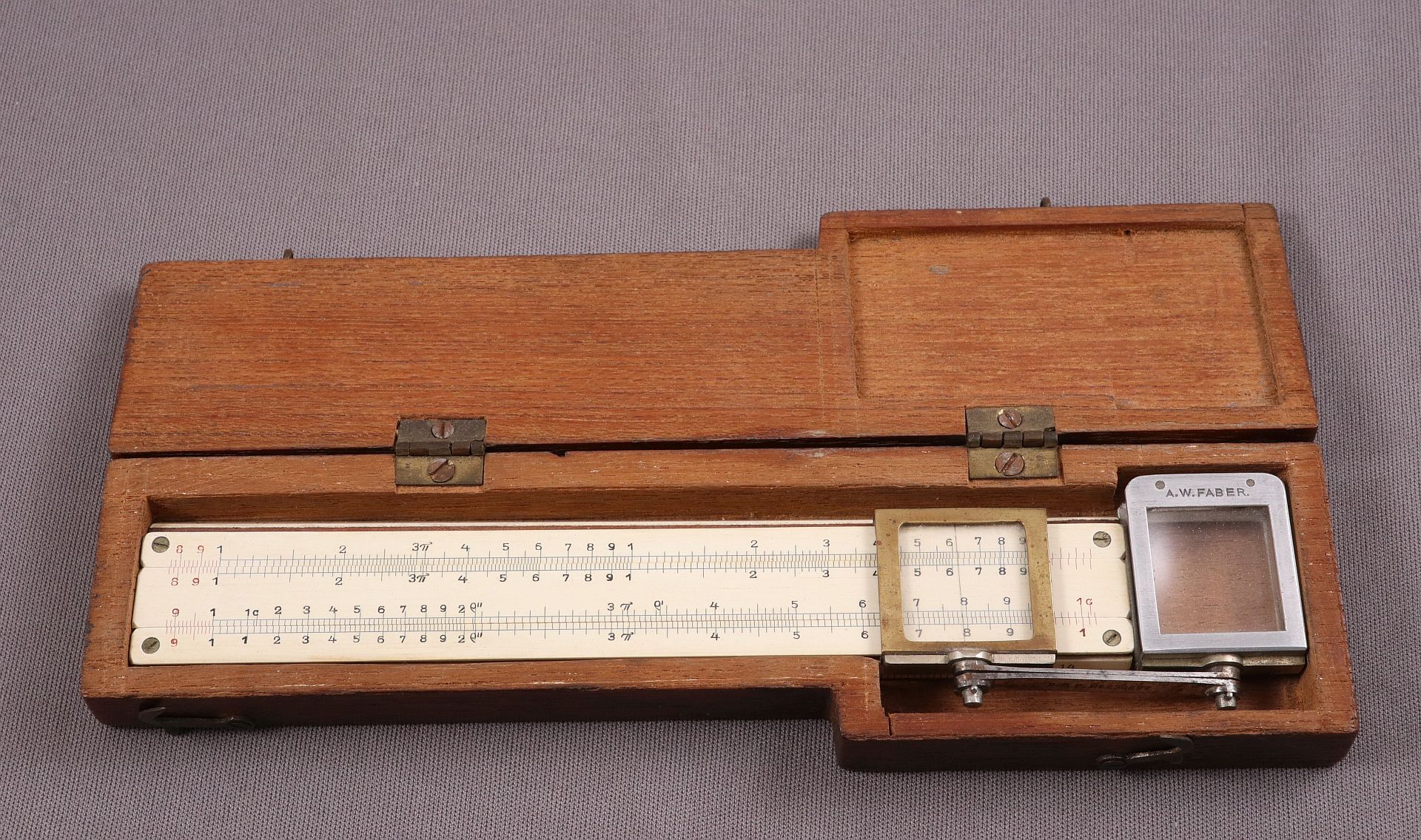
slide rule with folding cursor magnifier,
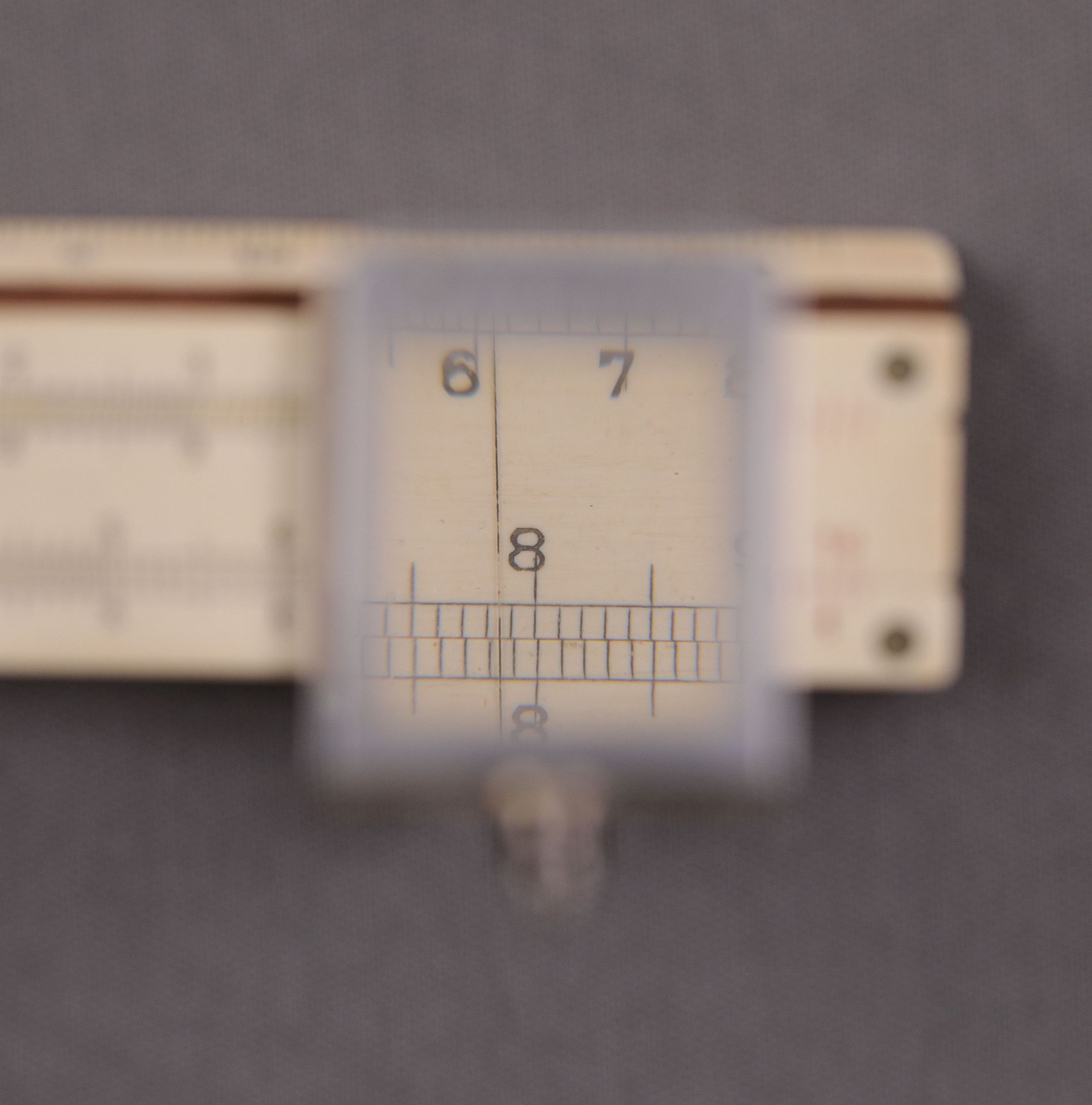
in wooden box. This beautiful little slide rule has a standard Mannheim layout with A, B, C, D scales on the front, and S, L, and T scales on the back of the slide. The cursor has a brass frame around the glass, with the lower anchor for the magnifier arm riveted to the lower part of the frame. The magnifier is a double lens design, yielding a very clear flat-field view. Both ends of the magnifier arm have detents, guaranteeing that it locks into the plumb, square and level position every time when folded up. The frame around the double magnifier is marked A. W. Faber on both sides, and the riser arm is marked D.R.P. No. 222297. The slide rule has centimeter rulers on both the upper and lower edges. The slide rule and magnifier are both in excellent condition. The wooden box is also in good condition, with tight hinges and latches, and some signs of wear from doing its job of protecting the slide rule. No points deducted for that.
|
|
| 39 |
Stevenson Adder
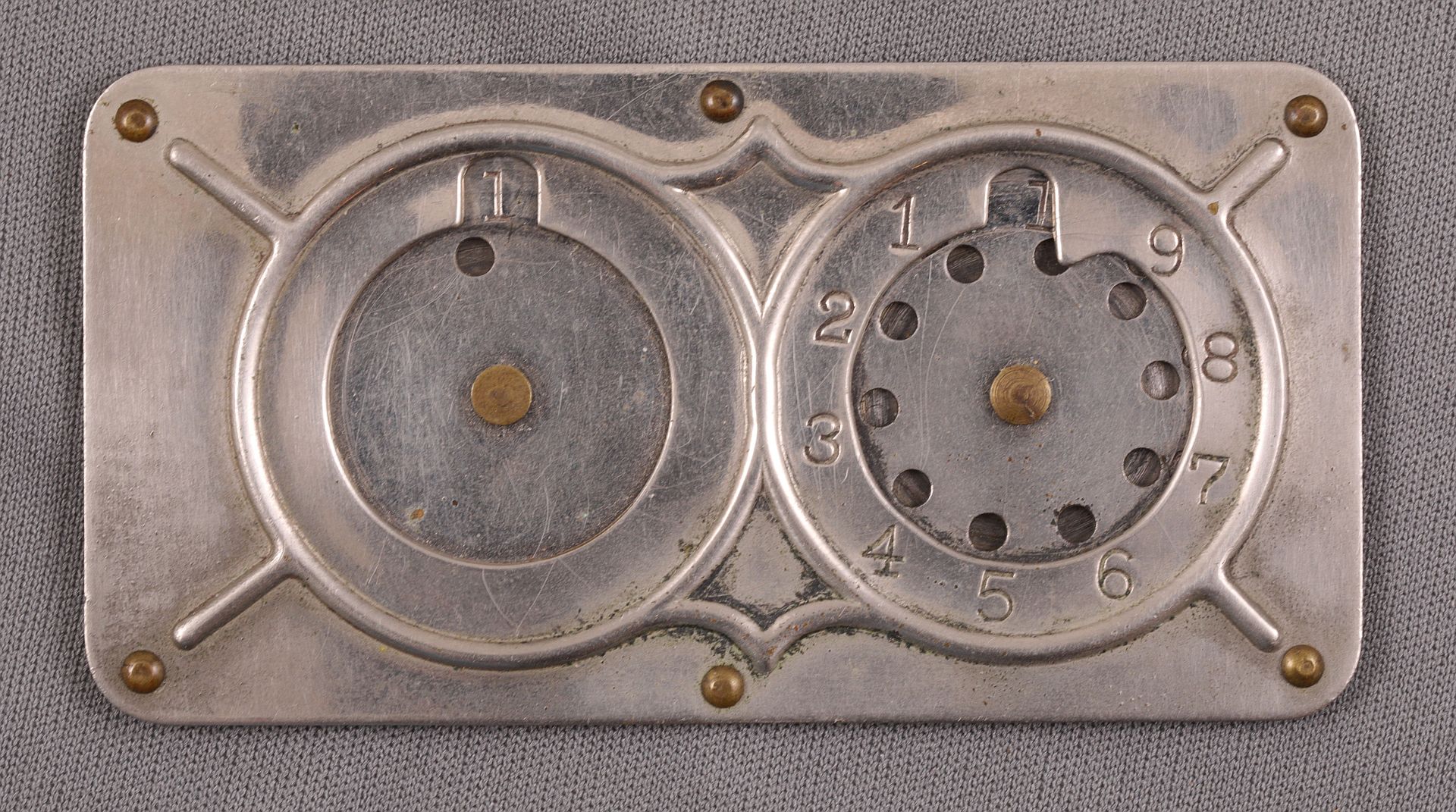
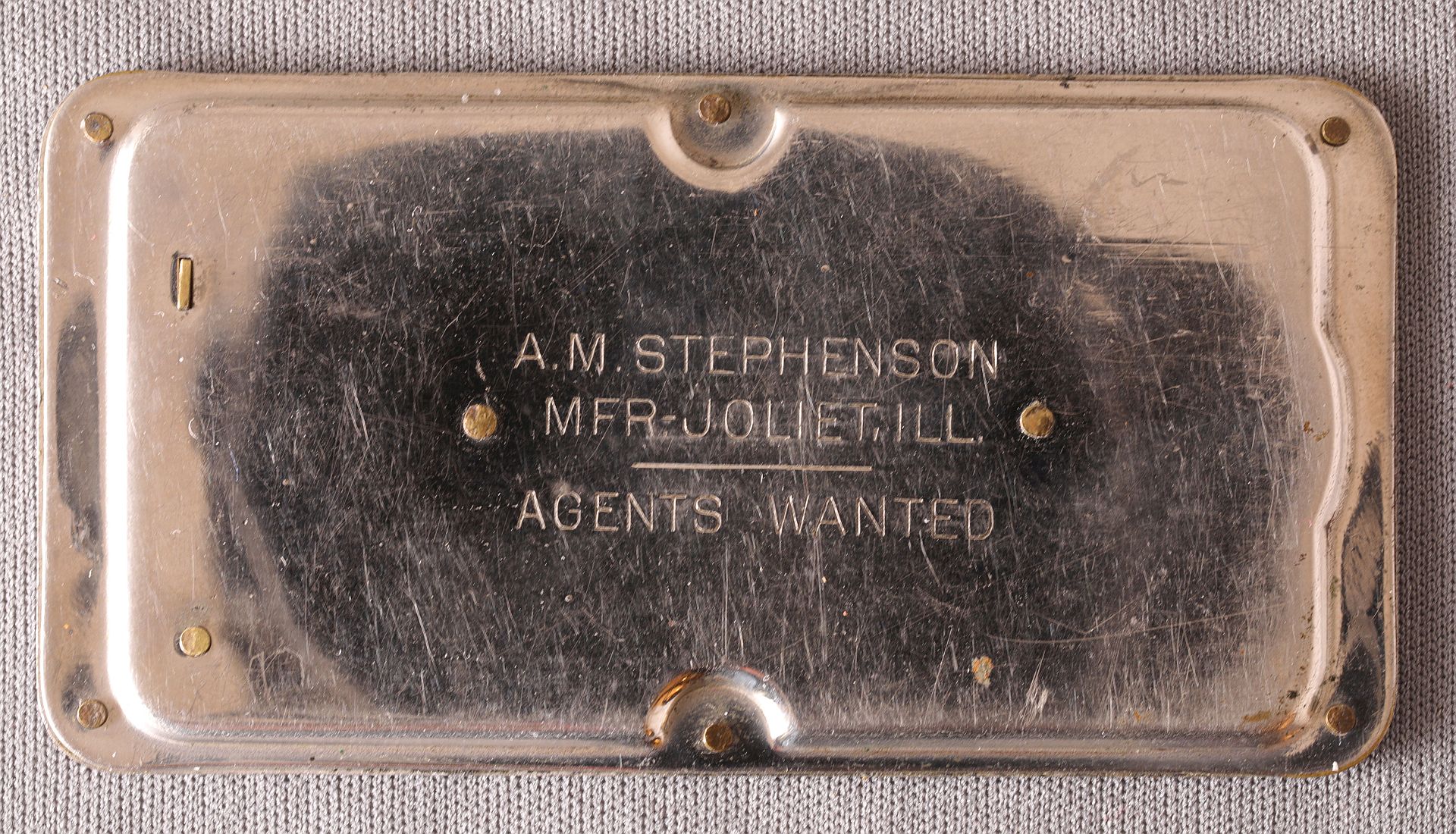
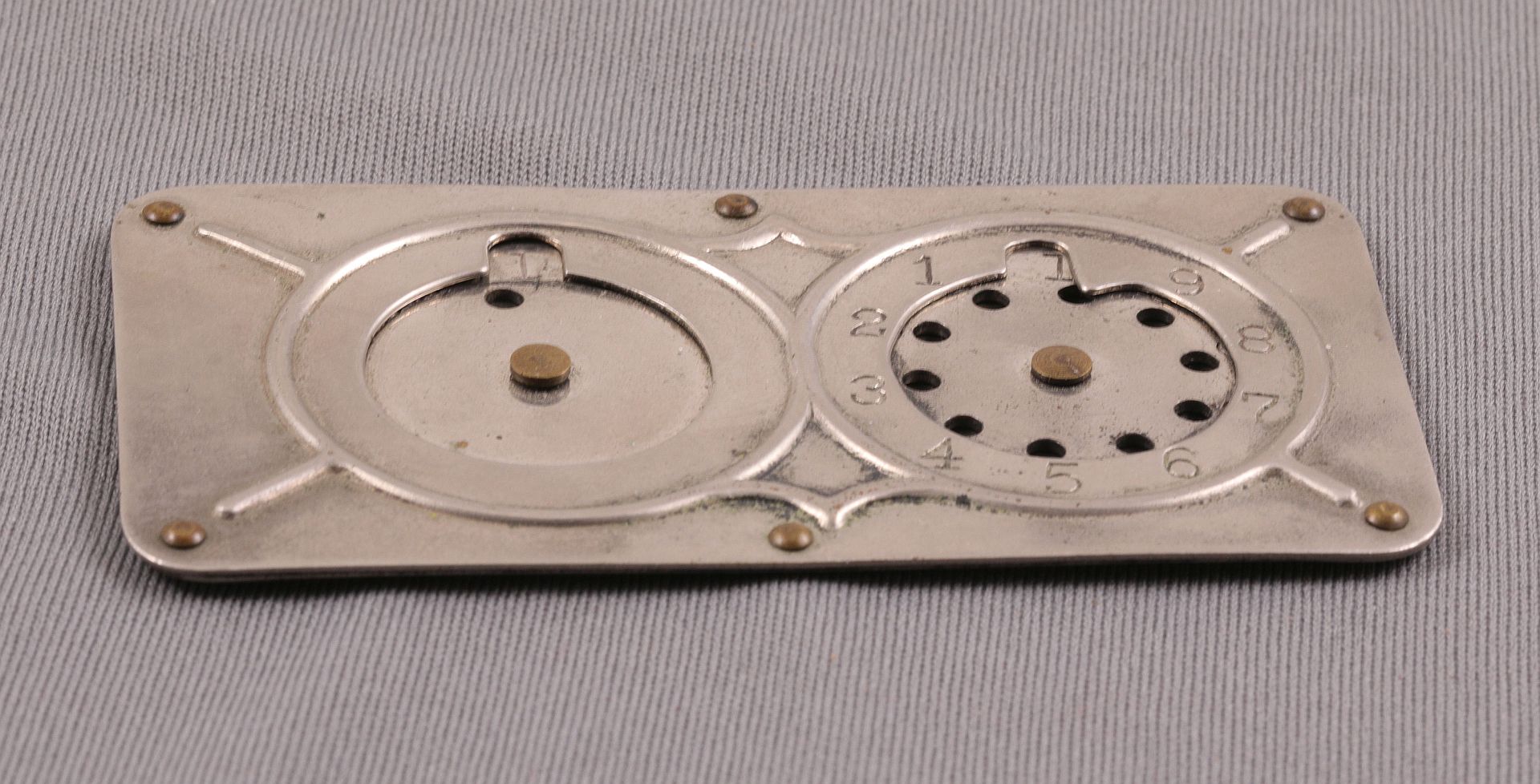
The Stephenson Adder was patented in 1873 by A. M. Stephenson, a man who was, at various times, a railroad agent, a clerk, a traveling salesman, and a printer. Part of his time as a traveling salesman (during which he visited every state and territory of the USA, twice) was no doubt spent selling his own invention, this adder. This is an interesting adder. It takes input only on the right dial, which has 10 digits. The left dial has 20 positions, 0 through 19. In use, the left dial is turned only when the right dial performs a carry, giving the Stephenson the ability to count up to 199. The stylus hole in the left dial is only used for clearing. This is not an adding machine, it is a column adder. Construction is extremely simple. Having the two wheels turn in opposite directions allows for a simple pawl (part of the right wheel) and spring detent on the left wheel to suffice for a carry mechanism. There are no detents on the right wheel, which turns smoothly. The front and back covers appear to be stamped nickel-plated brass. The spring for the detent on the second wheel is anchored in a hole in the back of the case. Six rivets hold the case together and two more serve as pivots for the wheels. The whole machine is barely thicker than a US Nickel (that's a $0.05 coin, for my friends around the world). The Stephenson Adder was sold from the early 1870s until the late 1920s, an incredibly long run for a mechanical calculator of any sort. This Stephenson adder is generally referred to as a Type 2, being distinguished by the embossed pattern on the front, as opposed to the completely flat Type 1. This particular Stephenson Adder has the Joliet, Illinois address on the back, one of the three addresses used by Stephenson. It is not known what chronological order those addresses fall into. While this adder is in excellent condition, there is a little wear to the nickel plating, and if I squint real hard I think I can see the underlying brass in a couple places. It works perfectly.
|
|
| 40 |
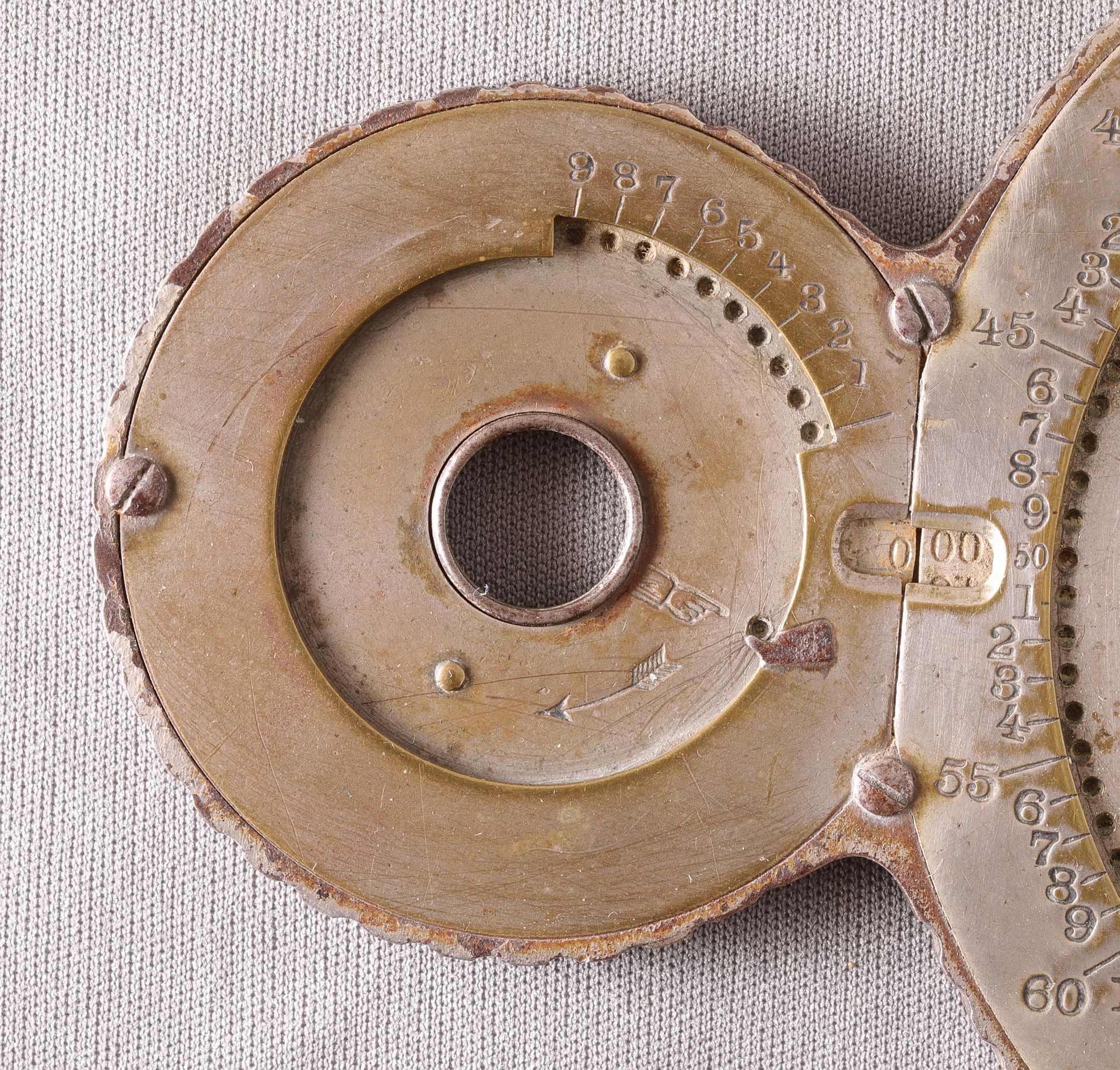
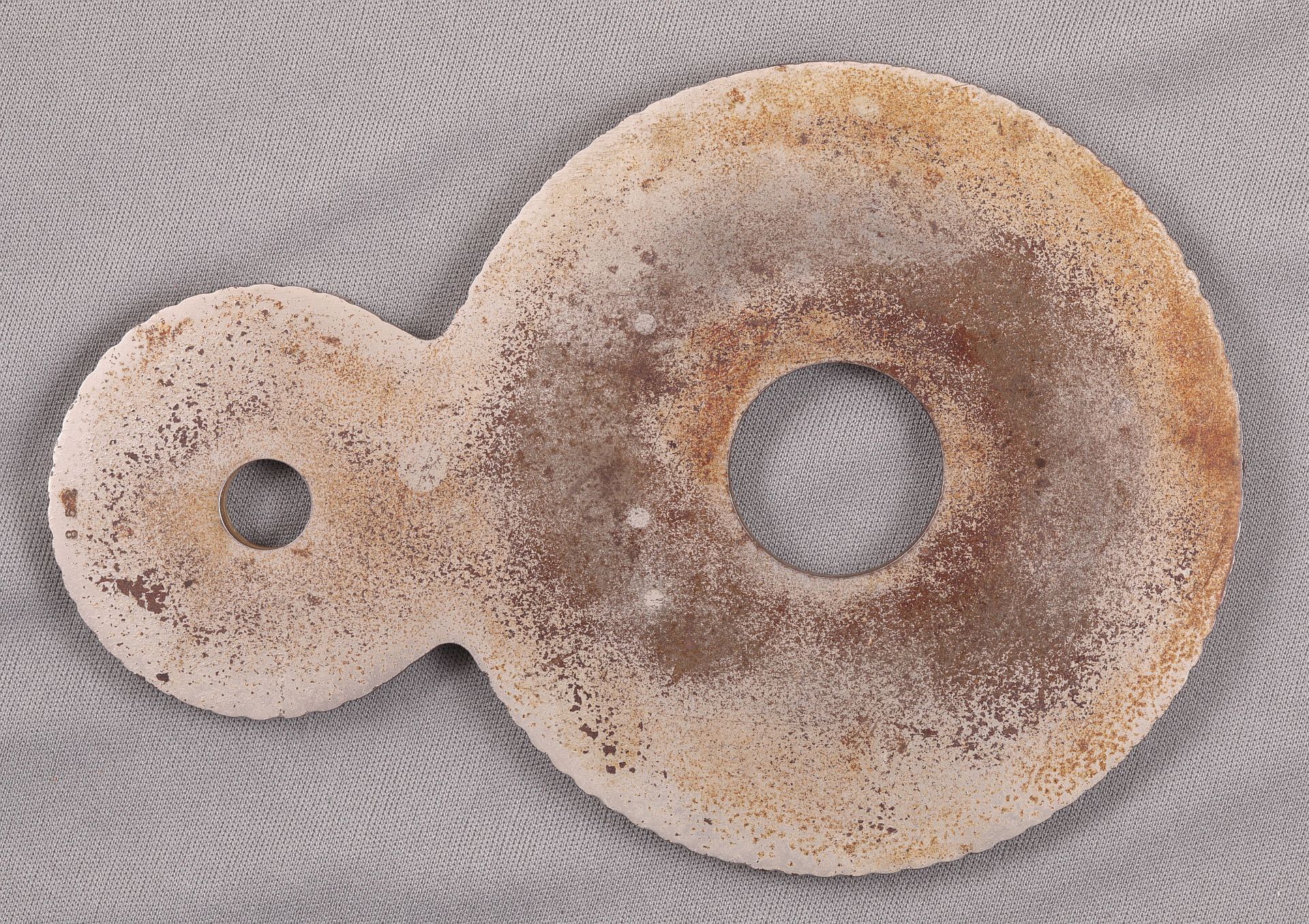
Webb Adder, all metal.
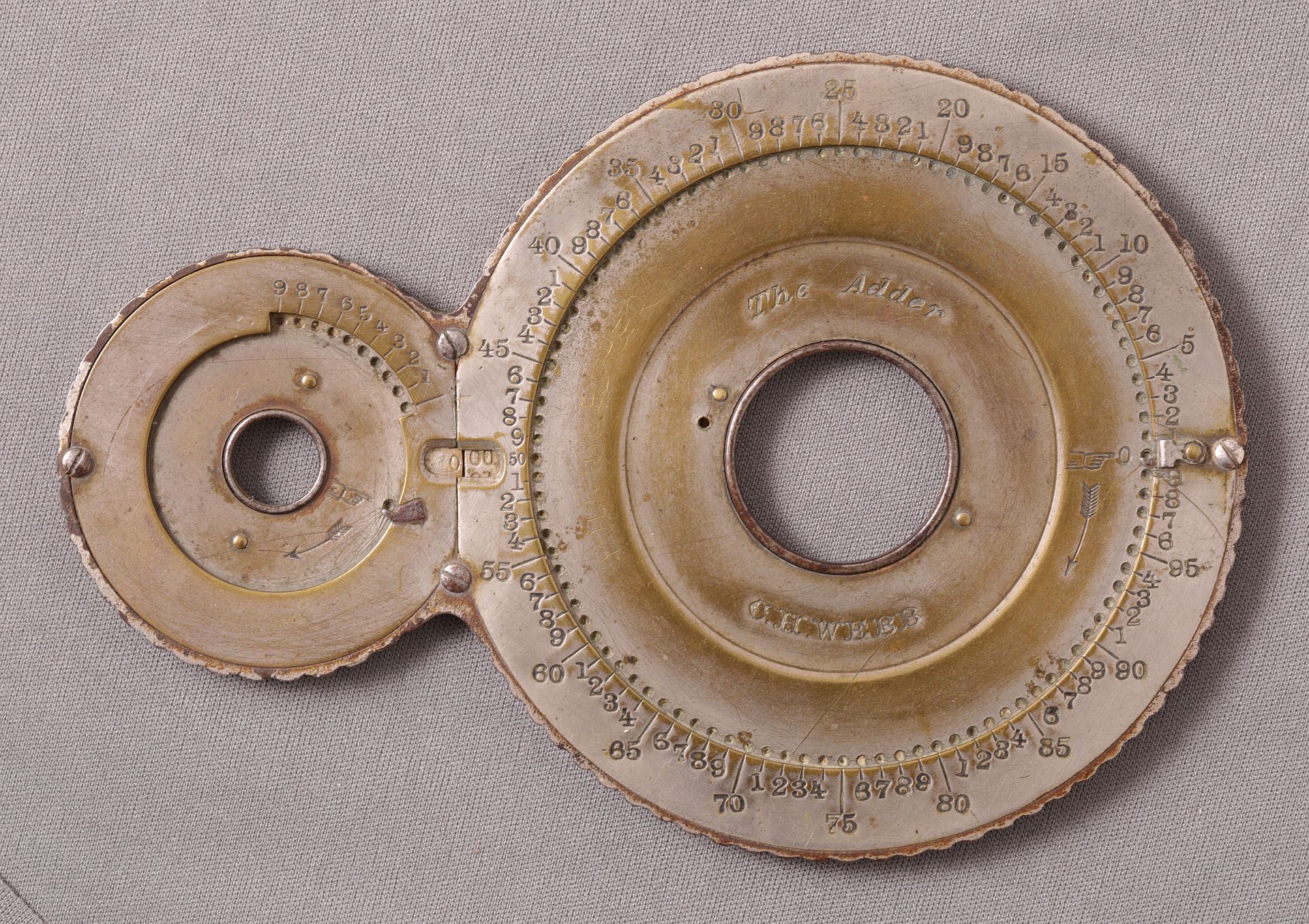
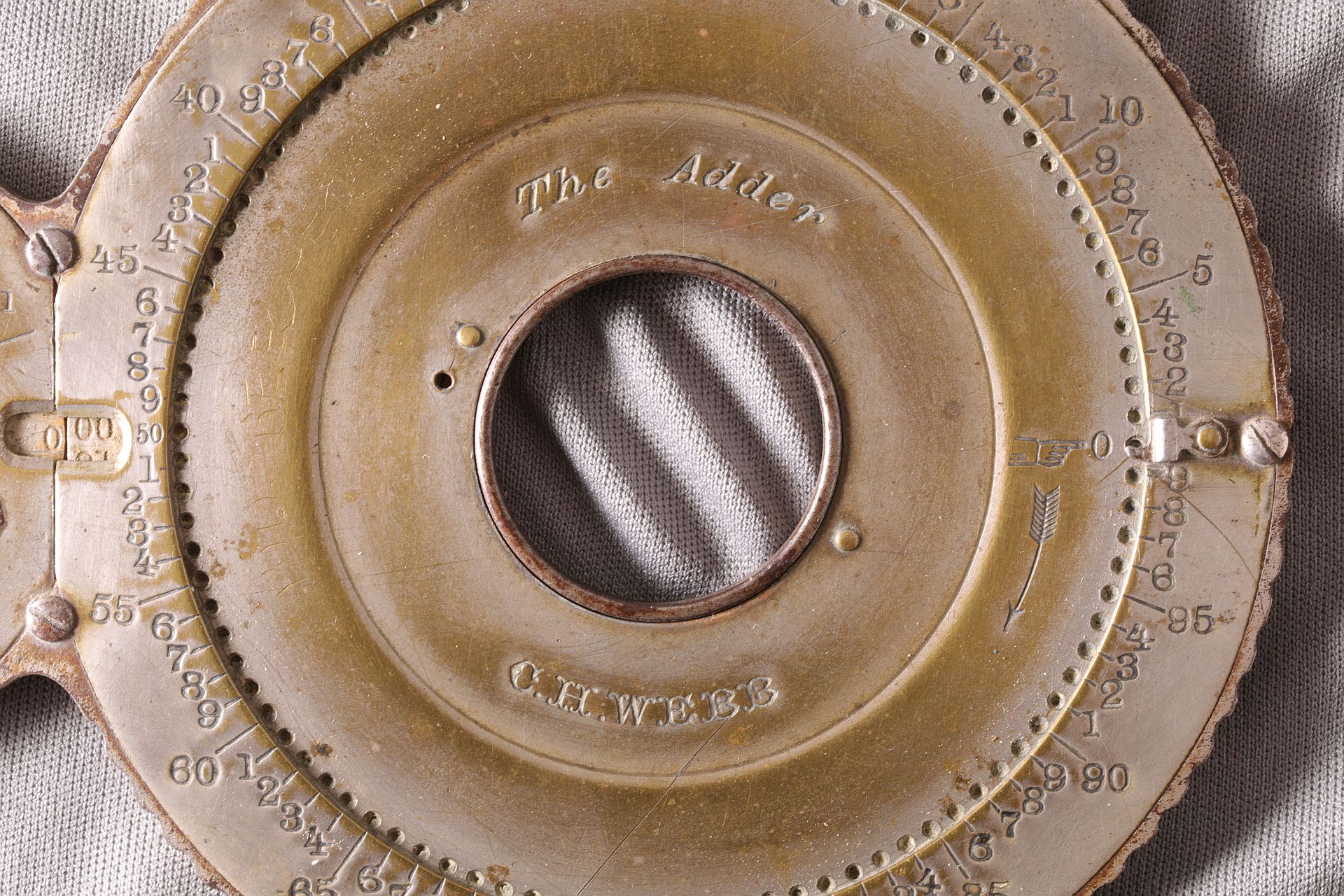
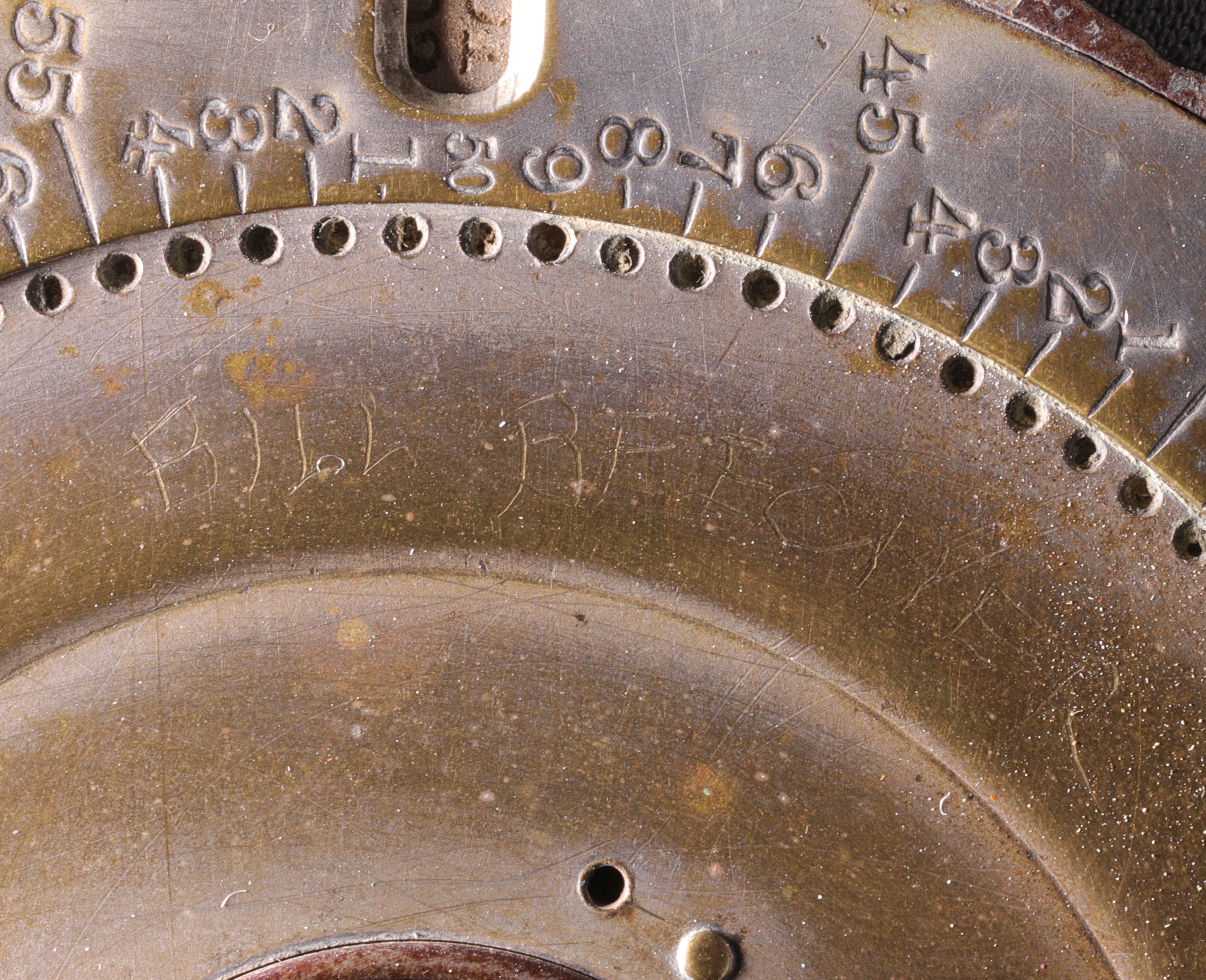
The Webb Adder was first patented in 1868, and an improved version was patented in 1889. This is that improved, all-metal version. The Webb is a column adder, meant to add numbers column by column, just like you were taught in school. What the Webb has over most other column adders is that it can add three columns at a time, thanks to having two dials, one of which handles numbers from 1–99, and the other for the third column. This works as long as the total is less than 5000. This would have been a significant improvement in speed over single-column adders. This Webb works very well, including carry and clearing. The large dial on the right turns smoothly but is a bit stiff. The small dial also turns smoothly, but with a ratchet mechanism, and its clearing also works well. There is a name lightly scratched into the large wheel. It is hard to read, but I make it out as "Bill R. F. Echer". I cannot find a serial number.
|
|
|
Terms and Conditions
The auctioneer for the Oughted Society will be Jim Bready.
|